The week that concluded on August 15 in Panama left much more than military exercises, speeches, and photographs among the defense officials of the continent.
Panama has recently become the stage for the new U.S. strategy against the cartels and organizations that Washington deems narcoterrorists.
The final phase of the multinational exercise PANAMAX 2026 coincided there, held during the first two weeks of August, along with a meeting of the Americas Counter-Cartel Coalition (A3C), the alliance promoted by the Administration of Donald Trump to bring regional cooperation against drug trafficking to a much more operational level.
The coalition, formed in March with the integration of 17 countries, contained a formulation that already hinted at its intentions: “operationalize hard power” against cartels and terrorist organizations. Trump's presidential proclamation established that the United States and its allies would use the legally available resources and authorities to dismantle those organizations.
Now the project continues to grow. Colombia has just requested U.S. cooperation for joint operations against narco-terrorism and will join as the 19th member of the regional initiative also known as Shield of the Americas.
It is in that context—not in a vacuum—where two messages sent from Panama must be understood.
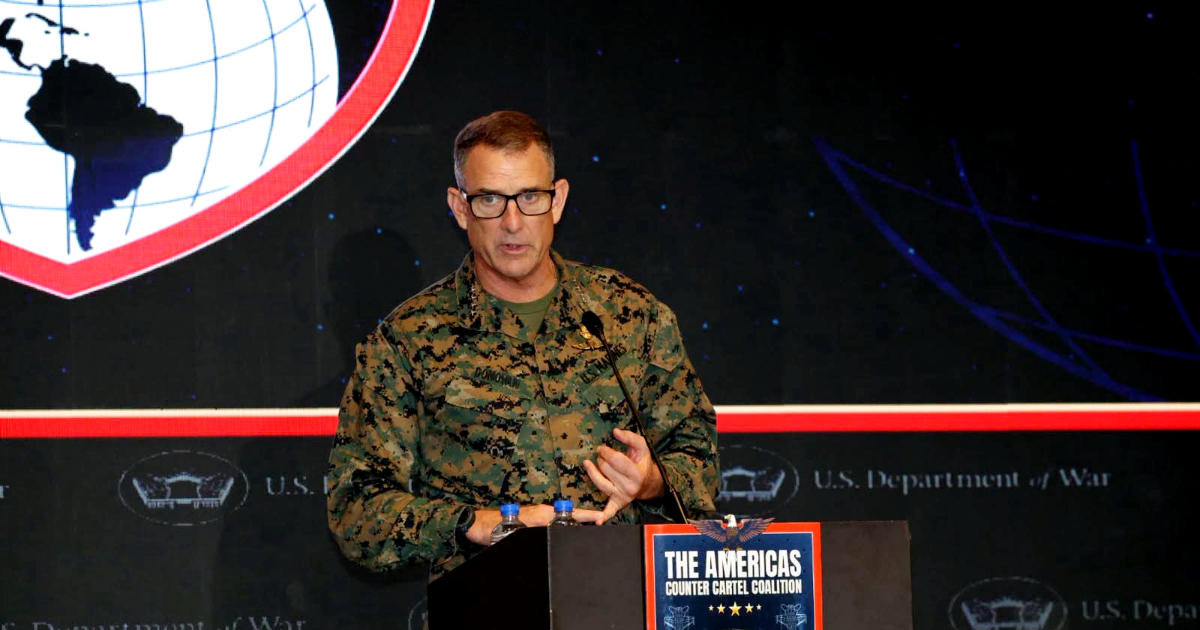
The first refers to the head of the United States Southern Command (SOUTHCOM), General Francis L. Donovan.
«Are we willing to take the fight to the enemy? I believe we are», he said before defense and security officials gathered at the forum. His conclusion was even clearer: «We must attack these networks. We need to apply total systemic friction to these networks».
Donovan did not mention Cuba. But practically on the same stage, the Secretary of War, Pete Hegseth, did.
Cuba is "on alert."
From Panama, Hegseth demanded "more cooperation from Cuba, whether they like it or not" and accused the regime of allowing rival powers and actors to use the island to spy on the United States.
His warning was straightforward: countries like Cuba are "on alert" and Washington will not tolerate certain presence and influence of adversaries in the hemisphere.
Questioned about a possible military action against the island, he also did not want to rule it out and reiterated that all options remain on the table.
The specific accusations made by Hegseth against Cuba in those statements primarily referred to security, espionage, armament, and the influence of adversarial powers. It would be inaccurate to assert that the secretary accused the Cuban regime of belonging to a narcoterrorist network.
But it would be equally naïve to analyze his words as if they were unrelated to the hemispheric strategy that was being discussed during those same days in Panama.
Donovan talks about attacking networks. Hegseth puts Cuba on notice. And both are part of an Administration that has turned the fight against cartels, narcoterrorist organizations, and hostile strategic influence into components of the same regional policy.
The official U.S. description of the Shield of the Americas includes not only combating transnational cartels, but also limiting foreign geopolitical interference in the hemisphere.
For Havana, the issue is that there is also a difficult dossier to overlook.
Long before the Cartel de los Soles
The United States was investigating the connection between high-ranking Cuban officials and drug trafficking decades before the concept of the Cartel de los Soles emerged.
In 1982, a federal grand jury indicted four Cuban officials in a case related to the use of Cuban territory and waters to facilitate operations for Colombian drug traffickers. U.S. intelligence reports from that time also described facilitation activities originating from the island.
Later came the Causa 1 of 1989. The regime itself acknowledged that high-ranking officials of the Armed Forces and the Ministry of the Interior —among them Arnaldo Ochoa and Antonio de la Guardia— had participated in negotiations with Colombian drug traffickers.
In 1993, U.S. prosecutors began investigating an accusation against Raúl Castro and other high officials for cocaine trafficking. It was never formally presented, and therefore, Raúl Castro's criminal responsibility for those events was never legally established.
But the file existed. And decades later, Venezuela emerged.
A route Venezuela-Cuba
In March 2020, the Justice Department accused Nicolás Maduro and other high-ranking Venezuelan officials of narco-terrorism and cocaine trafficking, outlining a structure in which state institutions would have been used to protect and facilitate the drug trade.
A few days later, a high-ranking official from the Pentagon assured Newsweek that the U.S. intelligence community had evidence that Maduro was trafficking drugs using ships between Venezuela and Cuba.
That alone does not demonstrate conscious participation of the Cuban government in those shipments. The Cuban connection did not play a central role in the public accusations against Maduro.
But it does demonstrate something important: the possible relationship between Cuba, Venezuela, and drug trafficking networks did not emerge in 2025 as a theory created by opposition organizations. An American military source had already attributed that information to Washington's intelligence five years earlier.
The investigations into the Cartel of the Suns
In 2025, research emerged that attempted to connect both stories.
A report from the Center for a Free Cuba and other organizations presented Cuba as a forerunner of the Cartel de los Soles model.
Another dossier, The Cuban Mafioso State and the Cartel of the Suns, prepared by Juan Antonio Blanco and Emilio Morales, went even further by suggesting that the Cuban apparatus would be a functional part of this ecosystem through intelligence, counterintelligence, political protection, international connections, and alleged financial structures linked to GAESA.
They are investigations by authors and organizations critical of the regime. Their conclusions do not constitute judicial rulings, nor is there any record that SOUTHCOM has officially adopted them.
But they raise a question that becomes much more interesting after Panama. What happens if a narcoterrorist network does not end with those who produce, transport, and sell cocaine? What if it also includes officials, financial operators, military personnel, intelligence, political protection, or state infrastructure?
Precisely, that seems to be the conceptual shift that Washington is developing.
Hegseth explained in June that the A3C aims to use capabilities from the United States and allied countries to "hunt down terrorist networks in our own hemisphere", even comparing this model to the American experience against ISIS and Al Qaeda.
And now Donovan says that we need to "attack these networks."
Trump had already included Cuba in the equation
There is another precedent that Havana is well aware of.
In November 2025, Trump publicly asked: “Will Maduro and his narcoterrorists take over another country, as they have done with Cuba, Nicaragua, and Venezuela?.”
That phrase did not constitute a judicial accusation against Cuba for drug trafficking. But it was the U.S. president himself who included the island in his political discourse regarding Maduro and the "narco-terrorists."
Then January 2026 arrived and Maduro's capture occurred. That precedent inevitably alters the political significance of the words spoken now in Panama.
The Trump Administration has already shown how far it is willing to go when it believes that drug trafficking, terrorist organizations, state structures, and threats to the security of the United States converge.
That does not mean that there is a U.S. operation being prepared against Cuba. There is no public evidence to support that claim. However, it also doesn’t mean that Havana can continue to assess its risks using the same rules as five, ten, or twenty years ago.
This time there was a warning
The usual response of the Cuban regime to U.S. accusations is well known: denunciation of slander, imperialist threats, fabrication of excuses, aggression against sovereignty, and victimization in front of Washington.
In the face of any new specific accusations, Havana has the right to demand evidence, and the United States would need to present it. What is becoming increasingly difficult is to play the role of the surprised actor who does not understand why Washington might be looking towards Cuba.
The file is there: the investigations from the 80s; Case 1; the process that was even contemplated against Raúl Castro; the information attributed in 2020 to U.S. intelligence about trafficking via ships between Venezuela and Cuba; the subsequent investigations into the Cartel of the Suns; and Trump's own words.
None of those pieces individually or collectively demonstrate that the Cuban regime is currently involved in an international drug trafficking network. However, they perfectly explain why Havana should pay attention when the SOUTHCOM chief speaks about targeting entire networks.
And this time there is something more.
While Donovan was stating in Panama that the time had come to "take the fight to the enemy," Hegseth was announcing new moves against the cartels, reiterating that all options remain on the table, and sending his own message directly to Cuba: you're on alert.
Havana might argue that Donovan did not mention the word Cuba when he spoke about attacking the narco-terrorist networks. That is true. However, one would have to overlook everything else that occurred this week in Panama to find comfort in that omission.
After Venezuela, this time Havana cannot say that no one warned it.
Related videos:
Filed under: