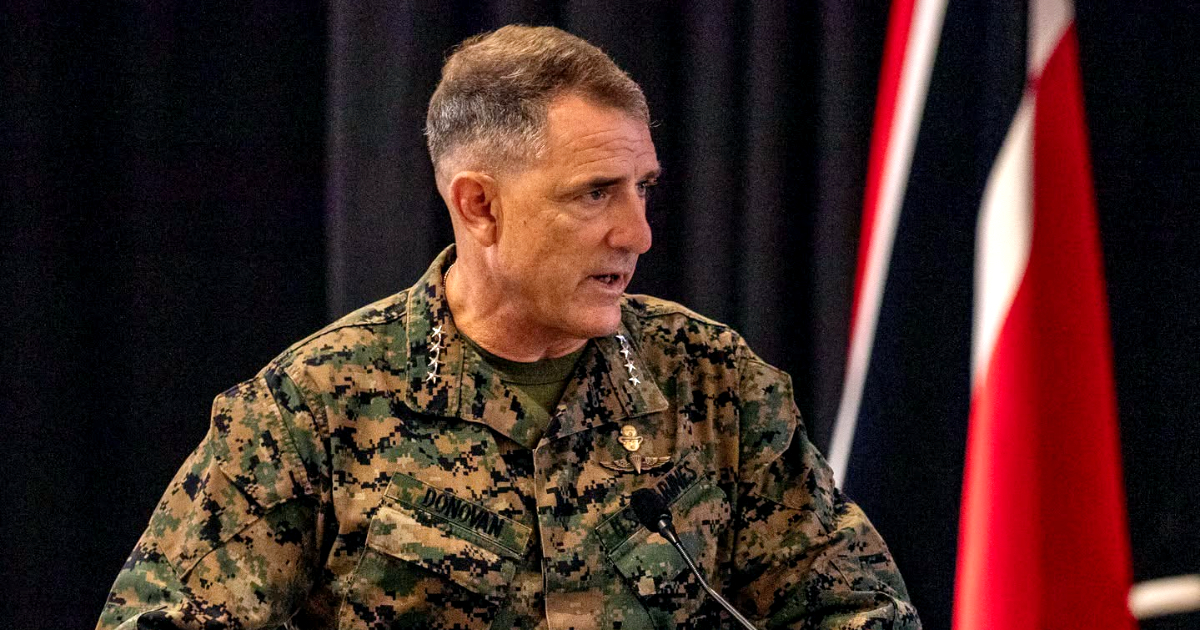
The time has come to fight against the enemy. With that assertiveness, General Francis L. Donovan, head of the United States Southern Command (SOUTHCOM), addressed defense and security officials from 19 countries gathered in Panama at the Americas Counter Cartel Coalition (A3C) forum.
"This is our chance to decide. Are we willing to take the fight to the enemy? I believe we are," stated Donovan. "These are networks [...] that are truly wreaking havoc on our own societies. We need to attack these networks. We have to apply total systemic friction against them."
In its message, SOUTHCOM did not mention Cuba. Therefore, it would be incorrect to present the general’s words as a threat specifically aimed at Havana.
However, the context in which they occur, the new U.S. strategy against narco-terrorism, the Venezuelan precedent, and the extensive historical record regarding the relationship between Cuban officials and international drug trafficking also allow for the interpretation of the message as a warning to the regime.
Donald Trump had already publicly included Cuba in his discourse regarding Maduro and the narcoterrorists. In November 2025, during the electoral campaign in Honduras, Trump asked on Truth Social: "Will Maduro and his narcoterrorists take over another country, as they have done with Cuba, Nicaragua, and Venezuela?".
The phrase does not amount to a judicial accusation of drug trafficking against the Cuban regime, nor does it demonstrate that Washington officially considers Cuba part of a narcoterrorist organization. However, it does explicitly place the island within the same political and regional security space that Trump associated with Maduro and his networks.
Months later, that rhetoric took on a very different dimension.
From rhetoric to "total systemic friction"
The expression now used by Donovan also does not seem improvised.
Imposing total systemic friction on drug cartels and terrorist organizations is one of the official priorities of the head of SOUTHCOM.
Another consists of denying U.S. adversaries footholds and undue influence in the hemisphere.
And Washington has already shown that this "friction" can extend beyond police cooperation, financial sanctions, or the interception of shipments. SOUTHCOM has employed the same concept in 2026 when reporting on kinetic operations against vessels that it identified as linked to narcoterrorist organizations.
The strategy aims to address the entire network: production, transportation, leadership, financing, intelligence, infrastructure, and distribution.
There is a particularly significant phrase by Donovan in Panama: «We need to take on these networks».
The concept of "network" allows for a much broader interpretation than that of the traditional poster made up of drug traffickers, laboratories, hitmen, and transporters. It can also include facilitators, financial operators, intelligence structures, corrupt officials, or infrastructure used to protect the business.
And it is precisely in that context where the historical record of Cuba gains significance.
Long before Ochoa
The connection between high-ranking officials of the Cuban regime and drug trafficking did not begin with Case 1 of 1989 and the executions of General Arnaldo Ochoa and Antonio de la Guardia.
Declassified U.S. intelligence documents indicated as early as the 1980s that Cuban officials were facilitating drug traffickers' operations.
In 1982, a U.S. federal grand jury indicted four high-ranking Cuban officials in a case that described the use of Cuban territory and waters to facilitate drug operations coming from Colombia.
Seven years later, the regime itself acknowledged during Cause 1 that officials at extraordinarily high levels of the Armed Forces and the Ministry of the Interior had negotiated operations with Colombian drug traffickers.
The official version maintained that they acted without the knowledge of Fidel and Raúl Castro. This explanation has been questioned for decades by defectors, former officials, and drug traffickers.
Carlos Lehder, co-founder of the Medellín Cartel, has claimed that agreements existed to use Cuban territory and directly implicated Raúl Castro. His testimony does not, by itself, constitute definitive evidence, but it partially aligns with operations and structures investigated by the United States years earlier.
Federal prosecutors in Miami even considered a 1993 indictment against Raúl Castro and other high-ranking Cuban officials for cocaine trafficking. The case was never brought forward, partly due to issues regarding the credibility of certain witnesses, intelligence-related matters, and other challenges in building the case.
The distinction is crucial: there is ample documentation regarding the historical participation of high-ranking Cuban officials in operations related to drug trafficking, but it has never been judicially established that Fidel or Raúl Castro personally led a drug trafficking organization.
The connection with the Cartel of the Suns
Research published in 2025 adds a new dimension to the historical record concerning Cuba and drug trafficking: the possible continuity between the operations documented since the 1980s and the subsequent development of criminal networks embedded in the Venezuelan state.
A report from the Center for a Free Cuba, along with other organizations, presented Cuba as a "precursor to the Cartel de los Soles" and argued that the methods, relationships, and capabilities developed by the Cuban apparatus would later have contributed to the Venezuelan model of using state structures to facilitate illicit activities.
Another dossier, The Cuban Mafia State and the Cartel of the Suns, created by Juan Antonio Blanco and Emilio Morales and distributed by Cuba Siglo 21 and Havana Consulting Group, goes further.
Its authors argue that Havana is not merely a historical antecedent but a functional piece of the ecosystem associated with the Cartel de los Soles, contributing intelligence and counterintelligence capabilities, political protection, and international connections.
The report also points to structures linked to GAESA as part of a financial network that should be investigated by U.S. authorities.
Without constituting established judicial facts, their conclusions— which have not been publicly adopted by SOUTHCOM— gain significance when compared to documented precedents: the U.S. investigations of the 1980s, the recognized involvement of high-ranking Cuban officials in operations with Colombian drug traffickers, the federal investigation that considered charges against Raúl Castro, and, decades later, the deep penetration of Cuban services into the intelligence and security apparatuses of Chavista Venezuela.
The hypothesis is especially relevant in light of the strategy now outlined by SOUTHCOM. If drug trafficking operates not only through traditional cartels but also through networks that combine criminals, officials, financial structures, intelligence, and state protection, the importance of Cuba would not necessarily depend on the island being a major physical route for cocaine today.
Precisely, this is what the 2025 research suggests: that the potential role of Cuba should be sought less in the shipments that cross its shores and more in the capabilities of intelligence, protection, funding, and international influence that could sustain those networks.
Cuba is not a major cocaine route today
There is also evidence that compels us to avoid maximalist conclusions.
Recent international assessments do not identify Cuba as one of the main centers for cocaine production or transit on the continent. The Global Organized Crime Index 2025 also does not regard the island as a significant international route, although it highlights illicit markets, drug trafficking, corruption, and issues related to criminal actors.
But Cuba's relevance to the strategy outlined by SOUTHCOM would not necessarily depend on large shipments of cocaine currently passing through the island.
It would depend on something different: for the United States to determine which Cuban structures provide intelligence, protection, logistics, communications, funding, political cover, or other services to organizations deemed narco-terrorist.
In that scenario, Cuba could be seen as part of a network even if it were not a major physical drug corridor.
The precedent that changes the interpretation: Venezuela
That is the context that makes Donovan's words particularly poignant.
In November 2025, Trump spoke of "Maduro and his narco-terrorists" and explicitly mentioned Cuba, Nicaragua, and Venezuela. In January 2026, the United States escalated its offensive against Maduro to a level that just a few months earlier seemed hard to imagine.
Now SOUTHCOM claims that the time has come to "take the fight to the enemy," "attack these networks," and apply "total systemic friction" against them.
None of these circumstances prove that there is a U.S. operation being prepared against Cuba. Nor do they allow us to assert that Donovan was specifically talking about Havana.
But the sequence is hard to ignore.
For over four decades, judicial investigations, intelligence documents, testimonies from drug traffickers, and U.S. records have repeatedly linked high-ranking Cuban officials to international drug trafficking operations.
Recent investigations attempt to link that experience with the subsequent development of criminal organizations within chavismo.
This is now compounded by a U.S. president who has already publicly included Cuba in his remarks about Maduro and the “narcoterrorists”, an Administration that has elevated the fight against these organizations to the level of national security, and a Southern Command that asserts it is no longer enough to intercept them: we must attack their entire networks.
Donovan did not mention Cuba in Panama. But after Venezuela, and following Trump's own words about the island, Havana has reasons to listen carefully to the message.
Related videos:
Filed under: