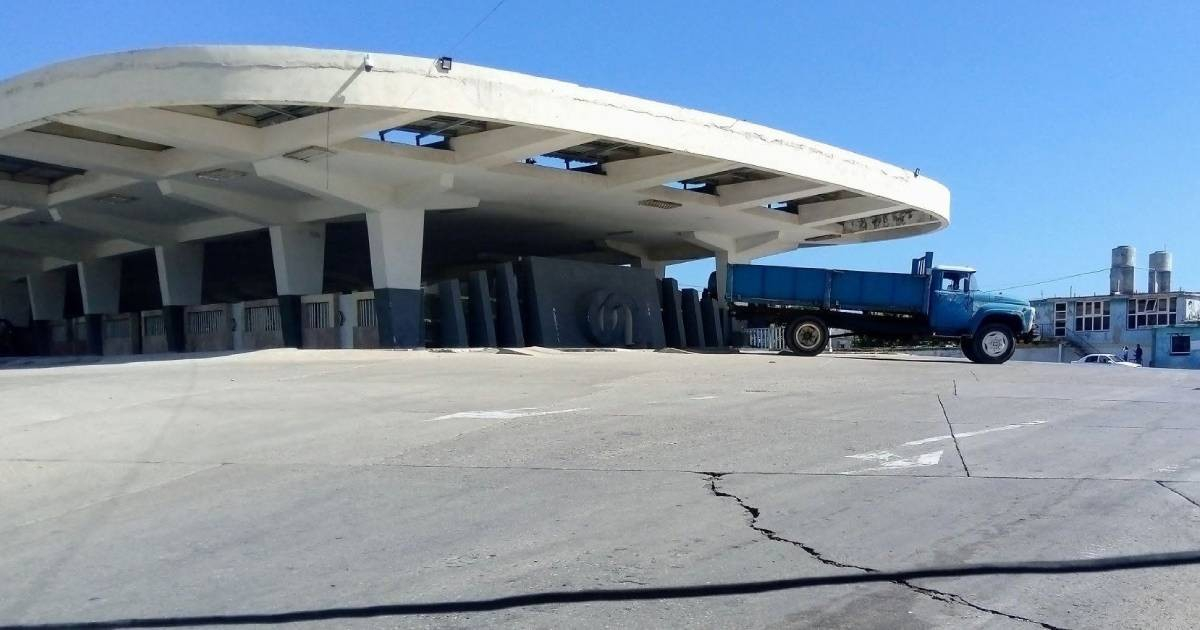
A photograph of the National Bus Terminal in Havana completely empty has evoked sadness and nostalgia for the days when its platforms were crowded with buses and passengers at any hour of the day.
The image, published last Monday on Facebook by photographer Agustín Batista, shows the platforms without a single bus, with just a blue truck beneath the distinctive circular concrete awning.
Batista titled the photograph with a single word: "DESERTIC," and attributed the scene to the "energy blockade and the resulting fuel shortage."
"It’s impossible not to remember my years as a university student and the years that followed, when that same platform was constantly filled with buses arriving from, or departing to, the entire archipelago, 24 hours a day," he wrote.
The publication evoked memories among those who had used the terminal for years to travel between Havana and other provinces.
"That terminal was always packed. I traveled between Ciego and Havana for five years, back and forth. It makes you want to cry," commented a Cuban woman. "Incredibly real," another added. Someone else recalled a time when the interprovincial fare was 11 pesos and one could board a bus without waiting more than an hour.
Another internet user pointed out that the image of an empty terminal contrasts sharply with what is happening in other parts of the country, where numerous Cubans continue to desperately seek a way to travel. As an example, they mentioned Parque Martí, in front of the Government headquarters in Ciego de Ávila, where, according to their testimony, people gather waiting for lists and turns to secure transportation. The commenter also described the presence of the elderly and people resorting to reselling turns as a means to earn some daily income. “On one side, some are desperately trying to reach another destination, and on the other, those who come up with ways to survive each day,” they summarized. For the user, a photograph of these everyday scenes would also reveal a reality capable of “bringing tears to the eye behind the lens.”
An empty terminal in the midst of a transportation collapse
The photograph reflects a mobility crisis that has deepened in 2026 due to extreme fuel scarcity and the deterioration of public transportation.
Cuba went for months without receiving regular supplies of imported oil following the disruption of shipments from Venezuela and Mexico. A Russian shipment of about 730,000 barrels arrived at the end of March, but the reserves were depleted again.
The Minister of Energy and Mines, Vicente de la O Levy, acknowledged in May the seriousness of the situation by stating that the country had "absolutely nothing" in terms of diesel or fuel oil to sustain the electrical system.
Transportation has been one of the main victims of the crisis. In February, the urban service in Havana came to a standstill due to a lack of fuel, while in June, the Ministry of Transportation implemented significant cuts to interprovincial connections.
National Buses between Havana and the provincial capitals have changed from daily departures to three weekly frequencies, while destinations like Baracoa, Manzanillo, and Moa have been reduced to one departure per week.
National trains to the east have also been cut: from 62 monthly services, they have decreased to just 16, a reduction of 74%, with frequencies that in some cases reach just one departure every 16 days.
New changes in ticket sales were added to the difficulties, including the suspension of operations of the Viajando app and the return of part of the sales to physical agencies, with reservations limited to just a few days in advance.
From 1,500 buses to a "desert-like" image
The contrast is particularly symbolic due to the history of the place. The National Bus Terminal, inaugurated on June 19, 1951, was then regarded as one of the most modern and well-equipped facilities of its kind in the world. The building was designed to accommodate a daily traffic of up to 45,000 passengers and 1,500 buses, a fact that highlights the contrast with the current image of its nearly empty platforms.
More than seven decades later, the photograph of an empty platform joins other images shared during the crisis of 2026: streets virtually devoid of vehicles, the Havana tunnel deserted, and areas of José Martí International Airport affected by blackouts and a lack of travelers.
Faced with the nostalgia expressed by someone recalling a bustling terminal, Batista responded with just four words: “It hurts, my friend. It hurts a lot,” a phrase that encapsulates the impact of an image where the absence of buses tells another story as well: that of a country where traveling from one province to another has become an odyssey for thousands of Cubans.
Related videos:
Filed under: