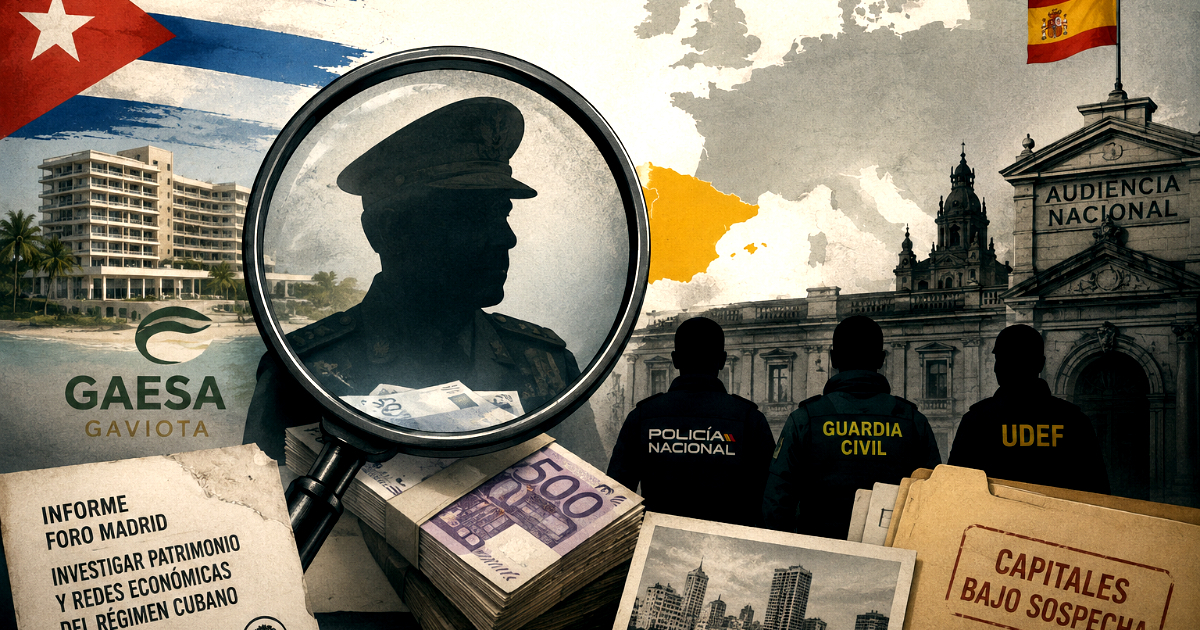
Foro Madrid has requested Spain to enhance the investigation into heritage, financial movements, and potential economic structures of the Cuban regime leaders and their associates, including family members, to prevent the country from becoming a haven for illicit capital.
The proposal appears in the report Cuba: a criminal regime sustained from abroad, which calls for the use of Spanish instruments against money laundering when there are sufficient indicators and for strengthening the coordination between the National Police, Civil Guard, judges, prosecutors, and intelligence services.
The request opens a particularly sensitive angle: Spain has been investigating the fate of fortunes originating from the Venezuelan chavista environment for years, but there is no publicly available effort comparable to determine whether individuals linked to the Cuban political, military, and business elite hold assets in Spanish territory that warrant similar scrutiny.
The issue becomes even more significant due to the close economic relationship that Spain has maintained with Cuba for decades and the influence of Spanish companies in sectors dominated by the Cuban state, particularly by the military conglomerate GAESA.
Spain has already followed the money from chavismo
The Venezuelan precedent shows that Spanish institutions have the experience to do so.
The National Court itself has described among its investigations into PDVSA the inquiries aimed at clarifying the alleged irregularities in the management of public funds of the Venezuelan oil company, as well as the money transfers made to Spain and the final destination of those amounts.
Investigations have been ongoing for years involving former officials, executives, entrepreneurs, intermediaries, and relatives linked to various Venezuelan schemes.
A study by El País calculated back in 2018 that a group of about ten individuals linked to chavismo had introduced into Spain more than 160 million euros, roughly half of which was intended for real estate investments, including luxury homes, large properties, and other businesses.
In some cases, the Spanish investigations concluded with extradition procedures. The National Court agreed, for example, to hand over to the United States Adrián Velásquez, the husband of former Venezuelan treasurer Claudia Díaz, to answer for an alleged money laundering and corruption scheme.
In others, Spanish researchers have directly pursued the heritage.
In 2024, a judge from the National Court proposed to prosecute the widow and a partner of Juan Carlos Márquez Cabrera, a former executive of PDVSA, for tax crimes, forgery, and money laundering. The proceedings even included a request from the Prosecutor's Office to initiate autonomous confiscation against the children of the deceased.
The actions indicate that the Spanish asset scrutiny regarding Venezuela has not been limited to high-ranking officials but has also extended to partners, intermediaries, and family members when investigations have found reasons to trace the money.
The investigations are ongoing. The National Court continues to investigate large amounts of capital allegedly originating from PDVSA and its possible laundering through companies, investments, and other mechanisms in Spain.
One of the most recent studies has also focused on Plus Ultra, the Spanish airline rescued by the Government of Pedro Sánchez with 53 million euros during the pandemic.
An ongoing investigation based on information provided by the authorities of France and Switzerland is examining possible fund movements from Venezuela and their connections to companies and entrepreneurs linked to the airline, as part of broader inquiries into allegedly diverted funds from Venezuelan state programs and operations related to gold.
In this context, the name of former Spanish President José Luis Rodríguez Zapatero has also emerged, due to his relationships with Venezuelan leaders and businessmen and the efforts he allegedly made on behalf of Plus Ultra. His mention in information related to the investigation does not imply that he is accused of money laundering nor does it suggest his involvement in the operations under suspicion.
The case, still under investigation, illustrates the extent to which inquiries into capital from Venezuela have expanded in Spain towards business networks, intermediaries, and political connections, going beyond the former officials of chavismo who were initially under scrutiny.
And what about the money of the Cuban elite?
It is precisely that precedent that provides context to the proposal from Foro Madrid.
That a Cuban official, businessman, family member, or person associated with the regime owns property, participates in a company, or resides in Spain does not in itself constitute evidence of a crime. There are also no elements that allow one to assume that any assets related to the Cuban elite have an illegal origin.
The issue raised by the report is another: if Spain has scrutinized for years the money coming from networks linked to chavismo, should it do the same with the wealth and economic structures related to the Cuban leadership when there are elements that justify investigating them?
The question is particularly important due to the close relationship maintained for decades between the governments of Cuba and Venezuela, as well as the Cuban presence in various sectors of the Venezuelan state apparatus.
Also due to the very nature of the Cuban economy, where significant foreign currency-generating sectors are controlled by GAESA, a business conglomerate belonging to the armed forces.
Spain has been doing business with GAESA for decades
Spain occupies a unique position in this scenario.
For decades, their companies have been key players in the development of Cuban tourism and have maintained operations in strategic sectors of the island's economy.
Until the recent tightening of U.S. sanctions, Spanish companies held around one hundred hotel management contracts in Cuba, many concerning establishments owned by GAESA.
According to data from the Spanish Diplomatic Information Office cited by EFE, over 280 Spanish companies were established in Cuba through delegations and more than 60 through investment projects. The stock of Spanish investment was around 442 million euros, primarily in tobacco, financial services, and wholesale trade.
In tourism, a particularly close relationship developed over the years: Spanish chains managed hotels whose ownership remained in Cuban hands, many of which belonged to Gaviota, the tourism arm of GAESA.
That relationship began to dismantle in 2026 under pressure from Washington. Iberostar abandoned the management of 12 hotels linked to GAESA and Meliá subsequently began its withdrawal until announcing the termination of all its contracts and services in Cuba.
The U.S. change has also brought new attention to the financial structure of the military conglomerate and its relationships with foreign companies.
Relatives of the leadership with business activities outside of Cuba
In recent years, there has also been information regarding the international economic activities of relatives of Cuban leaders.
One of the examples that directly relates to Spain is Manuel José Anido Cuesta, son of Lis Cuesta and stepson of Miguel Díaz-Canel.
The Official Bulletin of the Mercantile Registry (BORME) certifies that in April 2025, Anido Cuesta became the sole administrator and sole partner of Meridian Wealth Group SL, a company based in Madrid.
Among the company's offerings were strategic consulting for international clients—particularly American, Latin American, and Caribbean—in establishing businesses and investment platforms, as well as market prospecting in Europe.
The company was dissolved and extinguished in January 2026, with Anido Cuesta serving as the liquidator.
There is no indication of any illicit activity in the recorded data. This case is relevant only because it demonstrates that individuals from the immediate family environment of the Cuban leadership have engaged in corporate activity in Spain, precisely one of the areas where Foro Madrid calls for increased asset surveillance.
Other members of the Cuban elite have played leading roles in international movements that are difficult to explain solely based on their official functions.
Raúl Guillermo Rodríguez Castro, grandson of Raúl Castro known as El Cangrejo and son of the late head of GAESA Luis Alberto Rodríguez López-Calleja, completed at least 25 flights to Panama between 2024 and 2025 on private jets, according to documents obtained by Martí Noticias, La Prensa of Panama, and the Foundation for Human Rights in Cuba.
The records showed, among other aircraft, a jet that previously bore a Venezuelan registration. Rodríguez Castro has also maintained frequent ties with Venezuela and has appeared alongside the Cuban leadership at high-level political events.
These movements do not, by themselves, prove any financial irregularity. However, they illustrate the existence of international networks and movements of individuals belonging to the Cuban power core that transcend the ordinary administrative structures of the island.
Cuba and Venezuela, two closely related networks
The comparison with Venezuela does not arise solely from the fact that both countries have been political allies.
For over two decades, Havana and Caracas developed an integration that encompassed oil, medical cooperation, security, intelligence, public administration, and numerous business and financial agreements.
This relationship makes it particularly important to understand the extent to which the economic networks developed around chavismo —some of which ended up being investigated for money laundering and corruption in Spain and other jurisdictions— maintained connections with Cuban actors.
But that political and economic relationship does not automatically attribute responsibility to Cuban officials for the Venezuelan plots being investigated in Spain. Determining the existence of those connections, when there is concrete evidence, is precisely the responsibility of the competent authorities.
There lies one of the points of the Foro Madrid proposal: not to assume the existence of illicit fortunes, but to provide Spanish institutions with a more proactive strategy to detect them if they exist.
Follow the money, even in the Cuban case
The report calls for Spain to avoid becoming a sanctuary for capital linked to the Cuban leadership and to investigate possible structures used to conceal assets or move resources through family members, intermediaries, or others when there is sufficient evidence.
It also proposes to strengthen cooperation among the police, Civil Guard, judges, prosecutors, and intelligence in response to potential organized crime networks linked to the regime's interests.
The Venezuelan precedent illustrates how far such scrutiny can go: investigations into international transfers, companies, bank accounts, real estate, intermediaries, and beneficial owners; extradition procedures; and, when evidence permits, charges of money laundering or requests for confiscation.
The difference is that there is no publicly available patrimonial research of comparable dimensions on the Cuban elite in Spain, despite the depth of economic relations maintained between both countries and decades of Spanish businesses with sectors controlled by the State and the Armed Forces.
The proposal from Foro Madrid now puts that difference on the table.
It is not a matter of implying that Cuban officials or their relatives with interests in Spain have committed crimes.
It is a different question: if Spain has been tracking fortunes related to chavismo for years, are there reasons for the wealth and international economic networks of the Cuban elite to remain outside of equivalent scrutiny when signs that justify it appear?
Foro Madrid believes otherwise.
Related videos:
Filed under: