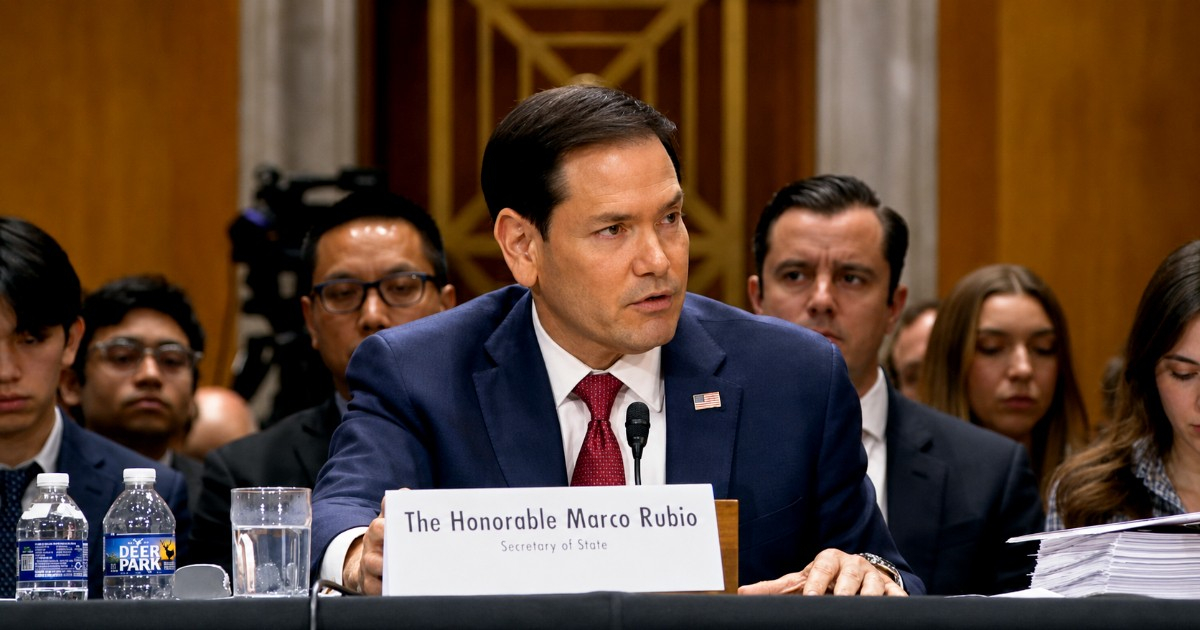
The Secretary of State Marco Rubio accused the Cuban regime on Thursday of using for decades a network of front organizations to "infiltrate, corrupt, and radicalize" American citizens, while announcing a new round of sanctions against leaders of the Cuban Institute for Friendship with the Peoples (ICAP) and nine entities linked to the repressive and economic apparatus of Havana.
"The Cuban regime has spent decades using front groups to infiltrate, corrupt, and radicalize American citizens," Rubio wrote when announcing Executive Order 14404, officially released under the title "Imposing Sanctions on Cuban Regime Actors Associated with Marxist Subversive Networks and Corrupt Economic Dealings".
The three designated officials are Fernando González Llort, president of ICAP; Noemí Ramona Rabaza Fernández, first vice president; and Leima Martínez Freire, director for North America.
The case of González Llort carries particular weight: he was arrested in 1998 and sentenced in 2001 for his role in the Red Avispa, a Cuban intelligence network infiltrated in exile groups in Miami, where he operated under the alias "Rubén Campa".
He spent approximately 15 years in prison on U.S. soil before returning to Cuba in 2014, and since 2017, he has presided over ICAP, the organization that Washington views as one of the main instruments of foreign influence of the regime.
Among the nine sanctioned entities this Thursday are the Ministry of Construction, the Comandante Ernesto Che Guevara Nickel Company, the Saline Mining Business Group (GEOMINSAL), and the Commercial Representation Contracting Agency S.A. (ACOREC S.A.).
Rubio warned that the measure has international reach: "Foreign banks and other companies that provide services or hold funds for these entities must take immediate action to cease their support," he stated, making it clear that any actor who supports the sanctioned individuals is at risk of being designated in turn.
This is not the first time that the ICAP has found itself at the center of U.S. sanctions. On June 4, the Treasury Department had already included it on the list of Specially Designated Nationals (SDN) maintained by the Office of Foreign Assets Control, accusing it of supporting Cuban intelligence and counterintelligence activities.
The institute then rejected those accusations and demanded to be removed from the list, arguing that in its 65 years of existence, it has been dedicated to promoting friendship and international solidarity.
Specialized media analyses estimate that about 90% of ICAP personnel would be linked to Cuban espionage services, a figure that the institution categorically denies.
The action taken this Thursday is the latest in a sustained campaign that began with the signing of Executive Order 14404 on May 1st of this year and has included rounds of sanctions in June, July, and August against the military, financial, energy, mining, and construction sectors of the regime.
In July, Washington also revealed a plan related to the Cuban regime to mobilize protests on U.S. soil, which reinforced the Trump administration's narrative regarding Cuban subversion in America.
Related videos:
Filed under: