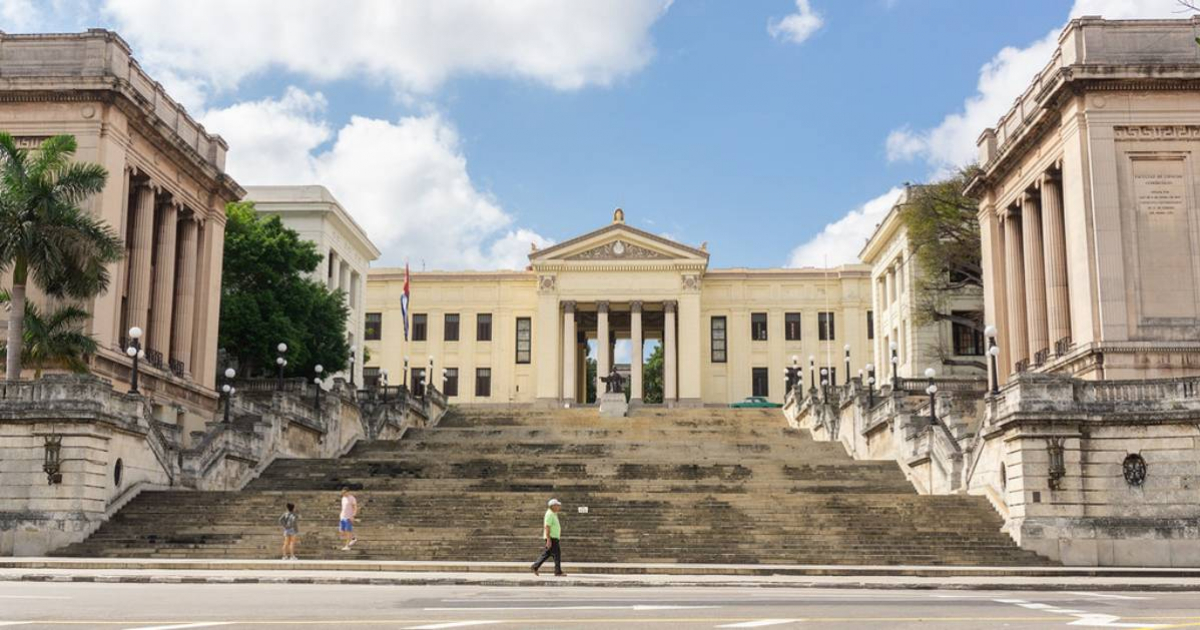
The fuel crisis will again impact the operation of Cuban universities during the 2026-2027 academic year, which will begin with blended and distance learning and limited periods of in-person classes, primarily for daytime students.
The Ministry of Higher Education (MES) announced this Thursday that the new academic year will begin on September 1 at all universities and higher education institutions in the country, amid what it described as a "worsening fuel shortage situation".
In light of this situation, the organization announced that it will essentially maintain the academic structure implemented during the previous semester, based on the decentralization of teaching processes and the use of the university structures in each territory.
The training will be conducted in both blended and online formats. The Ministry indicated that some in-person periods will be alternated, "whenever possible," primarily for students in the daytime course.
In-person activities may take place at the main campuses of the universities, the CUM, the FUM, and productive or service entities in each locality.
In the course by meetings, both in the Higher Technician programs and in university careers, in-person meetings will be held at least once a month to guide and assess the learning tasks.
The distance learning course will continue its regular operations.
At the universities under the Ministry, new students will be able to enroll from their places of residence.
The re-enrollment and re-registration of continuing students will also be organized in a decentralized manner.
Young people from national or regional programs will be able to complete those procedures at the university, at the Municipal University Centers (CUM), or at the Municipal University Branches (FUM) in their provinces or municipalities, either in person or online.
The Cuban government already has "experience" in implementing emergency solutions of this kind, which, according to its usual rhetoric, do not affect the educational process in the slightest.
For example, in February, the University of Havana extended the semi-presential modality to all its programs and courses of Higher University Technician for a period of 30 days due to the energy deficit and fuel crisis.
Each faculty was responsible for determining which activities needed to be conducted in person.
A few days later, the University of Oriente also switched to a hybrid model and closed its student residence, with exceptions for foreign students and other students who needed to stay there.
The institution turned to virtual platforms and WhatsApp groups to maintain teaching activities.
However, the crisis has not only impacted the functioning of higher education but also access to it.
In May, the Government canceled the entrance exams for universities for the 2026-2027 academic year and established that the assignment of careers would be based on the average or cumulative academic index of pre-university students.
The authorities acknowledged at that time issues with connectivity and transportation for conducting academic activities.
Related videos:
Filed under: