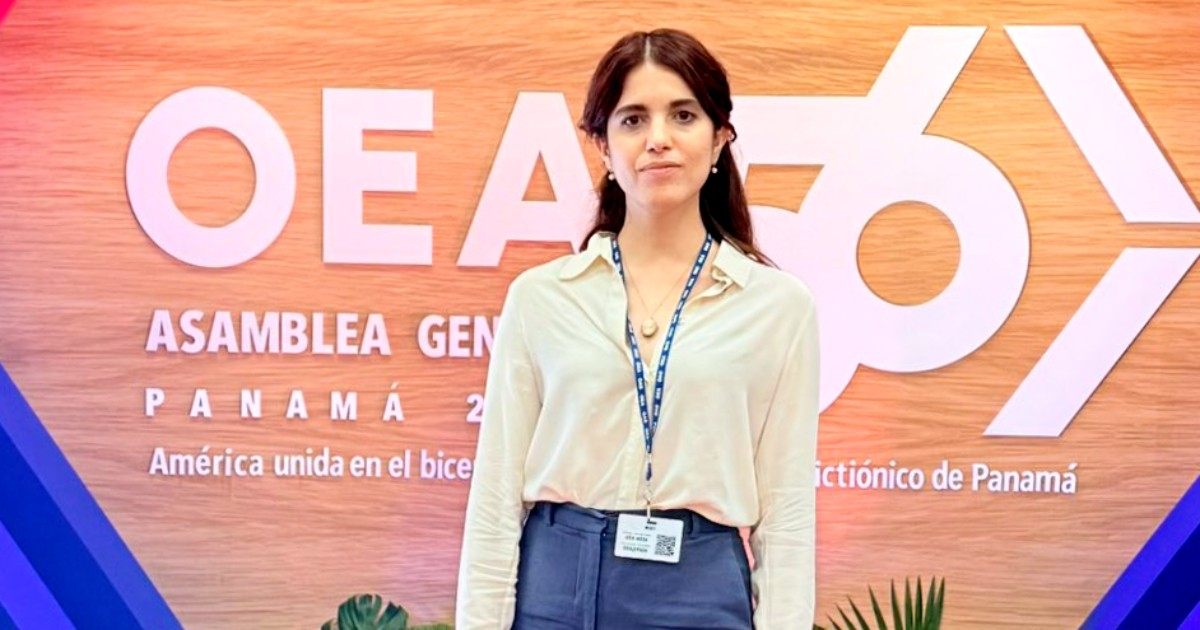
The Cuban art historian and activist Carolina Barrero announced this Monday her arrival in Miami to begin a doctorate at the University of Miami (UM) in a literary studies program that, as she described, is connected to politics.
In a message posted on his X account, Barrero described the move as "the return to America, closer to the homeland" and expressed his excitement for joining a city that he defined as "sustained by the perseverance of the memory of Cuba."
The young woman described her new academic stage as an immersion in «that distinctly Cuban tradition where word has never been separate from the polis», establishing a historical continuity that encompasses and connects the political and social discourse of many heroes and intellectuals from the Island.
At the same time, he clarified that his links with Europe and Spain —and his work with European institutions— "will remain intact," and he thanked the team of his organization, Ciudadanía y Libertad, for "continuing to grow on both sides of the Atlantic."
Barrero is one of the most recognized figures of Cuban civic activism of his generation.
The art historian, linked to the San Isidro Movement (MSI), participated in the 27N protests, the gathering on November 27, 2020, in front of the Ministry of Culture in Havana, the first public manifestation of its kind in decades, led by artists, intellectuals, and journalists demanding an end to repression and censorship.
The regime forced her into exile in Spain in February 2022 under the threat of imprisonment, following her activism in defense of those detained during the protests on July 11, 2021. Upon leaving the island, she stated that "leaving Cuba does not mean abandoning Cuba" and that she would continue fighting for civil and political rights on the island.
From Madrid, she built a work network over four years with European institutions, the UN, and the OAS. In March 2024, she received the Sájarov Prize from the European Parliament, an award aimed at human rights defenders, and in July of that year, she publicly launched Ciudadanía y Libertad, a non-partisan organization dedicated to promoting democratic culture and civil rights in Cuba.
His arrival in Miami occurs just a month after that of Luis Manuel Otero Alcántara, leader of the MSI, who arrived in the city on July 18 after serving five years in prison in Cuba, released on the condition of leaving the country permanently. Otero's arrival generated great expectations among the Cuban exile community in Miami, expectations that have gradually evolved over time.
Barrero serves as a connecting figure between the European exile—where he has worked before parliaments and international organizations—and that of Miami.
In May 2026, she warned that "the fall of the dictatorship does not automatically guarantee a consolidated democracy" and that it is necessary to strengthen democratic culture to prevent new authoritarianism.
In July, it demanded that Cuban civil society be part of any negotiation table concerning the future of the island, alongside conditions such as the release of political prisoners, free elections, and guarantees of non-recurrence.
I hope to get to know the entire community better, listen to them, and participate in everything that is to come, Barrero wrote when announcing his new stage, promising to inform soon about the spaces and events in which he will participate.
Related videos:
Filed under: