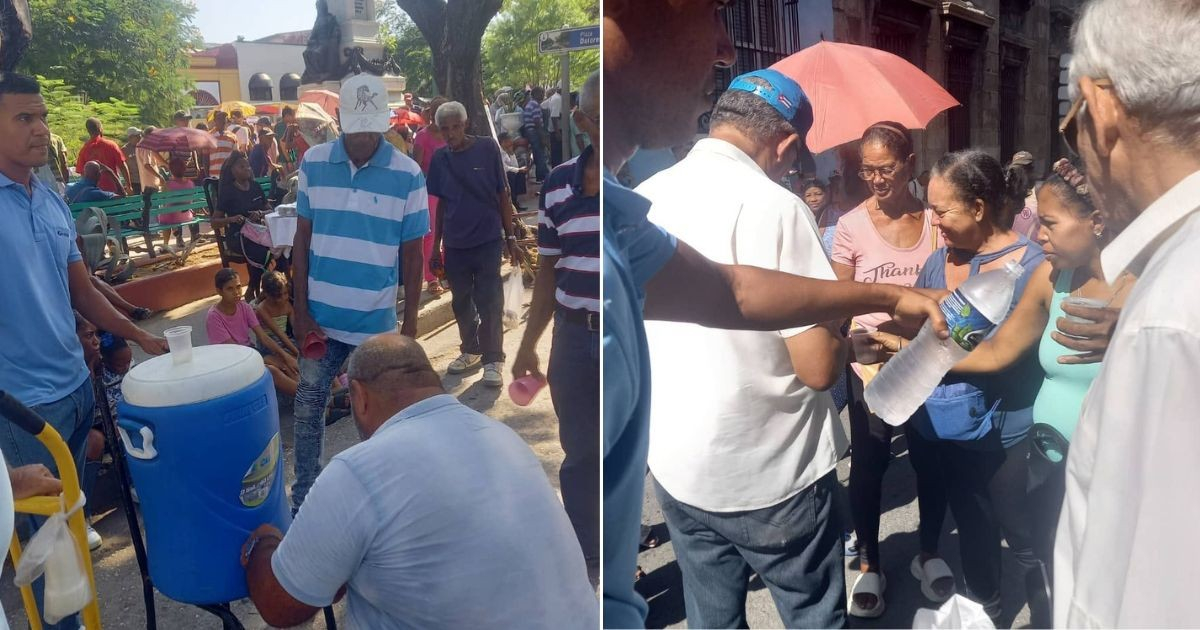
If there is one thing the Cuban regime has gained experience in, it's in juggling problems: alleviating the symptoms while leaving the causes intact. In Santiago de Cuba, this is once again evident with the long waits for retirees to receive their pensions.
The government, instead of ensuring them quick and effective access to their money, has responded by mobilizing food, drinks, and chairs to make the wait more bearable.
ETECSA in Santiago de Cuba reported this Thursday that its employees have joined the "logistical support for the payment of retirees" and that the Telecommunications Centers in the nine municipalities have made available to the institutions "soft drinks, instant soup, chairs".
The University Student Federation (FEU) of the University of Oriente also joined those actions.
The organization reported this Thursday that students belonging to the Community Youth Network brought food to elderly people who were at branch 8132 of the Popular Savings Bank (BPA) to collect their pensions.
The organization described the initiative as a "humanitarian work" and stated that it shows young people are making a "Revolution" by helping those in need.
The initiatives can relieve, for a few hours, the difficult conditions faced by retirees, and surely more than one appreciates a drink, a chair to rest, or a soup while they wait.
But the relief does not change the reality: retirees still have to wake up early —and sometimes start lining up the day before— in order to secure a good spot and try to withdraw their pension money.
There lies the contrast of a measure presented as "support": the intention is to make the waiting line more bearable rather than to eliminate the need to stand in it.
The images shared show numerous elderly individuals waiting around banking institutions, some of them exposed to the sun.
The publications from ETECSA and the FEU highlight a mobilization of resources to assist retirees during the payment periods, although neither specifies how long "the support" will last.
The new development now is the institutional makeup with which the response is presented: chairs for those who should not have to stand for hours, soup for those who should not have to spend a whole day waiting, and drinks for those who continue to face long lines due to a problem that remains unresolved.
What is questionable is to offer assistance as a response that merely alleviates the problem, while the essential solution remains unaddressed: allowing a retiree to collect their pension without having to wake up early, spend hours in the sun, or even start queuing the day before to access their own money.
The underlying problem is much older than chairs and instant soup. The scarcity of cash and the limitations of the Cuban banking system have long forced workers and retirees to endure long lines to withdraw their earnings.
In June last year, a massive gathering of retirees filled the Plaza de Dolores to withdraw their payments at a branch of the Popular Savings Bank, also located in Santiago de Cuba.
Some retirees began to queue up from six o'clock in the evening the day before and spent the night in front of the bank to try to secure a spot.
The vulnerability of retirees under those conditions was particularly highlighted in March 2024, when a 90-year-old man fainted while waiting in line to collect his pension in Santiago de Cuba.
The man remained under the sun and had to be assisted by others.
Related videos:
Filed under: