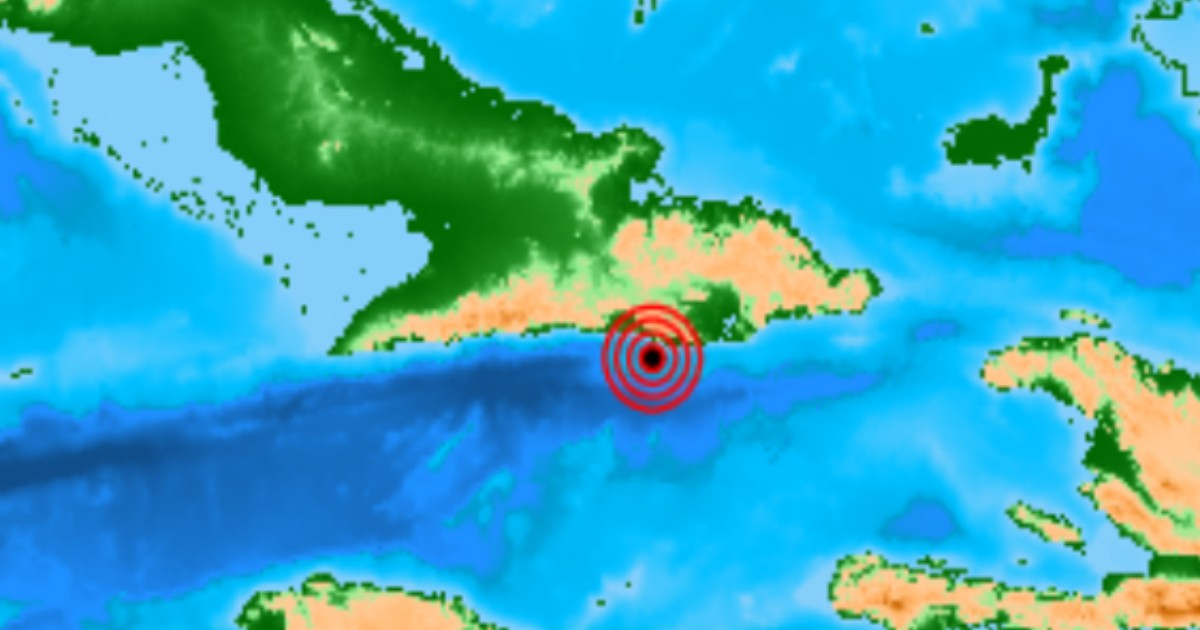
A tremor of magnitude 3.6 on the Richter seismic scale was recorded this Friday in eastern Cuba, with its epicenter located 31 kilometers southeast of Santiago de Cuba, according to the official report from the National Center for Seismological Research (CENAIS).
The event occurred at 5:13 PM local time and was classified as perceptible, indicating that the population was able to feel it.
The CENAIS located the seismic focus at a depth of 10 kilometers, with coordinates of 19.807° north latitude and -75.634° west longitude. No material damages or casualties were reported in connection with the event.
Enrique Diego Arango Arias, head of the National Seismological Service of Cuba, specified that the earthquake was reported as perceptible in some areas of the city of Santiago de Cuba and its surroundings.
The earthquake occurred just three days after a false earthquake alert triggered panic in Cuba on August 18, when thousands of mobile phones in the country received a notification of an earthquake that turned out to be entirely unfounded.
CENAIS itself immediately denied that alert: "No earthquake has occurred in Cuba this Tuesday, August 18, 2026," the agency stated, and Civil Defense classified the notification as "completely false."
Enrique Diego Arango Arias, head of the National Seismological Service, confirmed that no stations in the network detected any activity that would justify the alert.
Google, for its part, denied having sent the notification through its Android alert system, stating that the system "did not detect any earthquakes nor sent alerts in Cuba." The unofficial unconfirmed hypothesis suggested an internal test by ETECSA that may have escaped from a controlled environment.
This Friday, before the actual earthquake, Arango issued a new public warning about the consequences of that false alert and emphasized that "the National Seismological Service of Cuba does not have an established protocol to send alerts or alarms for earthquakes through any national or foreign communications entity."
The event this Friday is taking place during a year of intense seismic activity in eastern Cuba.
On February 8, a 5.6 magnitude earthquake with about 30 aftershocks was recorded within the first two hours; on March 17, a 6.0 magnitude tremor shook eastern Cuba with over 160 aftershocks; and on July 24, the ninth perceptible earthquake of the year was recorded in Santiago de Cuba, with a magnitude of 3.1.
Santiago de Cuba is the city with the highest seismic risk in the country. Its proximity to the Oriente fault —also known as the Bartlett-Caimán fault—, located at the boundary between the Caribbean and North American tectonic plates, makes eastern Cuba the area that accounts for approximately 70% of the nation's seismic activity and the highest magnitude earthquakes recorded on the island.
CENAIS warned that the public sensitivity following the false alarm on August 18 makes it even more necessary to have clear official communication protocols for real seismic events.
Related videos:
Filed under: