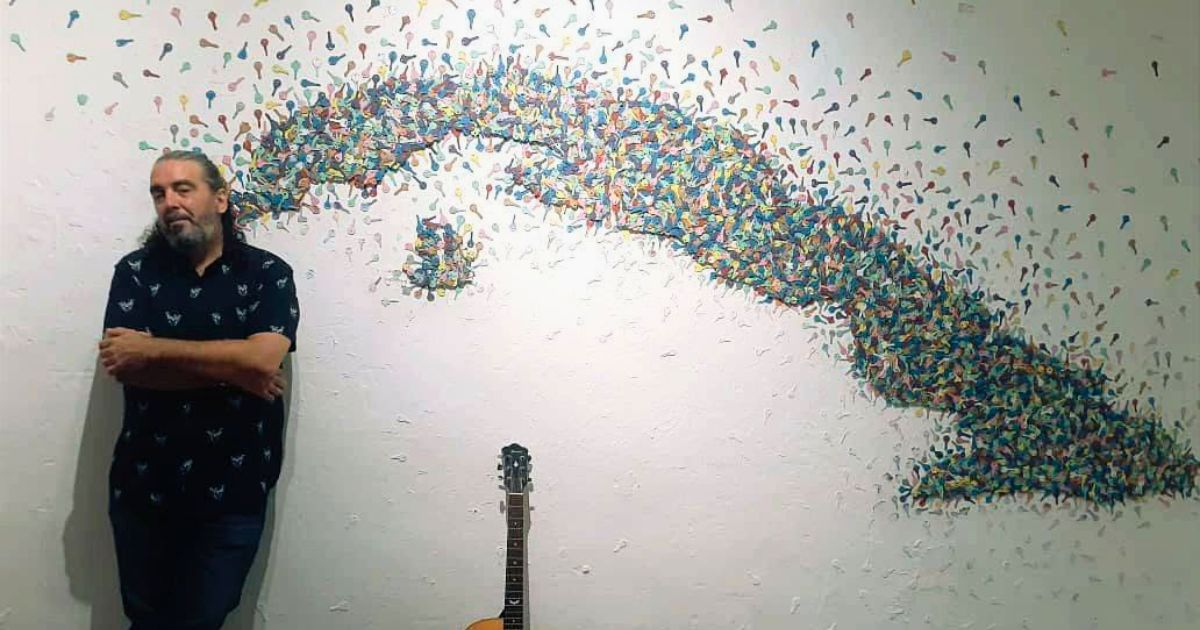
The Cuban troubadour Ariel Díaz published an intense message on Facebook this Friday in which he declares the definitive collapse of the Cuban revolutionary project, with words that could hardly come from someone outside the system: "Everything is over. We have reached the point of no return. The pillars that vaguely supported the country and the indispensable mystique of the Cuban Revolution have bent after years of weakening from external and internal factors."
Díaz, a recognized figure in Cuban trova with an artistic career spanning over two decades, does not write from the sidelines of dissent, but from within the very building that he now declares to be in ruins.
The text begins with a warning: "I'm not here to be optimistic; I’m here to be realistic. I know that shots will come from all sides, but I don’t have the talent to pretend." What follows is an account of losses that encompasses the political, cultural, sporting, and symbolic.
"The mask of Tropical Socialism has fallen to the ground. We have failed. In the end, the enemy has defeated us," writes Díaz, before drawing a historical parallel that strikes at the heart of the official narrative: "Just as before, when we lost the apostle, years of sacrifice for a free Cuba from Spain were thrown into the gutter of the Pseudo-republic; today, without the leadership of Fidel Castro, the mambises will not return to Santiago."
One of the most striking passages is the review of Cuba's historical allies, listed one by one as absent: "They have massacred us, divided us, forgotten us, abandoned us. The allies who benefited so much from our infinite solidarity now look away, cowardly, enslaved, and deaf." Angola, Ethiopia, Grenada, Vietnam, Algeria, Nicaragua, Venezuela, Namibia, Guatemala, Chile, Argentina, Bolivia, China, and Russia parade through the text as nations that have turned their backs on the island.
The image that Díaz creates of Cuba is that of a country exhausted on all fronts: "Dimmed, without a sugar harvest of millions, without young people mobilized to the fields, […] without wins in baseball, on the ropes in boxing, without serves in volleyball, without checkmate, […] without the Varadero festival, without neighborhood cinemas, without leftist Trova, without adventures at 7:30, without Vicente, without Santiago, without Corina, without Alden." The portrait culminates in a brutal sentence: "We are a hunched old woman, with peeling walls, rummaging through the trash of the world to survive."
The text is not an isolated fact. The singer-songwriter and official deputy Raúl Torres admitted days earlier on Facebook that "the people are there, giving their last breath and reflux of confidence in the guides of the revolution," although he did not break with the system. Silvio Rodríguez has questioned the Cuban economic model on several occasions during 2026, but without abandoning his defense of the Revolution. Díaz's text goes considerably further than both.
These voices of discontent emerge at the worst economic moment Cuba has experienced in decades: blackouts lasting more than twenty hours a day, a power generation deficit that typically exceeds 2,000 MW, and an accumulated contraction of over 15% since 2020. The Food Monitor Program reported that more than 90% of Cuban households are struggling to access essential products.
The troubadour concludes his publication with a metaphor that subverts the myth of the Swiss hero: "In the end, William Tell gave up the crossbow and his son missed the shot, piercing his father's forehead." The image suggests that the Revolution ultimately destroyed what it promised to protect, and that the failed shot was not fired by the enemy, but by its own.
Related videos:
Filed under: