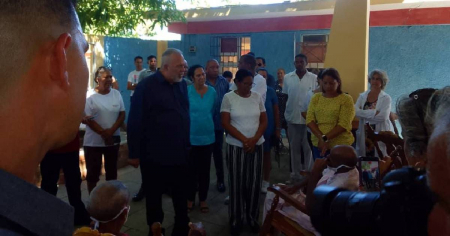
The Prime Minister Manuel Marrero Cruz finally decided to speak about the homeless in Cuba, and although he did not refer to them as such, he acknowledged that they are "a real problem that we have."
On Friday, Marrero visited the Rivera San Juan Social Protection Center in Matanzas, a visit that the government is trying to present as one of its "initiatives to address the growing population of vagrants," a term used by the regime to refer to those who live on the streets and have nothing to eat.
However, far from representing a substantial advancement in resolving the social crisis, the event once again highlighted the government's unfulfilled promises and the manipulation of reality.
The center, inaugurated in August of this year, has a capacity for 50 people and, according to the official report, is intended to provide care for those in vulnerable situations, with a special emphasis on homeless individuals.
During the visit, Marrero stated that "there are a number of concepts we need to clarify" in order to "give each case the appropriate treatment," and he emphasized the importance of locating the families of those affected and placing those individuals "in the right environment." This rhetoric sounds empty once again to those who have been facing social neglect for years.
Comments on social media quickly emerged, pointing out that, as in previous occasions, the visit coincided with the "miraculous" restoration of electricity in areas of Matanzas that suffer from blackouts lasting up to 24 hours, which fuels distrust regarding the true intentions behind such official gestures.
The residents of Matanzas criticized what they saw as a "staging" that aimed to conceal the reality of the country while poverty and destitution continue to rise.
The Cuban government has attempted several times to show that it is addressing the issue, but the solutions remain superficial.
In Ciego de Ávila, the Prime Minister had previously visited a similar center, which, like the one in Matanzas, was presented as an example of the "humanist character" of the revolution.
But what is perceived on the streets is very different: a growing wave of beggars, elderly individuals, and marginalized people who survive amid garbage, without access to medical services or any real assistance that reintegrates them into society.
The government continues to refer to these people as "vulnerable" or "homeless," while denying the existence of beggars in Cuba.
This denial was exemplified by the former Minister of Labor and Social Security, Marta Elena Feitó Cabrera, who in July caused a scandal by stating that "there are no beggars in Cuba" and that those who appeared to be were "simulators" or "drunks."
His statements sparked a wave of outrage, which forced his resignation just two days later. In his speech at the National Assembly, Marrero tried to distance the government from the leader's words, but the damage had already been done.
In parallel, a recent official report acknowledged that more than 310,000 people currently live in poverty or social vulnerability, a tangible reflection of the extreme conditions many Cubans endure.
The population, tired of empty promises, has continued to point out that the government prefers to manage the visibility of poverty rather than address its real causes.
Instead of addressing the root of the problem, efforts have been focused on glossing over poverty with euphemisms, but the testimonies of citizens and reports from the state-run media reveal the increasing marginalization affecting thousands of people.
A recent article in the provincial newspaper Girón described the situation of the "vagrants" in Jagüey Grande, revealing the deplorable living conditions in these centers, which instead of providing solutions, resemble "graveyards for the living".
The same press that previously denied the reality of poverty now reveals the harsh truth: thousands of Cubans survive amid waste and misery, without the necessary support from the State.
The issue of beggars and homeless individuals is merely a reflection of a system that has failed to provide adequate care for the most vulnerable sectors.
While the government focuses on staging a Cuba without beggars during its official visits, poverty is on the rise, and homelessness has become an epidemic that no one wants to acknowledge. The promises of social care and welfare remain just empty words, and citizens continue to live in inhumane conditions.
Frequently Asked Questions about the Situation of Beggars in Cuba
What is the current situation of beggars in Cuba?
In Cuba, the government has acknowledged that more than 310,000 people live in poverty or social vulnerability. Despite the regime's attempts to gloss over the reality by using terms like "drifters," the situation has worsened with the increasing population of homeless individuals, elderly people, and marginalized groups who survive under deplorable conditions without access to basic services.
What measures has the Cuban government taken to address the issue of homelessness?
The Cuban government has inaugurated social protection centers in several provinces, such as Matanzas and Ciego de Ávila, with the intention of sheltering homeless individuals. However, these measures are viewed as superficial and do not address the root causes of homelessness. The public criticizes that the government’s approach focuses more on managing the visibility of the problem rather than offering real solutions.
What statements sparked controversy regarding poverty in Cuba?
The former Minister of Labor and Social Security, Marta Elena Feitó Cabrera, stated in July that in Cuba "there are no beggars," labeling those who appeared to be as "simulators" or "drunks." These statements sparked public outrage and led to her resignation. Subsequently, both President Díaz-Canel and Prime Minister Marrero have acknowledged the existence of people living in poverty on the island, contradicting Feitó’s words.
How has the Cuban population reacted to the government's measures regarding beggars?
The Cuban population has shown skepticism and distrust towards the government's actions, criticizing official visits as mere "staged events" to conceal reality. Citizens perceive that the government prefers to cover up poverty instead of addressing it at its source, which has fueled social discontent.
Filed under: