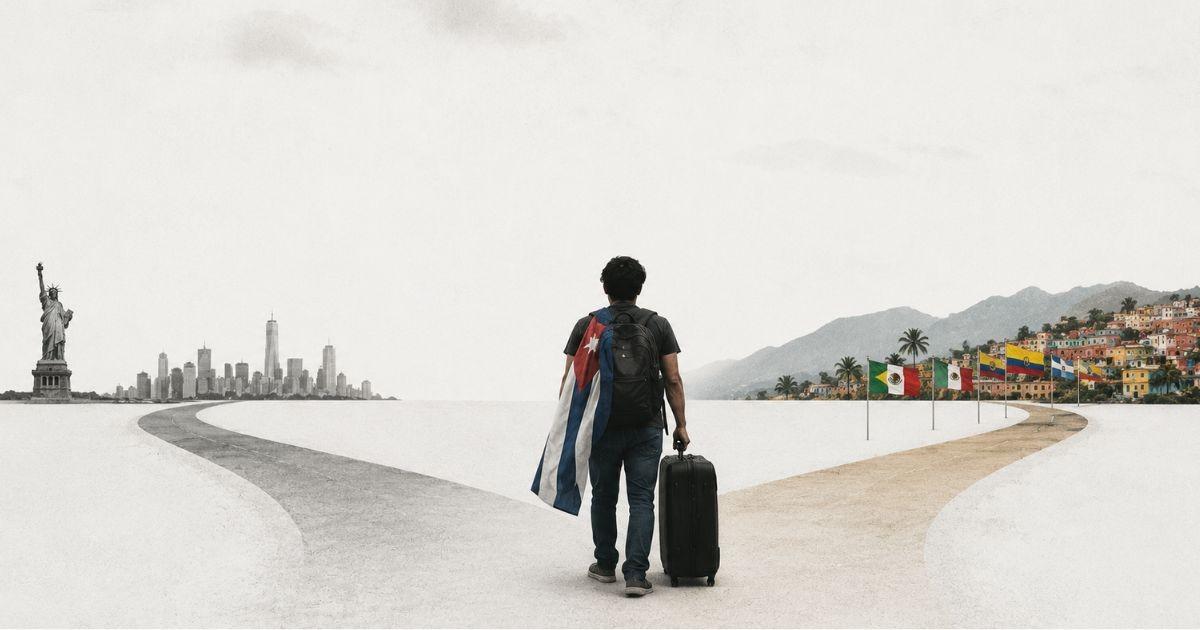
The Cuban poet Juan Carlos García Guridi shared a poem this Thursday, written in May 2023, that addresses a wound that does not heal: the pain of staying in Cuba as the country empties of people.
The composition, titled "Catarsis" and published on the author's Facebook profile, is written in décimas espinelas—a poetic form of ten octosyllabic verses with a long tradition of political resistance in Cuba—and accurately encapsulates the collective anguish of those who remain on the island.
García Guridi, born in Batabanó, Mayabeque, in 1968, is a poet, repentista, and literary researcher with more than a dozen published books on décima and Cuban folk poetry. The poem begins with an image of insomnia and sorrow: "Yesterday I lay down thinking / about how many people have left / and I couldn't sleep, / I was almost crying."
The pain intensifies when the poet turns his gaze towards the rafters: "Everything was harder when / I thought of the rafters / and of all those who / slowly perished mile by mile / never managing to set foot / on the other shore." It is not an abstract image: according to the International Organization for Migration's Missing Migrants Program, at least 142 Cuban rafters died attempting to cross the sea in 2024.
The poet describes himself as someone who remains in Cuba with "divided blood," facing a sea that invites him to cross "but I don't cross / I no longer know if it's because I'm naive / or because fear protects me." This ambiguity between illusion and fear reflects the paralysis of thousands of Cubans who contemplate migration without taking the leap. In 2024, 251,221 Cubans emigrated according to the National Office of Statistics and Information, and the island's population fell from 10,055,968 to 9,748,007 inhabitants in just one year.
"Catarsis" is not just a lament for those who have left but also a denunciation of the enforced silence. "I have no other activism / than my books. The sadness / lies in the fact that my mind / is a separate graveyard / and a pain that is shared / among rubble and weeds," writes García Guridi, before arriving at the central verse: "To endure in silence / is not worthy of a medal: / A poet when silent / dies but from silence... / I do not condemn myself to die, / it doesn’t matter if I don’t leave."
The poem also quietly inquires about those no one names: “[…] silently I wonder / who -amidst this matter / that slices me to the bone- / thinks of the mother of the prisoner / and the mother of the deceased.” Two figures that encapsulate the double tragedy of Cuba: political repression and death at sea.
The text resonates in 2026 with a strength that its author may not have fully anticipated. The U.S. Department of State warned in August that Cuba is experiencing a severe crisis, a direct result of the ruling regime, its failed economic model, and its incompetence. The Cuban Observatory of Human Rights estimates that 89% of the population lives in extreme poverty, and the informal exchange rate of the dollar has surged to over 670 pesos in recent weeks.
García Guridi published a series of protest poems in 2026 that gained widespread attention. In July, his poem in décimas "I ASK" generated a wave of reactions among his followers. One reader wrote: "The most brutal torture that can be inflicted on a human being is happening in our country; we have nothing left." Another commented: "God, how much suffering is in those verses! We all ask ourselves so many things daily. But no one has an answer; only uncertainty is present in our lives."
"Catarsis," written three years before this encounter with its readers, concludes with a desire that sounds like a utopia in Cuba in 2026: "I want to live, / and sing, and smile, / in a Caribbean corner / from where in search of a dream / no one has to leave."
Related videos:
Filed under: