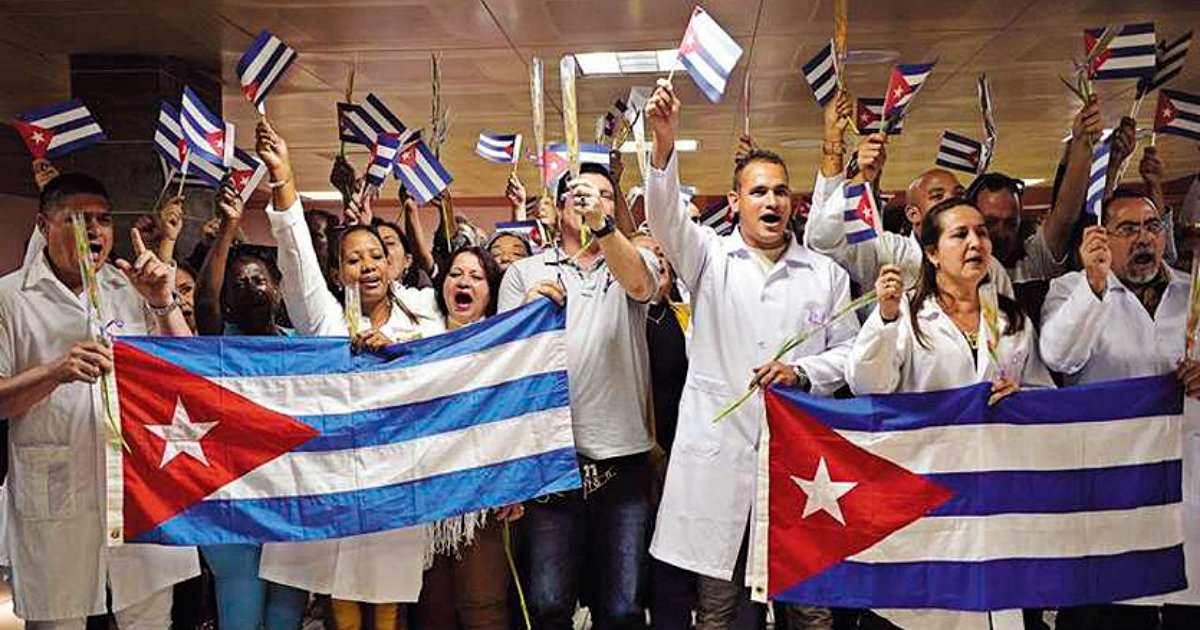
Nathalys Anchia Guerra, a specialist in Internal Medicine residing in Spain since 2021, published a post on Facebook where she details the migration control mechanism that the Cuban regime applies to emigrated doctors, which, in practice, sentences them to a permanent exile: returning to Cuba entails the risk of being trapped on the Island indefinitely.
The doctor reports that Cuban specialist doctors—except for those in Family Medicine—are classified as "regulated," a condition that prevents them from carrying out any immigration procedures, including obtaining or renewing a passport, without prior authorization from the public health system.
That authorization must go through a bureaucratic chain that culminates in a single individual: the National Director of Human Resources of MINSAP, identified as Marcos Agustín del Risco del Río, the only official with the authority to lift the restriction.
Anchia Guerra chose to request a temporary exit, the fastest option, because processing a permanent exit can take more than three years. However, when the deadline authorized by her workplace expires, a labor disciplinary procedure is automatically triggered that returns the doctor to the status of "regulated," even while outside the national territory.
The consequences are devastating: if you return to Cuba, you are once again subject to the restriction with no possibility of appealing to any authority. "Returning to Cuba, if you are a doctor, puts you at risk of getting trapped, even if all your family lives abroad and you have rebuilt your life outside," he warns.
The situation worsens because Cuban law suspends a doctor from their duties after 18 months of not practicing within the national territory, but there is no regulation that alters the status of being "regulated" in that case. The physician remains "a prisoner within the country where they were born, with no avenue for appeal."
An official from the MINSAP confided to a friend of the doctor that every time the issue was raised with the Minister of Public Health, the response was always the same: "Let them keep waiting."
Anchia Guerra directs her complaint to the European Parliament, Human Rights Watch, and the UN, among other international organizations, demanding that the consequences of these regulations be acknowledged and condemned.
"One of the most selfless and beautiful professions in the world becomes a prison, a kind of blackmail for those of us who wear the white coat," the doctor asserts.
"Cuban doctors in exile are, in practice, forced into exile. A forced banishment that feels omnipotent in determining our lives and those of our families," he concludes.
The complaint adds to a growing wave of similar testimonies that has shaken social media in recent months. In June, Dr. Alberto Tejeda Illas's open letter to Minister José Ángel Portal sparked a massive response from colleagues who identified with his situation. Tejeda has been receiving rejections for obtaining a passport for three years despite no longer having a contractual relationship with MINSAP.
The figures illustrate the magnitude of the problem. Prisoners Defenders documented 1,402 cases of Cuban professionals in the healthcare sector affected by these restrictions in a report from January 2024, compared to 110 cases recorded in 2019. Between 2021 and 2024, more than 77,522 left Cuba, worsening the crisis of the healthcare system on the Island.
The legal basis for these restrictions is Decree 306 of 2012, which classifies certain professionals as "vital" and conditions their departure from the country on the approval of their superiors. In 2023, the restrictions were expanded to include medical specialists, stomatologists, health technicians, and nurses, during an internal videoconference of the MINSAP in which "discretion" was specifically requested.
The new Migration Law No. 171/2024, published in the Official Gazette on May 5, 2026, does not resolve the situation, as the authorization still depends on the discretion of the officials.
Related videos:
Filed under: