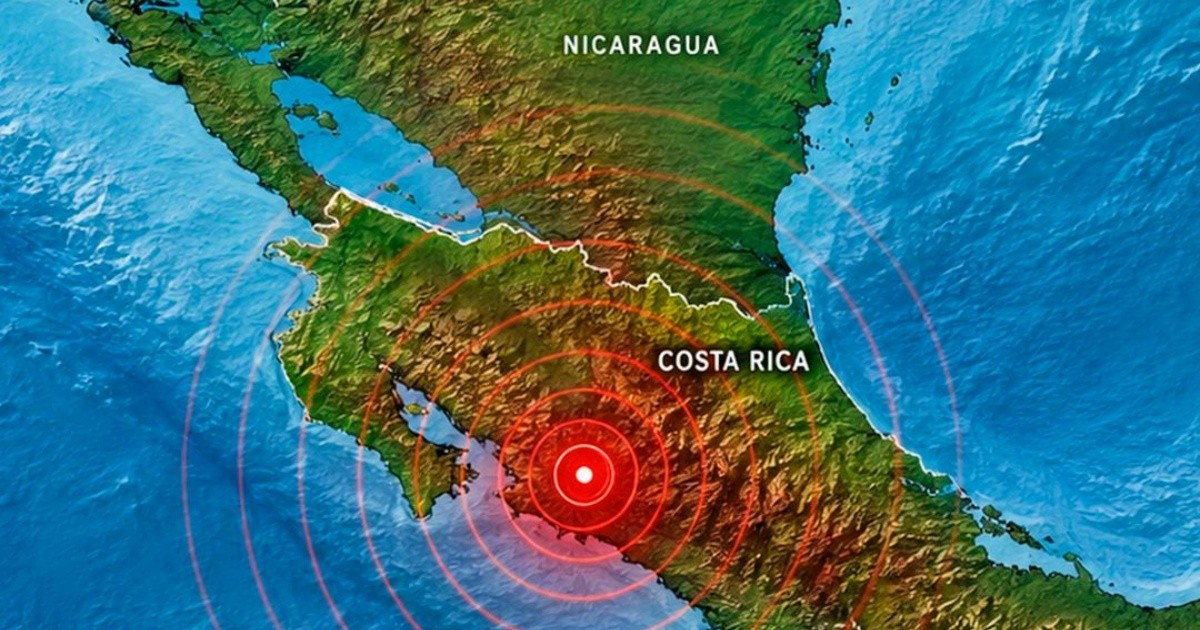
Two seismic events occurred just minutes apart, shaking the central area of Costa Rica early Monday morning, causing alarm among the residents of the Central Valley but resulting in no casualties or injuries, according to reports from the National Seismological Network and the Volcanological and Seismological Observatory of the country.
Earthquakes: Magnitudes and Epicenters
The first earthquake occurred at 1:37 a.m. (local time) with its epicenter in the Coronado area, San José province.
The National Seismological Network (RSN) of the University of Costa Rica recorded it with a magnitude of 5.4, while the Volcanological and Seismological Observatory of Costa Rica (Ovsicori), affiliated with the National University, reported it with a magnitude of 5.0 and located the epicenter eight kilometers northeast of San Isidro de Coronado.
The United States Geological Survey measured it at 4.9.
Two or three minutes later, a second tremor occurred, with a magnitude between 4.4 and 4.8 according to the consulted agency, also centered in the Coronado area and at a shallow depth.
Both earthquakes were felt in the Central Valley, where San José and the other three most important cities of the country are located.
Telemundo reported that the National Emergency Commission (CNE) received a single report of structural damage to the wall of a house in Vázquez de Coronado, in addition to the fall of a power line pole in San Vicente de Moravia.
The CNE also warned about landslides on Route 32 at the 30-kilometer mark and urged drivers to pass through that area with caution.
The Río Sucio fault, source of the tremors
The seismologist Lepolt Linkimer from the RSN explained that the earthquakes originated from the Río Sucio fault, an active lateral fault extending at least 14 kilometers and capable of generating earthquakes with a magnitude greater than six. Linkimer described the sequence as the most significant seismic activity recorded in that area over the past decade.
"They are earthquakes close to a local fault, very shallow; that’s why the population felt them strongly. They are sudden and very intense," the expert stated, as reported by La Nación.
Linkimer also warned that Costa Rica is a "highly seismic and vulnerable country" to earthquakes and urged the population to follow safety recommendations.
The RSN attributed the origin of the movements to a "failure in the crust of the Caribbean and Panama plates", according to CNN en Español.
The Central American country sits atop a complex tectonic boundary where the Caribbean continental plate converges with the Panama microplate, resulting in a system of active faults throughout the territory.
Replicas and seismic context
After the two main earthquakes, the RSN recorded at least 23 significant aftershocks during the early morning, while Ovsicori counted nearly 30, most of which were imperceptible to the population.
So far in 2026, Costa Rica had recorded 12 earthquakes of magnitude five or higher prior to this episode, the most intense of which was a magnitude 5.7 on April 15, with its epicenter in the Pacific Ocean off Playa Ostional in Guanacaste.
None caused material damage or injuries, according to the agency EFE.
The earthquakes on Monday occur within a context of intense regional seismic activity. On August 20, a 7.2 magnitude quake struck Ayacucho, Peru, leaving three injured.
Days prior, the 7.4 magnitude earthquake that devastated the west of Colombia on August 10 resulted in at least 294 deaths and 320 missing persons according to the National Unit for Disaster Risk Management of that country.
The RSN of the University of Costa Rica locates thousands of seismic events in the national territory each year; in 2023, it recorded 4,438 events, of which 153 were felt by the population.
Related videos:
Filed under: