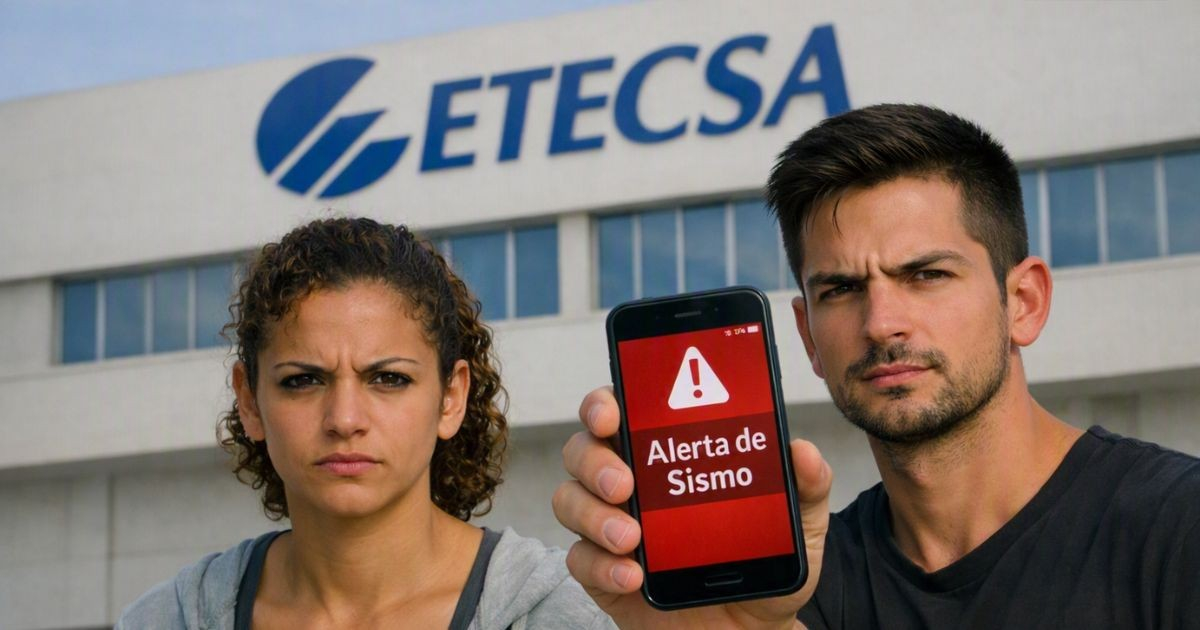
Three days after a false earthquake alarm caused panic throughout Cuba, ETECSA admitted that the incident was due to its own failure: the company's specialists accidentally activated the emergency messaging system while conducting tests on the telecommunications network.
On Tuesday, August 18th, in the afternoon, thousands of Cubans received an alert on their phones with a message urging them to remain calm and seek shelter in a nearby location, accompanied by an icon of a collapsing building. The Civil Defense clarified on the same day that the seismic alert was completely false and that no station in the national seismic network had recorded any activity that would justify it.
At first, official media and Cuban television pointed to Google as a possible source of the failure. However, Google categorically denied its involvement and confirmed that its platform had not detected any earthquakes or sent alerts on the island. It was only then that ETECSA issued its statement, admitting that "the messages were sent out due to a technical and human error, generated by our specialists conducting tests on the telecommunications network."
The public's response focused particularly on the consequences for sick individuals and residents in high-rise buildings. One user, who identified as having heart disease and hypertension, was even more direct: "a mistake that almost cost me my life."
The panic also resulted in scenes of physical danger. "Elderly people descended the stairs from the twelfth floor in Ciego de Ávila, frightened by human error," described one netizen. Another summarized the collective damage: "It was an unforgivable mistake; it created panic in our population, which is already under enough stress."
One of the forum participants questioned, "And what about the sanctions? In my building, 12 stories high, we had to bring down sick people in wheelchairs, those who were bedridden, and elderly individuals from very high floors, not to mention the blood pressure issues that arose. And now what is the justification? The blockade?"
The delay in assuming responsibility was another target of criticism. "Acknowledging the mistake is vital for correction. It's just that it took [several days] to make the responsibility public in something so sensitive [...] And it wasn't just a few users... it was thousands across Cuba, maybe hundreds of thousands," noted a commentator. Another pointedly remarked, "If Google doesn't deny it, you continue lying and saying it was Google."
The demands for concrete consequences were recurrent. “They should take responsibility for putting an entire already mistreated and stressed population in jeopardy, a community that can’t handle any more scares. Please, sanctions are what is appropriate,” wrote an internet user. Others demanded compensation and asked if it was possible to sue ETECSA, the only telecommunications operator in the country.
The episode exacerbates the already damaged credibility of ETECSA, which in May 2025 implemented a controversial rate increase that partially dollarized access to the internet. The final irony came this Friday when the National Center for Seismological Research reported a real earthquake with a magnitude of 3.6 in Santiago de Cuba. Several users reported that the alert did not work this time: “Well, there was shaking in Santiago and the alert didn’t work. Another thing that doesn’t work.”
Related videos:
Filed under: