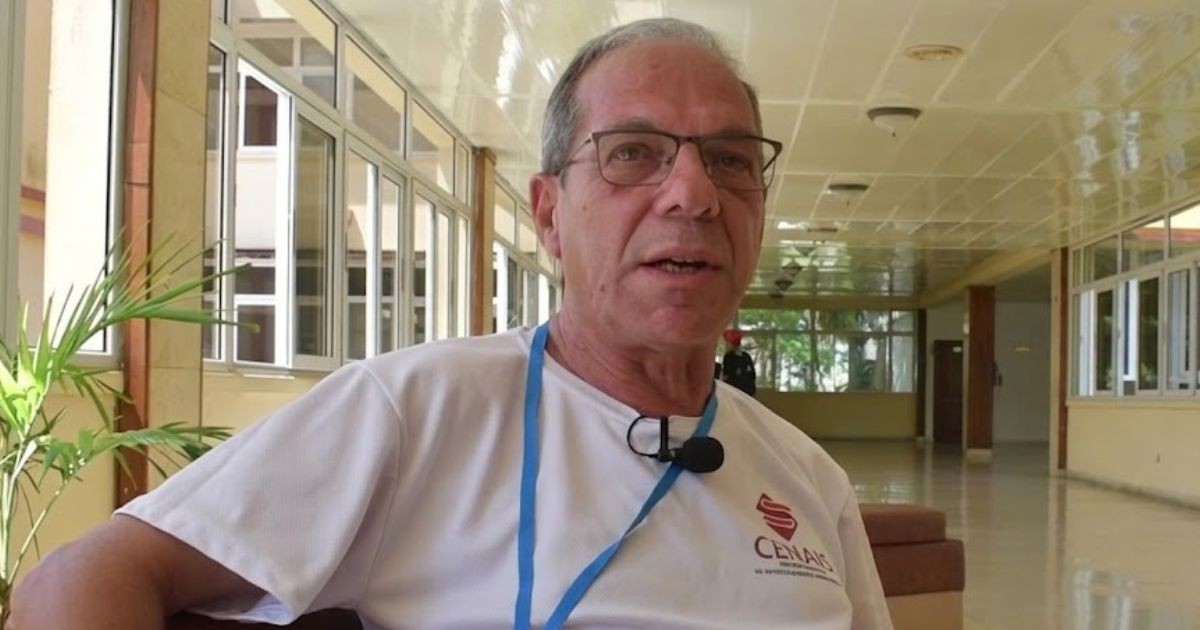
Enrique Diego Arango Arias, head of the National Seismological Service of Cuba, rejected this Saturday the official explanation from ETECSA regarding the false earthquake alert that shook the country on Tuesday, August 18, and stated on his Facebook profile that, in his personal opinion, the incident "was something malicious".
The state telecommunications company took responsibility for the incident on Friday, the 21st, attributing it to a "technical-human error" by its specialists during network tests, without specifying who authorized the test or what concrete measures would be taken to prevent a recurrence. This explanation, according to the public admission of ETECSA, also did not convince large segments of the citizenry.
"I am not convinced by ETECSA's statement regarding the causes that triggered the false earthquake alarm last Tuesday, August 18," wrote Arango Arias, who clarified from the beginning: "I have the flaw of saying what I think, and if someone doesn't like it, I'm sorry."
The scientist presented five reasons to question the technical error. The first points to the timing of the incident: "Never before in Cuba has something like this happened; it is too coincidental that it only occurs when the population is in a situation of extreme stress for known reasons." The second highlights the context of high worldwide seismic activity, which makes the alarm "entirely believable" for Cubans.
As a third point, he recalled that «recently in Venezuela and Colombia, this alarm was effective, when earthquakes struck these countries, resulting in substantial loss of life and property damage.» On June 24, 2026, two powerful earthquakes with magnitudes of 7.2 and 7.5, occurring less than a minute apart and centered in northern Venezuela, caused the Android Earthquake Alert System to send notifications to millions of phones in the region. In Colombia, the natural disaster, with a magnitude of 7.4, occurred on August 10.
The fourth point is particularly striking: "Phones have various alerts implemented in their operating system: for crises, earthquakes, wireless emergencies, among others, and it just so happens that the one that is triggered is the earthquake alert." The fifth argument refers to the political context: "The country is under constant attack to seek the overthrow of the government by any means necessary. Every day we are being monitored by drones that have even penetrated national territory."
Based on those five elements, the head of the Seismological Service reached his conclusion: "[...] it was something malicious, from outside or from within, to create chaos among the population at this time or to test a method that could be used for other purposes at another time." However, he left open the possibility of being mistaken: "It is possible that I am wrong; if it was truly a technical-human error, my apologies. Nevertheless, the reality is that the alert caused chaos throughout practically the entire country, not just in several areas, as has been stated."
Arango Arias also clarified a technical aspect that many Cubans are unaware of: "This seismic alert or alarm operates after the earthquake has already occurred; it is not a prediction of earthquakes. It is independent of the records from seismic stations. Cell phones function as seismic sensors, and when a significant number of phones detect the vibrations, the alert is triggered." This explains why CENAIS and the Civil Defense were able to immediately confirm, on August 18 itself, that no actual seismic event justified the alarm received on the mobile phones.
The public reaction was intense from the very beginning: the comedian Ulises Toirac publicly criticized ETECSA following the incident, and numerous Cubans demanded explanations from the state-owned company. Before ETECSA took responsibility, Google had denied that its Android alert system had sent the notice in Cuba.
The scientist emphasized that his analysis is a reflection of his professional responsibility: "I conduct this analysis due to the direct relationship this situation has had with my responsibility at the helm of the National Seismological Service and the monitoring of the international seismic situation and its impact on the Cuban population."
Related videos:
Filed under: