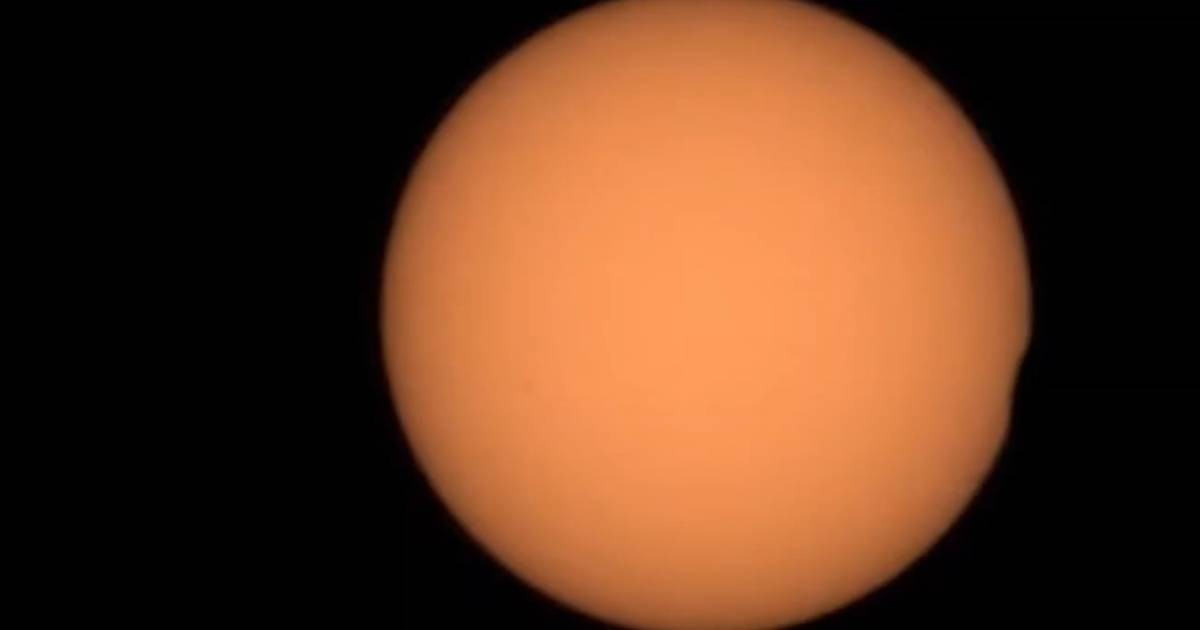
One of the most striking astronomical events of the year will arrive in South Florida on Thursday night: a nearly total lunar eclipse will be visible from Miami-Dade, Broward, and Palm Beach, starting at 9:23 p.m. with its peak occurring shortly after midnight, reported Telemundo 51.
From Miami, the Earth's shadow will cover almost the entire diameter of the Moon, and the eclipse will reach a magnitude of 0.93, making the phenomenon visually resemble a total eclipse, even though it technically is not.
The Moon will delve deeply into the umbra—the darkest part of Earth's shadow—leaving only a small fraction illuminated directly by the Sun. This almost complete immersion is what can cause the lunar surface to take on reddish, coppery, or orange hues near its maximum.
Key schedules for South Florida
The event will take place in clearly defined phases throughout the night:
9:23 p.m. — Start of the penumbral eclipse. The Moon enters the Earth's faint shadow; the change will be almost imperceptible to the naked eye.
10:33 p.m. — The partial phase begins. The shadow starts to visibly cover the lunar disc, and the spectacle becomes evident.
12:12 a.m. (early hours of Friday the 28th) — Maximum of the eclipse. The Moon will be about 51 degrees high towards the south-southeast, a very favorable position for observing it from the metropolitan area.
1:51 a.m. — End of the partial phase.
3:01 a.m. — Conclusion of the penumbral eclipse.
In total, the phenomenon will last approximately 5 hours and 38 minutes, with a spectacular partial phase lasting about 3 hours and 18 minutes.
Where to look and what to expect
At the beginning of the eclipse, one should face east-southeast. As the night progresses, the Moon will rise and move southward, so that at the peak of the coverage, it will be in a favorable position for any observer in the metropolitan area.
It won't be necessary to go far away to a place with a completely clear horizon to enjoy the main part of the event; however, it is advisable to find a spot away from bright lights to enhance the experience.
The good additional news is that the entire eclipse will be visible from start to finish in South Florida, as long as the clouds cooperate.
The enigma of time
The weather forecast introduces some uncertainty. The models indicate about a 50% chance of rain or storms in rural areas of Miami-Dade on Thursday, with partially cloudy periods expected in the evening.
However, the extended duration of the phenomenon works in favor of observers: even if a cloud temporarily obscures the Moon, it is likely that breaks will appear in the sky between 11:30 p.m. and 12:30 a.m., right around the peak.
Why the Moon can appear red
The reddish coloring that the eclipsed part can take on has a precise physical explanation. Part of the sunlight passes through the Earth's atmosphere before reaching the lunar surface; this atmosphere easily scatters the blue wavelengths and allows the red and orange light to pass through, which ultimately gets projected onto the Moon.
The result is, as the source describes it, "as if all the sunsets on the planet were reflected on the surface of the Moon at that moment."
This eclipse concludes an exceptionally active August in astronomical terms: the total solar eclipse on August 12 was visible as a partial eclipse from Cuba and the Caribbean, and the event this Thursday completes the so-called "eclipse portal" of the month. The times for Havana are practically identical to those for Miami, as both cities share the same time zone.
Related videos:
Filed under: