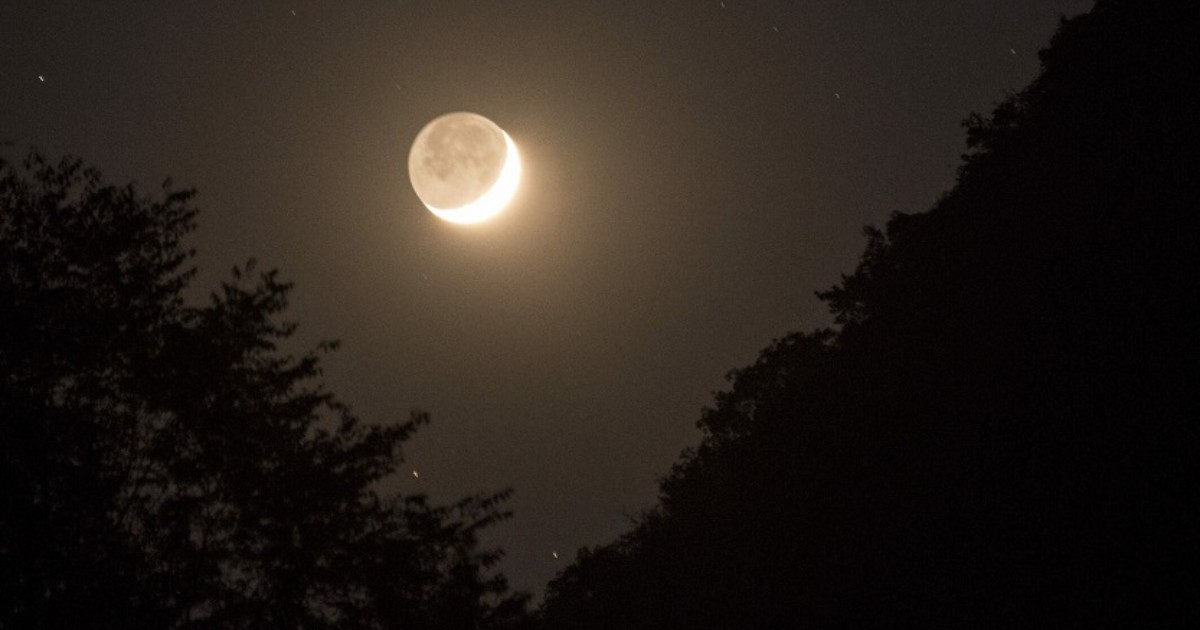
A partial lunar eclipse will be observable from all of Cuba between the night of this Thursday and the early morning of tomorrow Friday, with a very deep coverage of the lunar disk and several hours to enjoy the phenomenon.
Granma reported, based on data from the Institute of Geophysics and Astronomy (IGA), that the eclipse will be visible in the national territory throughout all its phases.
According to the schedules released by that institution, the Moon will start to enter the Earth's penumbra at 9:22 p.m. on Thursday.
The peak moment will occur around 12:12 a.m. on Friday and the complete exit from the penumbra will happen approximately at 3:03 a.m.
- 9:22 p.m.: onset of the Moon's penumbral phase.
- 12:12 a.m.: maximum of the eclipse.
- 3:03 a.m.: moon's exit from the penumbra.
NASA's calculations closely match these times: they place the beginning of the penumbral phase at around 9:24 p.m. and the maximum at approximately 12:13 a.m. Eastern Time, which currently aligns with Cuba's time.
In the point of greatest obscuration, nearly 93% of the Moon's diameter will be within the umbra, the darkest part of the Earth's shadow. Although it will not become a total eclipse, visually it will come very close to one.
Additionally, EFE reported, citing the Cuban Meteorology Institute (Insmet), that the Moon will remain within the deep shadow cone for three hours and 18 minutes.
The agency also noted that the phenomenon will be visible from various areas of America, Europe, and Africa, and that NASA estimates that over 3.3 billion people will be able to observe some of its phases.
During a lunar eclipse, the Sun, Earth, and Moon align, and our planet casts its shadow on the lunar surface. The eclipsed portion may take on reddish or coppery hues due to sunlight filtered through the Earth's atmosphere.
Unlike a solar eclipse, the lunar eclipse can be observed directly and does not require glasses or special filters. A clear sky and a location with low light pollution can enhance the experience.
There is, however, a discrepancy in one of the reports released this Thursday. EFE, citing Insmet, noted that the peak occurred at 11:13 p.m. Cuba time.
That schedule does not match the data from the IGA released by Granma or the calculations from NASA, which place the peak around 12:12-12:13 a.m. on Friday.
The phenomenon can also be observed from South Florida. In Miami-Dade, Broward, and Palm Beach, the eclipse is expected to be visible from start to finish, provided that weather conditions permit.
The eclipse this Thursday marks the end of a particularly active month for astronomy enthusiasts, following the total solar eclipse on August 12, which could be partially observed from Cuba and other areas of the Caribbean.
Related videos:
Filed under: