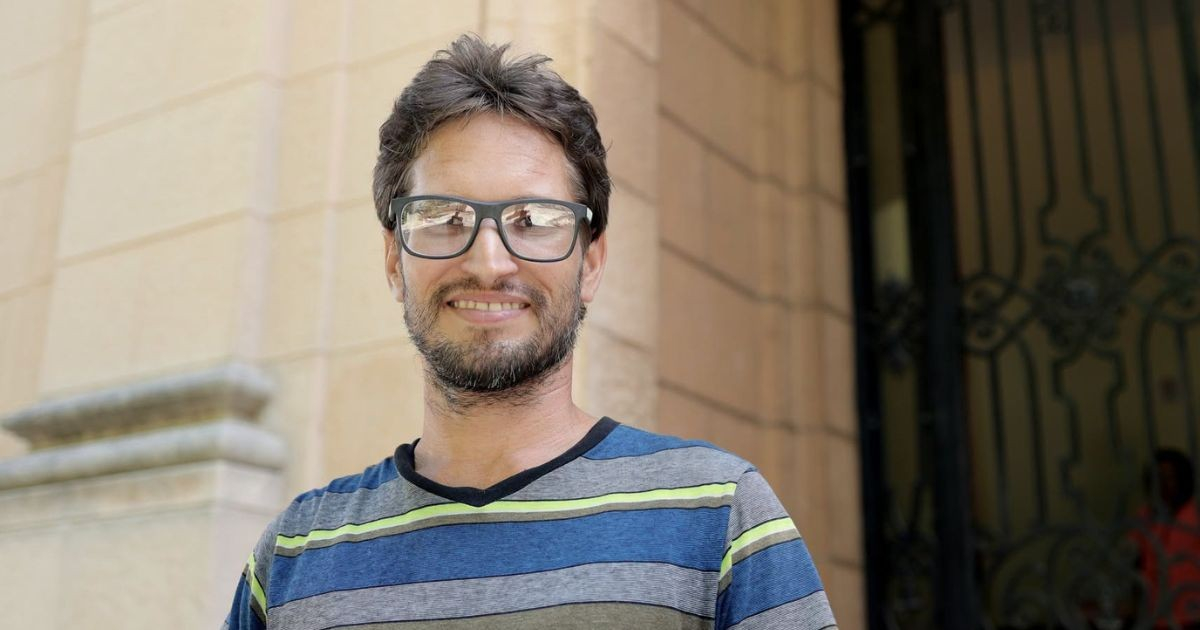
A young Cuban scientist acknowledged that the majority of the professionals he graduated with no longer work in the country, a loss of human capital that he attributed, among other reasons, to low research salaries and the search for better economic conditions.
The testimony of Manuel Cruz Rodríguez, a graduate in Mathematics and a master in Numerical Mathematics, was shared this Thursday by Armando Rodríguez Batista, the current Minister of Science, Technology, and Environment (Citma), as part of a series dedicated to the Institute of Cybernetics, Mathematics, and Physics (ICIMAF).
Cruz, who also serves as the secretary of the Scientific Council of ICIMAF, spoke openly about the brain drain of professionals trained in Cuba and the challenges of retaining them within the state scientific system.
On that subject, he stated bluntly that most of his fellow graduates no longer work in the country.
Some pursued master's or doctoral studies abroad, while others sought alternatives that would allow them to improve their economic conditions because, as the scientist explained, the salaries allocated to research are insufficient.
"They are very good professionals, recognized and in demand out there, and those are skills that are being lost in Cuban science," Cruz lamented.
The publication is particularly significant because it comes from the head of the organization responsible for directing Cuba's scientific policy and acknowledges, through the testimony of one of its researchers, a problem that has affected universities and research centers on the island for years: the sustained exit of highly qualified professionals.
The institutional text itself acknowledges that “it is imperative to improve the economy of those dedicated to science in Cuba” and recognizes the need to compensate them better in accordance with their contributions and the conditions in which they work.
Cruz's personal situation reflects several of those difficulties.
The mathematician expressed his hope that over the next five to ten years conditions in Cuba will improve, specifically mentioning the coverage, amenities, and electrical stability necessary to focus on research without worrying about water or keeping the cell phone charged.
Despite this, he remains connected to ICIMAF and hopes to pursue a doctorate in a subject he is passionate about.
That project, however, also competes with his family responsibilities: the scientist acknowledges that his young children take up a good portion of his time, and he does not want to take that away from them.
His wife also belongs to the scientific sector and works at the Center for Molecular Immunology (CIM).
According to the publication, Cruz is actively involved in the care and education of his children so that both can continue to develop their respective careers.
In the professional sphere, he is part of a team that uses numerical mathematics and computational simulations to test numerous alternatives before resorting to physical experiments, a methodology that allows for the conservation of materials and other laboratory resources.
These models can also be used to predict behaviors and reduce risks in certain technological applications.
But that activity takes place in a sector that, as acknowledged by the very text disseminated by the minister, faces technological obsolescence, deterioration of workplaces, and loss of talent.
Warnings about the exodus of Cuban professionals is an old issue that has persisted for years.
In January 2023, a professor from the University of Havana made a desperate call regarding the departure of teachers and specialists, warning about the loss of valuable personnel and the enormous difficulties in replacing professionals with years of training and experience.
The problem has also reached scientific areas directly linked to essential services.
In that regard, Cuban meteorologists warned in 2025 about the loss of specialists caused by low salaries, lack of resources, and the exodus of professionals, a particularly critical situation in a country that is regularly exposed to hurricanes, droughts, and other extreme weather phenomena.
Furthermore, the departure of young people is also part of a much broader demographic phenomenon.
Recent data from the Center for Demographic Studies showed that half of those who emigrated from Cuba in 2024 were under 35 years old, a particularly important segment for the renewal of the country's workforce and professionals.
Related videos:
Filed under: