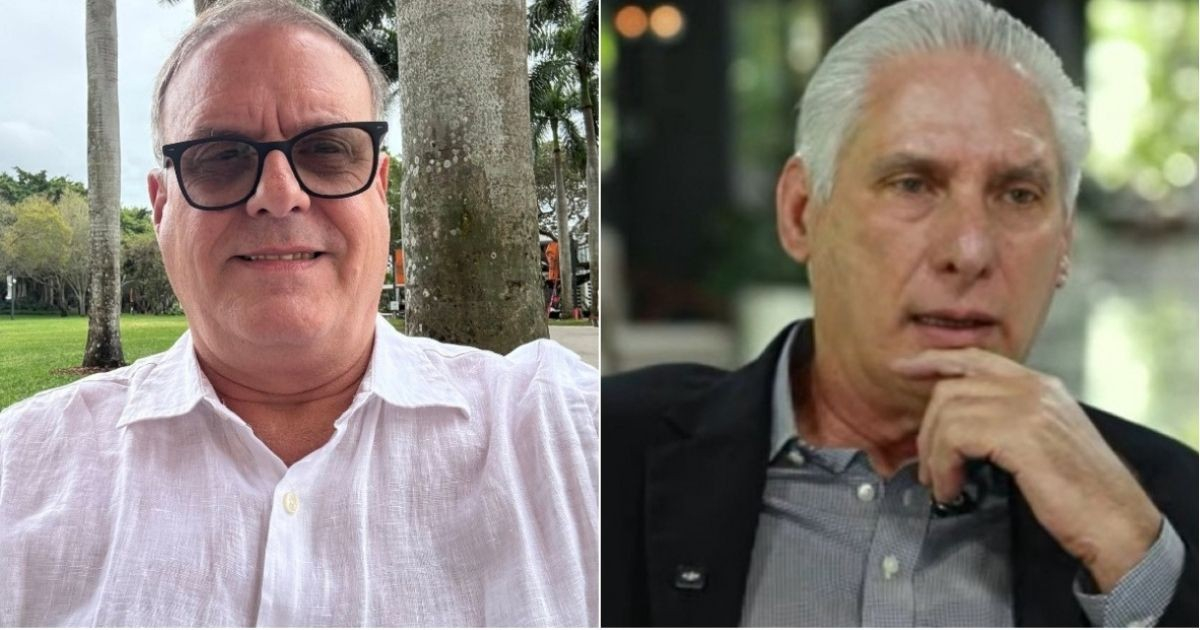
The Cuban economist Mauricio De Miranda Parrondo published an analysis on Facebook in which he refutes the statements made by Miguel Díaz-Canel during the interview with the Brazilian newspaper Folha de S.Paulo, conducted by journalist Mônica Bergamo.
De Miranda, a full professor at the Pontificia Universidad Javeriana de Cali and a doctor in International Economics from the Complutense University of Madrid, was straightforward from the beginning: "Cuba has an appointed president—who is not elected no matter how much he claims otherwise—who provides figures of unknown origin, which in the best case shows ignorance and in the worst, deceit."
According to the academic, one of Díaz-Canel's mistakes was claiming that Cuba had an illiteracy rate of 40% before 1959. The 1953 Census of Cuba recorded that figure at 23.6% among individuals aged ten and older. According to data from the Pan American Union, the Island ranked fourth in literacy in Latin America at that time, only behind Argentina, Chile, and Costa Rica.
Another lie from the ruler was claiming that Cuba reached 1959 with only 50% electrification. De Miranda contradicts him with the Demographic Yearbook 1958-1959 from the United Nations, which records that 82.9% of Cuban homes had electricity that year. The economist adds sarcastically: "What good is it that 100% of Cuba is 'electrified' if electricity is only available 10-20% of the time or less?"
He also refutes that the income gap in Cuba is smaller than in any capitalist country, pointing out that the regime does not provide the United Nations with data on poverty or income inequality. "Allow an independent scientific study, and then we can talk!" he demands. Despite the lack of data, he asserts that just by looking at the reality of the Cuban people, it is evident that "the vast majority of the population lives in conditions of multidimensional poverty."
Regarding political systems, Díaz-Canel stated that in France the president is elected by Parliament—which is false, as the president is elected by direct universal suffrage—and that in the United States the people cannot choose candidates, ignoring the primary system. De Miranda describes both errors as "mistakes that reflect ignorance even on elementary issues."
The point that the economist considers most revealing is the statement from the leader that the private actors in the Cuban economy are "necessary concessions". De Miranda warns those who invest on the Island: "Beware, investors, beware, small and medium entrepreneurs; beware, private business owners: your security hangs by a thread of 'political will'. Tomorrow, that will may change, and you could be left 'hanging by a thread'."
The warning is particularly relevant following the package of 176 economic measures approved in June, which includes the removal of the cap of 100 workers for small and medium-sized private enterprises and the authorization of direct foreign investment in the private sector.
The professor also questioned the ruler's assertion that "socialism has not been allowed to develop" and recalled that between 1965 and 1989, Cuba enjoyed a "pipeline" of resources sent from the former USSR.
"During those years, Fidel's voluntarism (...) led the country's economy into a dead end and to the most visible condition of underdevelopment, which is the inability to develop. Cuba today is more dependent than it was in 1958, because the 'order and command' economic system destroyed the very foundations of the country's economy: the sugar industry, agriculture, and the entrepreneurship of a business class that managed to be dynamic, with all its ups and downs," he emphasized.
About Díaz-Canel's refusal to acknowledge the seriousness of the situation, De Miranda is blunt: «Díaz-Canel said that Cuba is not on the brink of collapse. No, it is in collapse. Can you mention anything that works besides the ability to repress dissent?».
In conclusion, the expert urges Díaz-Canel and his entire government apparatus to acknowledge that they have not been able to carry out the transformations that the country needs, either because they are not qualified or because they lack the necessary political courage. "When that happens, the best course of action is to step aside."
The Cuban intellectual Alina Bárbara López, for her part, reacted similarly, describing the interview as "the same lies, albeit increasingly shameless."
Related videos:
Filed under: