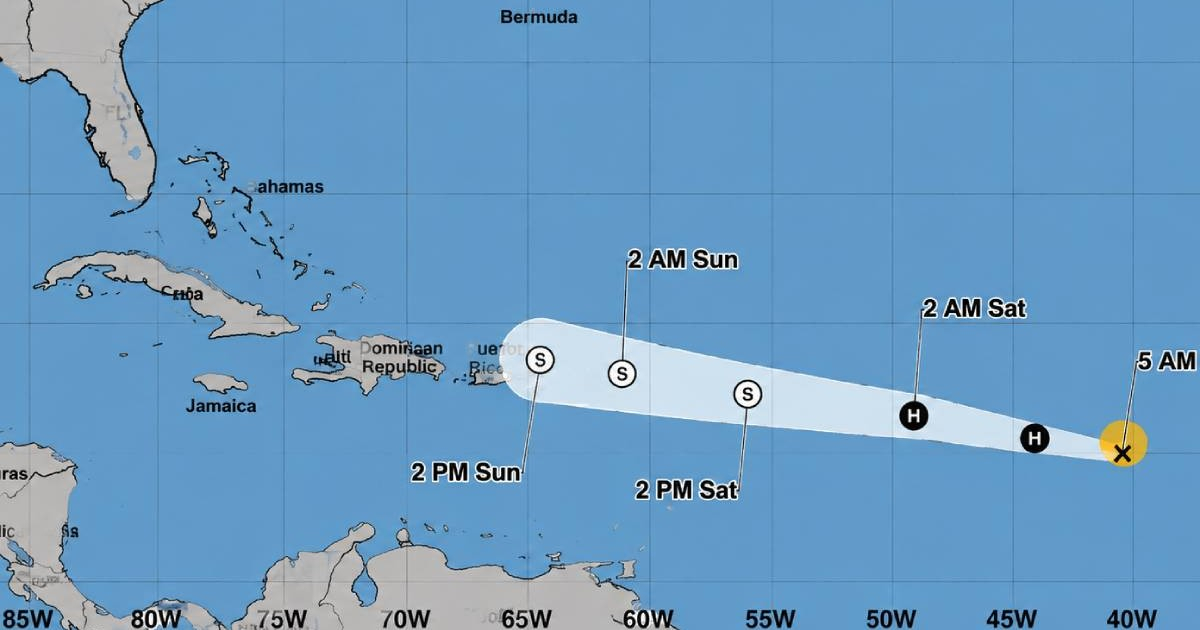
The tropical storm Dolly, the fourth named system of the Atlantic hurricane season 2026, downgraded this Friday to an open tropical wave, but its threat does not disappear.
The National Hurricane Center warns that the remnants of Dolly could bring heavy rains to the eastern Caribbean starting Saturday.
According to the fifth advisory from the NHC, issued at 11:00 a.m. AST on Friday, August 28, the remnants of Dolly were located near Latitude 15.0 North, Longitude 46.9 West and are moving westward at about 25 mph (41 km/h).
This movement is expected to continue over the next two days. The advisory confirmed the system's degradation to a tropical wave, although maximum sustained winds remain at 40 mph and are expected to drop below tropical storm strength by Saturday, August 29.
The main risk is flash flooding
These floods, according to the NHC, will primarily affect the areas of higher elevation. The Leeward Islands are expected to be the first to experience the impact, from Saturday night to Sunday, August 30, with possible extensions toward the Virgin Islands, Puerto Rico, and Hispaniola between Sunday and Monday.
The Cuban meteorologist José Rubiera had warned about the system since Thursday, in line with the NHC's forecast regarding the possible weakening of the system before reaching the Caribbean.
"There is a possibility that it will not arrive here as a tropical storm, but rather as a weaker system and possibly as a strong tropical wave," Rubiera noted.
Despite this weakening, the meteorologist was clear in urging caution: "The inhabitants of the Lesser Antilles, especially in the northeast and, to a lesser extent, Puerto Rico which is further behind, should be aware of the circumstances surrounding this tropical system whose trajectory is heading towards that area."
Dolly formed on Thursday, August 27 from tropical wave 96L, which had earlier reached a 90% chance of becoming a tropical cyclone. Since its formation, the NHC warned that conditions were not favorable for significant strengthening, which was ultimately confirmed with its degradation in less than 24 hours.
For now, the current forecasts do not indicate a direct threat to Cuba, but the population should stay informed because the Atlantic hurricane season lasts until November 30.
The Meteorological Institute of Cuba (INSMET) predicted in May a less active than normal season, with 11 tropical cyclones expected, five hurricanes, and two major hurricanes. It estimated a 75% probability that at least one tropical storm will impact the country during this period.
Related videos:
Filed under: