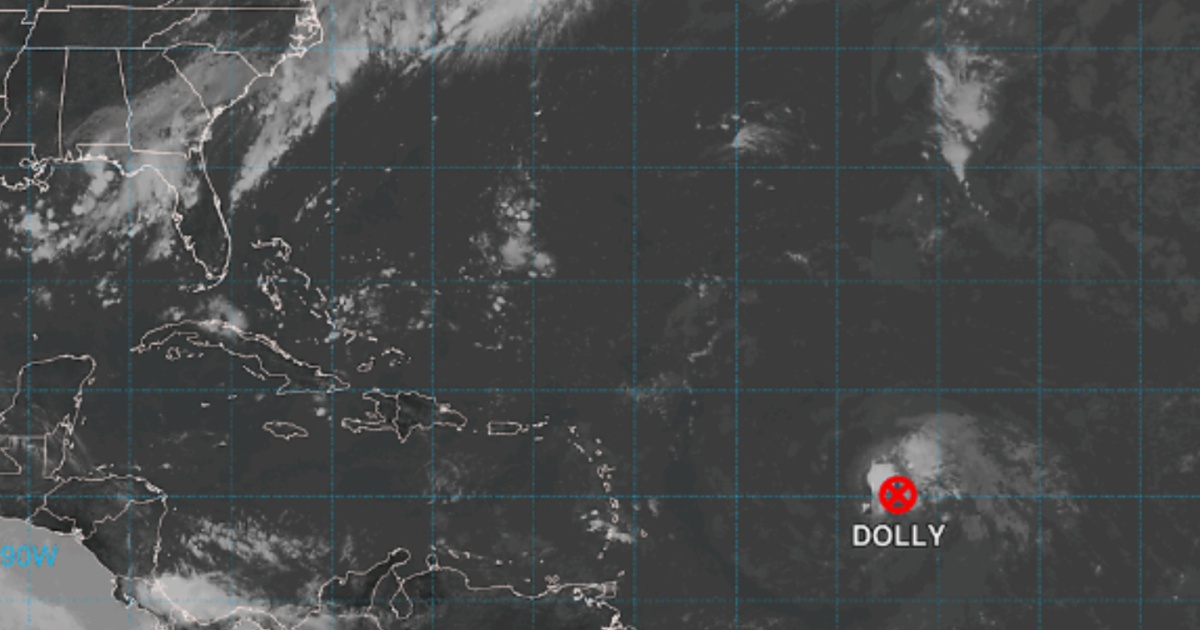
Tropical storm Dolly was downgraded to a tropical wave on Friday morning, as confirmed by the Cuban Meteorological Institute (INSMET) in its Tropical Cyclone Advisory No. 3, the last to be issued for this system.
INSMET explained that Dolly "has encountered unfavorable atmospheric conditions that have contributed to its progressive weakening" during its rapid movement westward across the central Atlantic.
At 11:00 AM on this Friday, the center of the system was located at 15.0 degrees North latitude and 46.9 degrees West longitude, about 1,610 kilometers east of the Lesser Antilles.
At its peak intensity, Dolly recorded maximum sustained winds of 65 km/h and a minimum pressure of 1,007 hPa, without reaching hurricane status.
The Cuban agency specified that the tropical wave will continue moving westward and will approach the northern part of the Lesser Antilles on Saturday night and throughout Sunday.
However, the forecast rules out any recovery of the system: "Throughout its trajectory, the atmospheric conditions will remain unfavorable, so no tropical development is expected for the system," stated INSMET.
The mechanism that caused Dolly's degradation was the combination of strong wind shear coming from the southwest and the presence of dry air, factors that the National Hurricane Center of the United States also confirmed in its analyses.
There are no active watches or warnings, and Cuba is not facing a direct threat from this system.
The main risk that remains is the possibility of heavy rain and flash floods in elevated areas of the Lesser Antilles, the Virgin Islands, Puerto Rico, and Hispaniola between Sunday and Monday.
Dolly was the fourth named storm of the 2026 Atlantic hurricane season, preceded by Arthur in June and by Bertha and Cristóbal in August, the latter also without any consequences for the Island.
The rapid dissipation of Dolly is consistent with the forecast for a below-normal season, largely attributed to the influence of El Niño, a phenomenon that increases vertical wind sheer in the Atlantic and hinders the organization of cyclones.
The INSMET had estimated in May 2026 about 11 tropical cyclones for the Atlantic basin, including five potential hurricanes and two of significant intensity, along with a 40% chance that at least one hurricane will impact Cuba before the season closes on November 30.
Related videos:
Filed under: