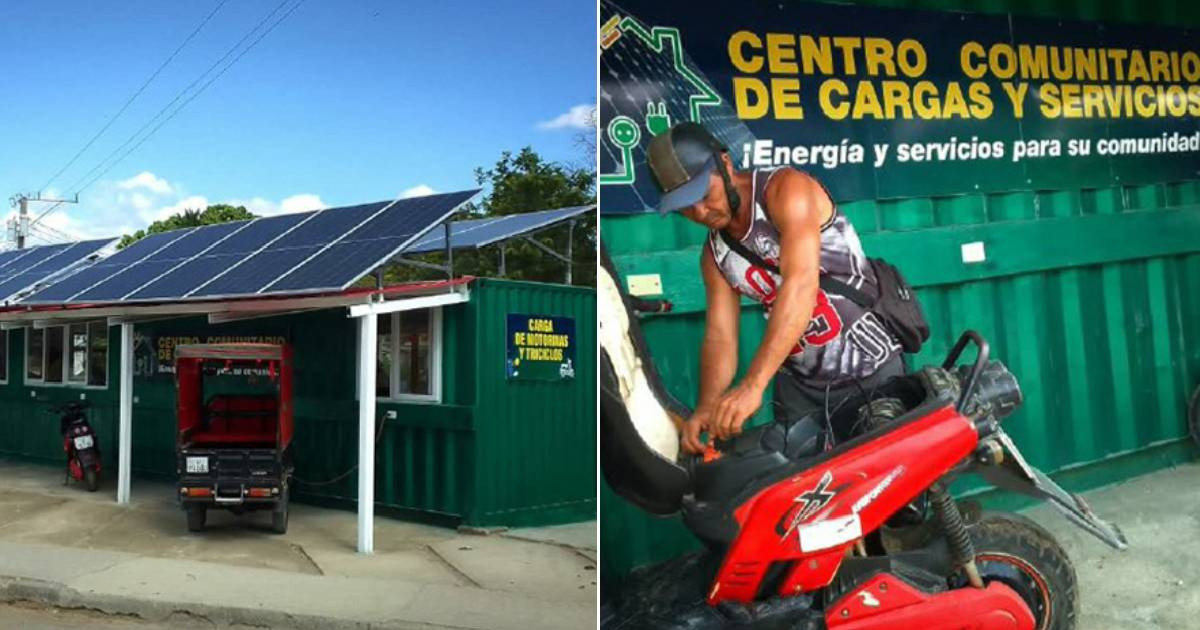
The province of Guantánamo has at least five community charging centers, popularly known as "solineras," operating in the municipalities of Maisí, Imías, and the provincial capital, while also planning to expand this network to reach around 30 locations throughout the province.
Most of these facilities are set up in repurposed shipping containers equipped with a 400-watt solar panel kit, three inverters, and four 15-kilowatt batteries each, which allows them to provide charging services and cooking facilities during the prolonged power outages affecting the region, explained the official newspaper Venceremos on Thursday.
The first center, located in the provincial capital, opened on July 25 at the intersection of Crombet and Martí streets, managed by the Mipyme Sabor Auténtico.
A second point, in the San Justo Popular Council, was inaugurated on August 12 and is already receiving up to 50 people per day, the report indicated.
His manager, Santiago Kindelán, explained the pricing policy of the establishment. While recharging a scooter costs 300 pesos per hour and an Ecoflow costs 200 CUP, "but we don’t charge for a fan or a lamp, because we always think it could be for someone sick, a child, an elderly person; many times, they are vulnerable individuals whom we consider even until they don’t pay," he explained.
In addition to the equipment rental, the centers offer cooking of food in rice cookers and multi-purpose pots, refrigerated storage for perishable products, takeout meals, coffee for 20 pesos, and soup for 50 pesos.
A neighbor from the area, Aida Limonta Lara, summarized the value of the service: "We come to charge our phones for free and the fans, which thanks to them we can sleep. Those who wish can have a coffee and their chocolate, they make a good stew."
The retiree Virgen Pérez also highlighted an unexpected benefit. "Since the project started, I have already received my check twice, an excellent idea for the community and the town, because it saves us from those long lines at the bank."
The progress exceeds the plan that the provincial authorities announced at the beginning of August, when it was reported that around 15 stations were being constructed in eight of the 10 Popular Councils of the capital, with a joint investment between state enterprises and private small and medium-sized enterprises amounting to approximately 25 million pesos.
The urgency of these solutions reflects the extreme energy vulnerability of Guantánamo, a province that relies on a single 110-kilovolt transmission line from Santiago de Cuba to connect to the national grid.
This fragility was exposed in June, when a shot along that line left the entire province without electricity, with some areas experiencing up to 33 consecutive hours without service.
The model of solineras is spreading across various Cuban provinces due to the regime's inability to address the underlying crisis. Villa Clara has already accumulated 46 solineras distributed across its 13 municipalities, prioritizing communities that experience power outages of 20 hours or more per day.
The proliferation of "solineras," a Cuban neologism that combines "solar" and "gas station," occurs as a decentralized response to Cuba's worst energy crisis in decades.
The official narrative portrays these initiatives as a response to the U.S. embargo, but it omits that most are operated by private small and medium-sized enterprises, not by the state, and that the structural energy crisis is the result, among other factors, of decades of poor government management and a high dependence on imported fuel.
Related videos:
Filed under: