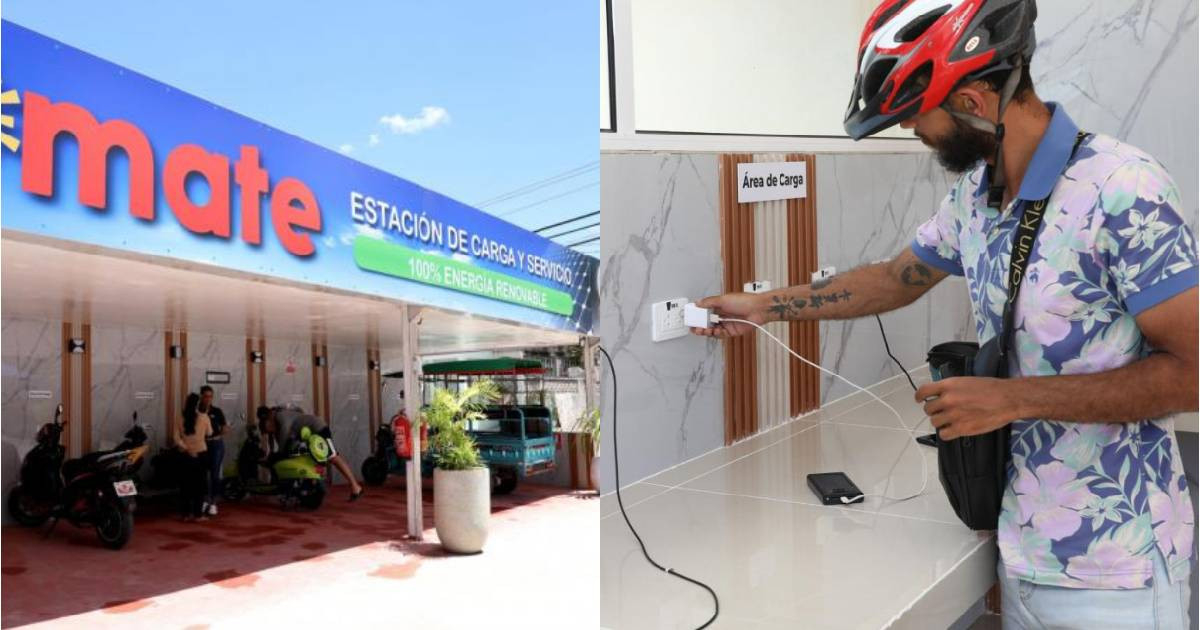
The newspaper Vanguardia, the official organ of the Communist Party in Villa Clara, presented this Saturday an "energy advance," highlighting that the province now has 46 operational "solineras" or solar charging stations, some located in communities subjected to power outages of 20 hours a day or more.
Armando Hernández Pedroso, provincial director of the National Office for the Rational Use of Energy (Onure), reported that the facilities are spread across the 13 municipalities of Villa Clara, with priority given to Santa Clara and other areas affected by prolonged power outages.
"The preference when creating these instances that greatly benefit the population has been those areas that experience daily blackouts of 20 hours or more," the official stated.
In those communities, solar charging stations allow for the free charging of cell phones, fans, and lamps, in addition to facilitating food cooking. The service for charging electric vehicles and bicycles does come with a cost.
Each installation has an average power of 10 kilowatts and 20 kilowatt-hours of storage, although some exceed those values, according to Hernández Pedroso.
The authorities plan to inaugurate in September a new charging station in each municipality of Villa Clara and four more in Santa Clara, with the intention of strengthening the province's position as one of the most developed in this model in the country.
The first solar station in Villa Clara was inaugurated on April 5 in the Virginia council area. The installation was completed in nine days by the Gomate Local Development Project and features 56 solar panels, 30 kilowatts of power, and 60 kilowatt-hours of storage.
Since then, other stations have been installed in neighborhoods such as Sandino, José Martí, and Ciro Redondo, including the first fast and ultra-fast charging station in the country for electric vehicles.
An element that the official narrative systematically omits is that the majority of the solar power plants are initiatives of private SMEs, not the State.
In July, the First Secretary of the Communist Party in Villa Clara, Susely Morfa González, celebrated on Facebook the inauguration of the LEOS gas station, operated by the private entrepreneur Leandro Prada Santana, and credited the achievement to the state Electric Company without mentioning it.
That contradiction was documented when the official wrote: "The Electric Company is an example of seeking alternatives and new services," actually referring to a private initiative.
The proliferation of "solineras," a Cuban neologism that combines "solar" and "gas station," is occurring as a decentralized response to Cuba's worst energy crisis in decades.
The National Electroenergetic System has experienced several total and partial disconnections over the past 18 months and daily records indicate significant generation deficits, resulting in ongoing blackouts that exceed 24 hours in various locations.
The situation worsened since January with the suspension of Venezuelan crude shipments and the cutoff of Mexican oil exports under pressure from sanctions imposed by the Trump administration.
Related videos:
Filed under: