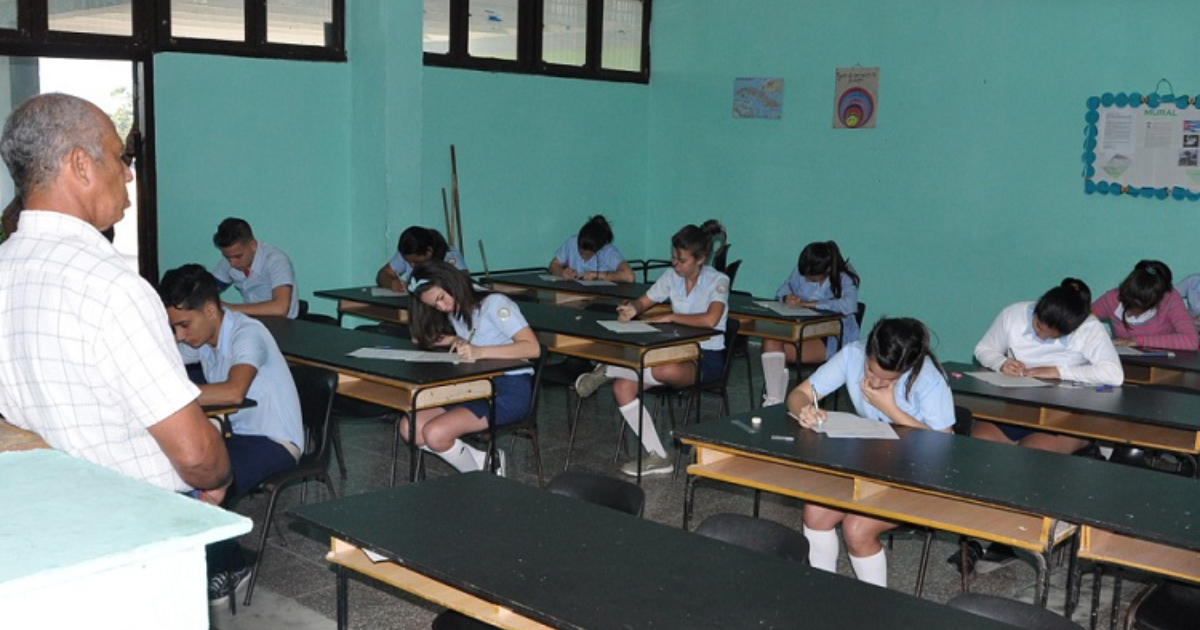
A few days before the start of the 2026-2027 school year, set for September 1, the Cuban activist Thais Mailén Franco Benítez posed a question that captures the feelings of thousands of families on the island: "Do you think that after more than 30 hours without electricity, teachers and students can perform well in a class?"
In her Facebook post, Franco was straightforward in listing the shortcomings that make a normal return to the classroom nearly impossible: "There is no electricity, no water, no food, no health services." The activist emphasized that teachers and students "have to face an increasingly difficult reality, where studying, teaching, and even getting to school becomes a daily challenge."
Franco's questioning did not go unanswered. Dozens of Cubans shared their own experiences in the comments, painting a picture of precarity that the regime prefers to ignore.
Verónica C. Barrios explained that her daughter only attends classes because their area is connected to the electrical circuit of a hospital, but the situation has conditions: "When there is no electricity: she doesn’t go. When there is no water: she doesn’t go. When I don’t have anything to give her for breakfast: she doesn’t go. When I don’t have anything for her to have a snack, or money for her to buy a snack: she doesn’t go."
Yunia Avila, the mother of a high school student, was even more emphatic: "He has been sleeping on the floor for over a month with hardly any water, and he goes because he wants to, because I'm not making him go."
Rina Gutiérrez summarized what many think: "Under these conditions, neither a child can learn nor a teacher can be in a position to teach a class. Hunger, heat, without any kind of comforts... I don't think it's possible."
The energy backdrop is devastating. On August 27, for instance, the electrical crisis left 65% of the island without electricity, with blackouts in some areas exceeding 30 consecutive hours this month.
This energy crisis is compounded by a teaching deficit that the regime has been unable to resolve: at least 24,000 teaching positions remain unfilled nationwide, which is equivalent to 12.5% of the total. In Camagüey alone, the school year will start with nearly 3,000 teacher vacancies to cater to over 95,000 students across 690 schools.
Faced with the magnitude of the crisis, the Ministry of Education acknowledged "exceptional" conditions and announced emergency measures: reduced class hours, flexibility in uniform usage — whose production would barely cover 20% of the student body — and the possibility of a single teacher attending to multiple institutions. The universities, for their part, will begin with hybrid or semi-presential models depending on the energy availability in each region.
It is not the first time that the energy crisis has impacted the education system. In May 2026, the government advanced the end of the 2025-2026 school year due to a lack of fuel and suspended university entrance exams, which were replaced by assignments based on the pre-university academic index.
Tony Cabrera, another Cuban who commented on Franco's post, pointed to a potential collective response: "The solution lies in the hands of the students' parents and teachers: to unite and declare that under these conditions, learning and imparting knowledge is difficult."
Franco's question remains officially unanswered: "How is a new school year supposed to begin under these conditions?"
Related videos:
Filed under: