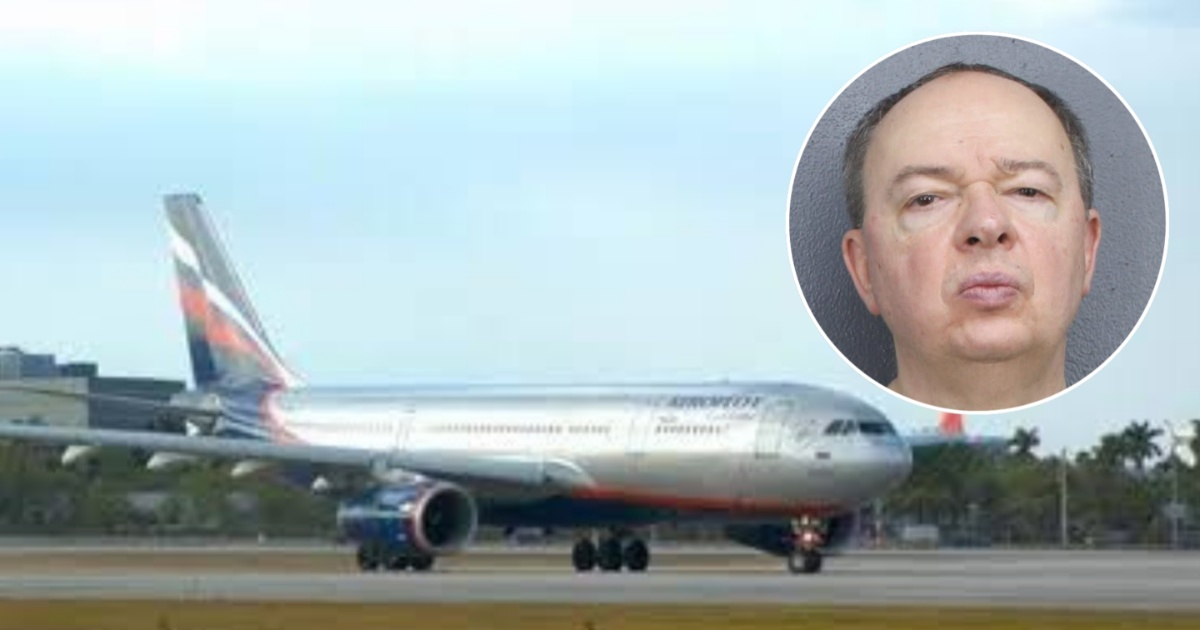
A federal jury found Alexander Mamonov, a 62-year-old Russian citizen residing in South Florida, guilty this Thursday of illegally exporting nearly one million dollars in aviation parts to Russia and the state airline PJSC Aeroflot, in violation of U.S. sanctions and export controls.
The verdict, issued in the Southern District of Florida, was unanimous on the 12 charges brought against Mamonov, which include conspiracy to violate the Export Control Reform Act, smuggling goods, submitting false export information, and conspiracy to commit money laundering.
According to court documents and testimonies presented during the trial, Mamonov is a former Aeroflot employee who moved from Russia to South Florida.
After the tightening of U.S. export controls — imposed following the Russian invasion of Ukraine in 2022 — he conspired with Ignat Vakorin, a Russian citizen who remains at large with an international arrest warrant.
To circumvent U.S. suppliers, both falsely declared that the shipments were destined for countries like the United Arab Emirates and China, when in fact the parts were being directed to Russia and Aeroflot.
The federal prosecutor for the Southern District of Florida, Jason A. Reding Quiñones, was emphatic in assessing the verdict: "Russia cannot evade U.S. sanctions and export controls by channeling its purchases through South Florida. You cannot put a false destination on a shipping label and make export laws disappear. This defendant conspired to secretly divert nearly one million dollars in U.S. aviation parts to Russia and Aeroflot, and then used false destinations and financial transactions to conceal what he was doing."
On his part, the Deputy Director of the FBI's Counterintelligence and Espionage Division, Roman Rozhavsky, warned that the case should serve as a warning: "Let this verdict be a warning to anyone considering smuggling American technology to our adversaries."
"We will continue to aggressively pursue those who use our district, our financial system, or U.S. businesses to undermine the national security of the United States," concluded prosecutor Reding Quiñones.
The formal charges against Mamonov and Vakorin were filed in April 2025. Federal Judge Kathleen M. Williams set the sentencing for November 20 of this year.
Violations of the Export Control Reform Act can result in up to twenty years in prison and fines of up to one million dollars per charge.
The case was investigated by the FBI Field Office in Miami with the assistance of the Bureau of Industry and Security of the U.S. Department of Commerce, which in 2022 issued measures against Russian airlines for operating aircraft in violation of export regulations.
This process is part of a broader pattern of Russian attempts to evade Western sanctions through intermediaries in third countries.
The Department of Justice has prosecuted similar cases in recent years: in January 2024, the owner of a company in Kansas pleaded guilty to sending airplane parts to Russia with false export forms.
In February of that same year, two Russian citizens in Florida admitted to exporting controlled aviation technology to users in Russia; and in February 2025, three individuals associated with a company in Ohio were charged with exporting approximately two million dollars in aviation parts to Russia.
Related videos:
Filed under: