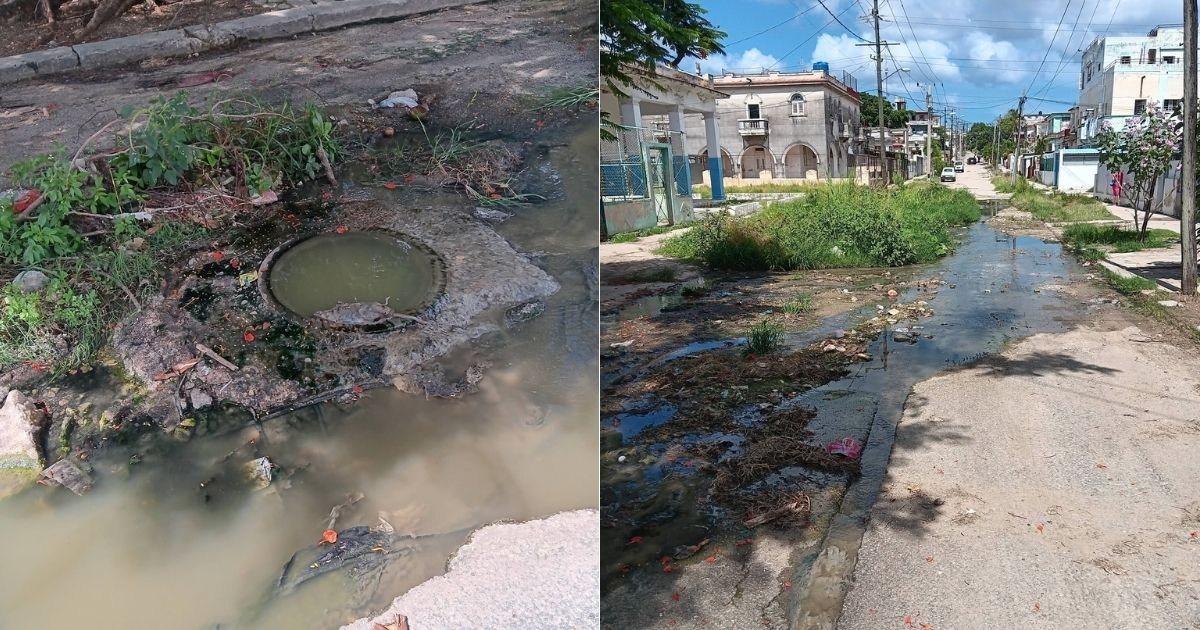
The writer, linguist, and translator Rodolfo Alpízar Castillo published an ironic complaint about the overflow of sewage at the corner of Figueroa and Luis Estévez, in the Santos Suárez neighborhood, municipality of Diez de Octubre, Havana.
The first words of his brief post say it all: "Beautiful tourist views." With that trademark irony, Alpízar described how the sewage waters "join with the potable water without prejudice, as a show of inclusivity," and warned that "the street no longer exists" at that point in the neighborhood.
The photographs accompanying the post leave no room for doubt: murky water of a greenish-gray color covers the pavement, a manhole cover is missing its metal lid and is completely flooded, the pavement shows severe cracks and sinkholes, and weeds are growing among the debris.
The punchline was as predictable as it was devastating: "Oh, I almost forgot: It's the blockade's fault." With that remark, Alpízar parodied the argument that the regime repeats like a mantra in the face of every calamity, from power outages to the collapse of transportation.
Internet users responded in kind. One asked with the same sarcasm, "With such beautiful resources, I don't know why tourists aren't coming." Another was more direct: "Even the blockade has erased the intelligence of many managers."
What Alpízar portrays is not a specific anecdote, but rather a symptom of structural collapse. The sewage system of Havana was built between 1908 and 1914 for a city of about 600,000 inhabitants; today, it must serve around two million people, with 1,755 kilometers of pipes in a state of obsolescence.
The municipality of Diez de Octubre is facing blow after blow. On August 20, a rupture in a 78-inch pipeline in Cuenca Sur left six municipalities in the capital without water, including this one.
On the other hand, over 80% of the water supply system on the island relies on electric pumping, turning every power outage into an automatic water cutoff. In July, more than 500,000 residents of Havana were experiencing supply issues.
Alpízar's voice is particularly uncomfortable for the regime because it cannot be dismissed as that of a "mercenary of imperialism": he is an intellectual who is a former vice president of the Literary Translators Section of UNEAC, a winner of the Aurora Borealis Award from the International Federation of Translators in 2011, and received the Distinction for National Culture in 2013.
As of 2026, the writer has created a lengthy, irony-laden chronicle of Cuban decline. In June, he issued five political demands to Díaz-Canel: amnesty, the enforcement of Article 56 of the Constitution, abolition of the death penalty, transparency, and a plebiscite. And at the beginning of August, he declined to participate in the 34th International Book Fair, with a statement that summarizes his position: "Every cent of the budget spent on the fair is, for me, a stolen cent from the welfare of the people. I will not support it with my presence, even if my gesture changes nothing."
His post about the sewage waters of Santos Suárez is the latest installment of that sharp and intense chronicle.
Related videos:
Filed under: