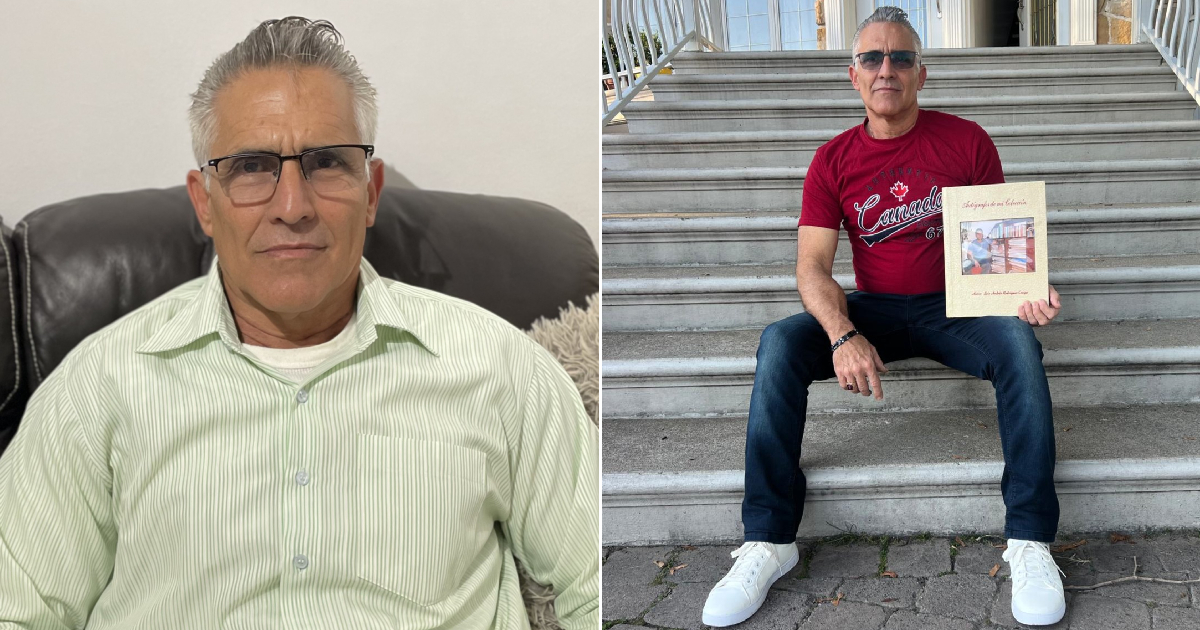
I met him more than two decades ago; he introduced himself during one of my visits to Santa Clara to cover the playoffs of Cuban baseball. A jovial and friendly person, with a firm handshake and then, solid hugs accompanied by wide smiles... I am talking about Luis Rodríguez Crespo, known as “Luisito, the Collector”, a historian of great figures in Cuban sports.
Who is Luisito? How and when did you start collecting photographs of famous athletes?
Luisito is just a simple boy from the Macuca neighborhood in Santa Clara, Cuba. I grew up playing baseball, with my father, Papín, as my role model. Later, I enrolled in the "Fructuoso Rodríguez" Sports School. I remember that the bus stop was in front of a small shop where they sold many sports magazines of the time, all the national newspapers, Bohemia, and other magazines.
I don't know why this caught my attention, and I started to buy and keep them. The posters that were featured in the magazine Deporte Derecho del Pueblo, which were in color, I would stick on the wall of my room on C Street #13. Then, one day, I started making small albums with some brochures using very low-quality glue.
As the years went by, I improved the album's construction using higher quality materials and binding. At this point, I would like to pause and thank my friend Rodolfo as well as Maikel for listing the albums. Over time, the albums have also been enriched with thousands of photos from the internet, but that wasn't the case before.
Which athlete did you start with, and when? Did Isis always support you, did your family support you, or did they say you were crazy?
The first albums I remember were from Víctor Mesa, Alberto Juantorena, and Javier Sotomayor. They were the most prominent athletes, and therefore, the ones I had the most material on. It was the year 1984, and I still didn't know Isis. My parents, since I was quite entertained, didn’t label me as crazy; being out on the street pursuing other "inventions" was less preferable than being with my collection. I remember perfectly that the first time I showed an album to an athlete was to Víctor Mesa when he lived in Santa Clara, on Avenida 7 de Diciembre, during his first marriage.
My father took me because I was very shy; just imagine, I was a young boy. At this point, when you ask me if anyone has called me crazy, I have an interesting anecdote. In 2017, I started building, as a mason, a room to store my sports magazines and the JIT newspapers in metal drawers. This way, I could also have better conditions and space to make the albums. None of this was easy due to the significant expense, but believe me, I have lived for this hobby without obtaining anything material in return; that's why I have mixed feelings about being temporarily separated from my prized collection.
What did it mean for you to show your work to that first athlete?
Imagine, Julita, me as a child practically inside the house of Víctor Mesa, none other than the best Cuban athlete of 1984. I truly have no words to describe such emotion. It's a pity I don't have any photos from that meeting because cell phones didn't exist, and I didn't have a camera or anything like that. Hahaha... I think he gave us coffee because my dad was really addicted to it. Subsequently, I maintained my friendship with Víctor until today.
Luisito, at first your hobby wasn’t that difficult: newspapers, magazines, other publications had photos, but then everything got complicated. How did you manage to put together those large albums? Did you get help with the binding, or did you buy them?
Yes, at the beginning and during the 80s there were many sports magazines. LPV, Deporte Derecho del Pueblo, Deporte en la URSS, Panorama Olímpico... There were also the LPV supplements that started to be published in 84-85. Later on, the newspaper JIT.
I also enriched the albums at the book fairs, and I can tell you that I have duplicates of absolutely all that bibliography, and I have kept that material with a love that no one can possibly imagine.
The binding began with a cousin of my wife who worked in graphic arts, El Chiqui. My eternal gratitude to him. Later on, over the years, I collaborated with my friend Rodolfo Pensado, who provided me with better materials; among them, sheets, glue, and vinyl (to cover the album), making the albums for me. He left Cuba, and I had to learn to bind on my own. I accomplished this with five albums, including, if I remember correctly, the one of the cyclist Arlenis Sierra.
What were you working on and how did you balance that work with your hobby?
Well, for 20 years I worked as a warehouse manager at three different companies: Mantenimiento Constructivo, Fusa (a furniture company), and CEDAI. The time I dedicated to putting together the albums was at night, whenever I had the chance, because there were always things to do at home. As you can see, my job had nothing to do with sports.
Do you currently live in Canada, or are you coming and going? Is the whole family already there?
I am currently residing in Canada, but my heart and soul are entirely in my home in Santa Clara. It's quite difficult to accept that we are far from Cuba. I am of a certain age now, and since we built everything there in our youth, I feel a deep sense of nostalgia.
Anyway, every time I can, I go back home; in 2025 I spent three months there and put together two albums, one for the classic wrestlers Filiberto Azcuy and Héctor Milián, both Olympic champions, with Fili being a champion twice.
And yes, we are all here. My son Luisín and his wife Ana Carla, my daughter Isita and my son-in-law Maikel; Isis, “my beloved friend,” and my grandsons Alex, who is seven, and Lucas, who is nine, both Canadians, are the joy of the garden, little devils of the highest order but very affectionate.
I imagine you can't put together any albums over there...
Here, it's difficult for me to put together albums because life is more hectic and complicated; it's a completely different system. Moreover, the origin and place of the albums is and will be at Mujica #108; I have no doubts about that.
I assume you weren't able to take any because of the weight, but if you could take one, which one would you choose and why?
If I'm being honest, I think it's impossible to bring them for several reasons. They are 72 albums of significant size and weigh a lot. On the other hand, from a more sentimental perspective, the birth and magic of those albums is in Santa Clara and nowhere else. I believe they will rest there forever, and that is my deepest wish. If I had to bring one, it would be the one I dedicated to GM Leinier Domínguez, which are actually two and are very complete.
I would like to tell you that I have 72 albums and I can easily reach 100 given all the material I have from many athletes. Baseball and athletics are the most numerous, with 27 and 13, respectively.
Migration and the passage of time have fragmented the history of Cuban sports. How do you manage to piece together those broken fragments in your albums and recover the names that the official narrative or forgetfulness tried to erase?
It's quite a complex question. The truth is that when I started creating albums, I had no other intention than to organize the images of my childhood and youth idols in a notebook. As time went by and I matured, I began to see things differently; I realized that I was helping to preserve the archives of Cuban sports, even though the sources of printed information were increasingly diminishing and national circumstances were wreaking havoc in sports.
I believe that as time goes by, my collection gains greater historical value because many factors have contributed to the forgetting of our sports glories and our most notable athletes. Today, no kid knows who Antonio Pacheco, Lourdes Gourriel, or Agustín Marquetti were, let alone when it comes to other sports.
And of course, they also don't know who Leinier Domínguez, Osleidys Menéndez, or even Manrique Larduet are. Many have emigrated, and their memory in Cuba has faded, or has been erased, however you want to put it. My albums help preserve the memory of everyone despite so many challenges.
Luisito, you who keep the glories of the past: Is the so-called "revolutionary sport" in Cuba officially dead or just in a coma?
Cuban sports, as we knew it, is in a state of severe decline and nearly dead. The incredible thing about our situation is that on the Island, great talents continue to emerge despite so many shortcomings. This issue pains us deeply, but unfortunately, the Cuban political system has not wanted to open up to the world or to professionalize everything. Times have changed, but in Cuba, they refuse to change anything, and that has taken its toll. The human resources are still there, but nothing more. It's an endless and cumbersome topic for which we have no solution and we don't foresee much hope.
Cuban sports in crisis, a country devastated... As a lover of Cuban sports, what do you foresee for the future?
This question is more complicated than the previous one. It is inconceivable that our country is currently experiencing the worst situation in its entire history. It is worse than the Special Period, Julita. Painful, sad, humiliating, shameful. A radical change in the system is needed for the Cuban people to live as normal human beings.
Of course, for that, there needs to be the will and desire which, I hope I am wrong, I see as far off. I don’t know what else to tell you about it; I don’t know much about politics, but I do see that people in our country suffer a daily ordeal. It's very sad, truly.
The day I met Luisito, I walked with him through Santa Clara, on that almost mystical route from Coppelia to the Sandino Stadium, and I attended a lesson in civility and Cuban pride.
For decades, in the privacy of his home or among his closest acquaintances, his obsession might have been labeled as madness. Who in their right mind would spend years, resources, and sleepless nights archiving newspaper clippings and photographs?
Today, time and history have vindicated his persistence. While the present of Cuban sports navigates through a landscape of uncertainties and heated debates, on Mujica Street, the memory remains intact and dignified; for within the bound pages crafted by this Santaclareño lie, safe from dust and forgetfulness, the great achievements of Cuban sports.
Related videos:
Filed under: