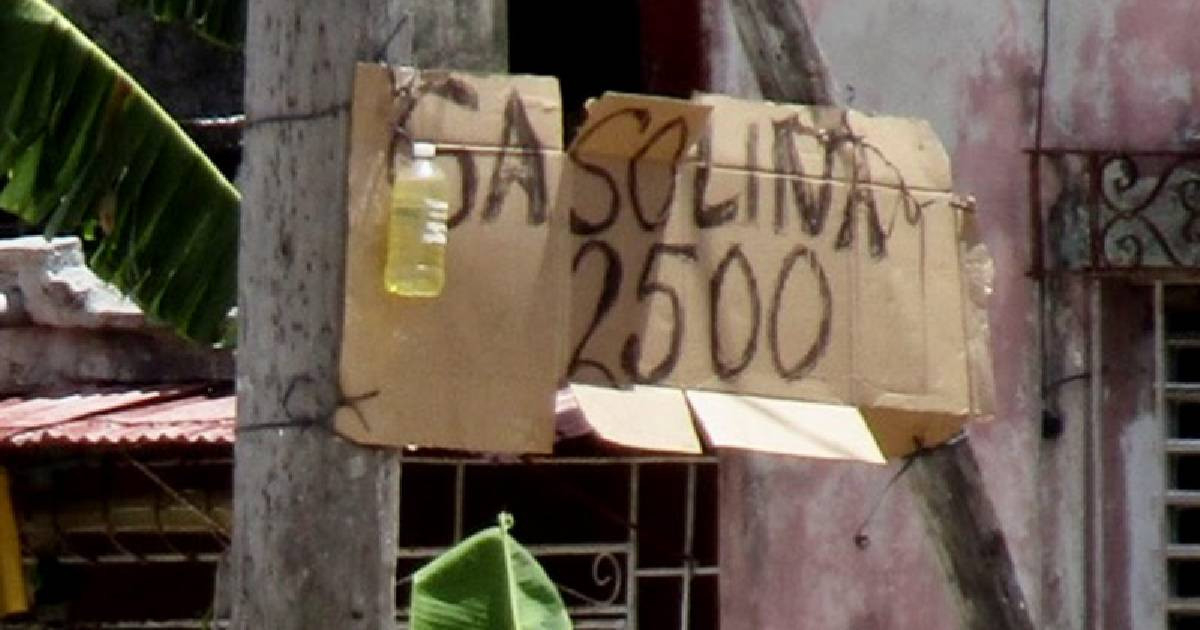
The sale of fuel by new economic players is proliferating in Holguín amid evident violations of the security measures established for its transportation, storage, and marketing.
According to a study published this Sunday by the official newspaper ¡Ahora!, there are "only a handful" of certified locations to store the volumes of fuel that are entering the territory through the new economic actors, despite the existing regulations establishing specific conditions for these facilities.
A source with extensive knowledge of the subject, whose name and the organization they represent were not disclosed, explained that a person can only transport up to 20 liters of gasoline in containers and no more than 200 liters of diesel. They also pointed out that it is not permitted to fill containers with quantities exceeding these limits at service stations.
The risk increases during the transfer of fuel. According to the source, a spark can occur during the discharge from a hose or nozzle into another container, even in the absence of a visible flame or a person smoking. For this reason, there are specific requirements for handling these products and for transporting the containers.
The problem, according to the same source, primarily arises at the final destination of the fuel. A supposed customer may buy 1,000 liters for personal use and later start selling it, while the place where they store the fuel does not qualify as an inspectable or certifiable facility for that activity.
The first fire inspector of Holguín, Rafael, provided documents outlining the general and specific requirements for the transportation of combustible substances, as well as the conditions that service stations and oil storage bases must meet. These provisions apply to both the state and private sectors.
The areas used for storing fuel must have adequate ventilation, fire extinguishers, proper signage, and clear boundaries. Furthermore, the individuals responsible for handling these substances must be properly trained.
However, only four fines of 60 pesos each have been imposed on the audit-able establishments. The investigation itself considered the amount to be laughable and warns that the penalties highlight the limited scope of control over an activity that, according to the sources consulted, presents numerous irregularities.
The regulations also establish measures for individuals storing fuel, including keeping containers in safe, cool, and ventilated places, never exposing them to sunlight and out of reach of children, as well as avoiding smoking near them.
The investigation also found difficulties in obtaining updated official information about the actions taken to address this situation. Some sources indicated that they needed authorization to provide data, while others did not respond despite repeated requests.
The report also highlights the responsibility of property owners who rent out spaces for these activities. Those who allow the irregular storage of fuel or hazardous materials on their properties may be held accountable for violations, while tenants are obliged to adhere to safety regulations and obtain the necessary certifications before operating.
The described outcome is a scenario in which fuel marketing expands, while the conditions required to ensure its storage and handling do not seem to keep pace with this growth, and the control measures implemented thus far are limited to four fines of just 60 pesos.
In June, during its third Ordinary Session of the X Legislature, the National Assembly of People's Power authorized non-state management forms to commercialize fuel as part of the country's new economic measures.
Such authorization requires adherence to strict regulations: the premises must be approved by the National Institute of Territorial Planning and Urbanism (INOTU) and certified by the Fire Department before commencing any storage or sales activities.
In mid-August, firefighters in Guantánamo warned about similar violations in private businesses across Cuba, due to the use of plastic tanks for large volumes, lack of grounding, and absence of containment walls.
In Matanzas, authorities recently initiatedfuel inspections on roadways to detect mixtures with stolen dielectric oil from transformers, in a province that accounts for 60% of the thefts of this product in the country.
According to data from Reuters, by the end of July nearly 200 Cuban companies had received authorization to distribute fuel wholesale, representing a rapid expansion of the sector that the regime's inspection and control structures have either been unable or unwilling to monitor at the same pace.
Related videos:
Filed under: