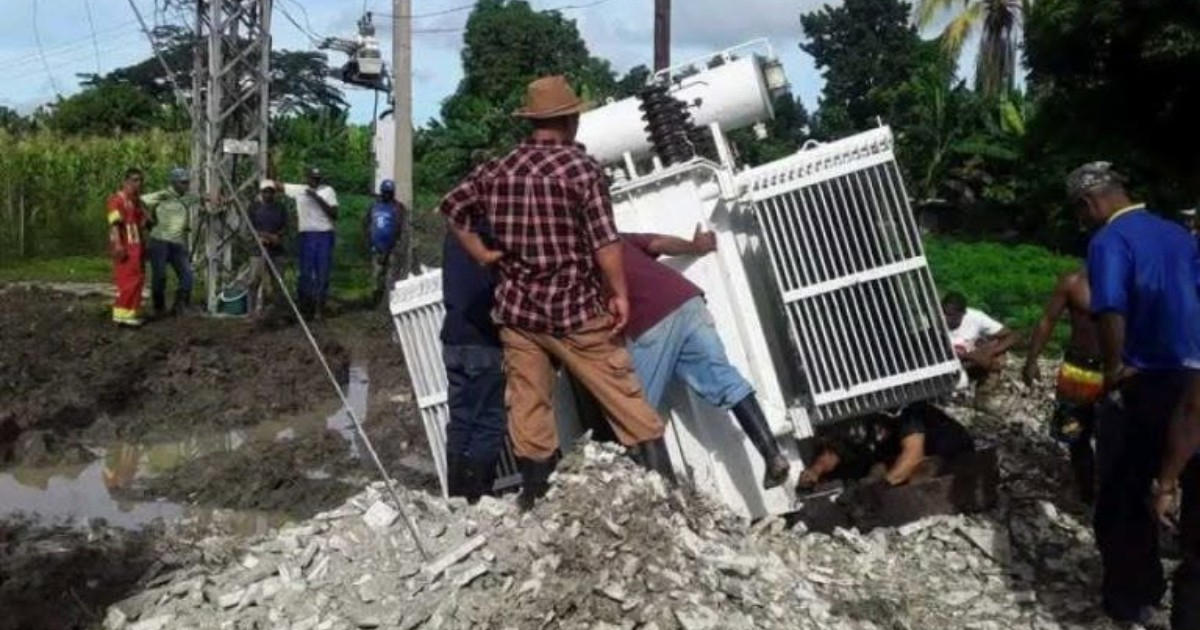
Santiago de Cuba ranks among the five provinces in the country with the highest incidence of dielectric oil theft from transformers, a practice that has left communities without electricity for extended periods and that Cuban authorities are treating as a sabotage offense.
The information was released this Monday by the Office of the Attorney General of the Republic and shared by an institutional profile of the Government in Santiago de Cuba.
Matanzas, Ciego de Ávila, Mayabeque, and Artemisa complete the group of territories with the highest incidence, but in Santiago, judicial proceedings related to this type of events have already been recorded.
This month, for example, it was reported that a man was sentenced to 12 years in prison for stealing 120 liters of dielectric oil in Contramaestre.
The robbery left more than 2,000 people in Bungo La Venta and nearby areas without electrical service for 48 hours.
Despite the seriousness of the matter, the release of the new data generated a variety of reactions among residents of Santiago de Cuba.
Some called for even harsher penalties for those who damage electrical infrastructure, with comments requesting sentences of 20 to 30 years or even life imprisonment.
Other users, however, focused their criticisms on the surveillance and the response of the authorities themselves.
A person stated that when neighbors report thefts of oil or street lighting equipment to the Police or the Electric Company, at times they do not receive a response.
"You call for no reason, and they don't pay you any attention," she lamented.
Another resident called for more night patrols by the Police and requested that the allocated fuel be used to strengthen the security of the facilities.
There were also testimonies about the consequences of the power crisis in the city. One user described the situation in high-rise buildings in the Garzón area, stating that the blackouts leave residents without water, elevators, and landlines, while some families have resorted to cooking with firewood.
According to that comment, the lack of elevators is particularly serious for patients and people living on upper floors.
The user stated that the complaints directed at the Communist Party and the Government have not resolved the issue.
Another person stated, "In my neighborhood, the blackout lasts 24 to 26 hours."
There were also those who, while supporting the condemnation of those responsible for the thefts, questioned the overall energy situation.
A user wrote that those responsible should receive a life sentence, but added: “Either way, we are always shutdown and who do we condemn for this apocalypse?.”
The reactions thus reflect two parallel concerns: on one hand, the rejection of the theft and destruction of an already severely damaged electrical infrastructure; on the other, the inaction of the regime and the dissatisfaction of a population that continues to face prolonged blackouts, water issues, and other challenges.
More than 300 reports of transformer oil theft in Cuba
According to figures released by the Prosecutor's Office, between 2025 and the first half of 2026, more than 460 criminal investigations were initiated in Cuba for crimes against the National Electric System (SEN).
Of these, more than 300 complaints specifically relate to the from transformers.
The investigations also include the cutting and theft of cables, wires, and screws from electrical networks, the removal of angles from high-voltage towers, and damage to solar photovoltaic parks.
The Prosecutor's Office warned that the consequences could extend far beyond the immediate loss of electric service.
The damage has affected thousands of families for extended periods and may cause disruptions in water pumping, communications, agricultural production, and other essential services.
In some cases, the agency added, the transformers are damaged to the point that recovery is impossible.
The authorities have also determined that part of the stolen oil ends up being sold in the informal market for use as fuel.
The Prosecutor's Office acknowledged another risk associated with these thefts: some of the perpetrators have died while attempting to steal components from facilities with live wires.
The institution also warned about the severe legal consequences for those who are prosecuted for such acts.
As of May 2025, the People's Supreme Court considers the theft, damage, or alteration of components intended for the electrical system and other critical infrastructures as sabotage.
Articles 125 and 126 of the Penal Code stipulate penalties for this crime that can range from seven to 30 years in prison and, in the most serious cases, life imprisonment or the death penalty.
In practice, the Prosecutor's Office indicated that 87% of the defendants charged in these cases were placed in provisional custody.
Moreover, all individuals judged in 2026 for offenses related to the SEN were sanctioned for sabotage, with sentences predominantly ranging from nine to 20 years of imprisonment.
The Prosecutor's Office stated that it will continue to enhance preventive measures, surveillance, and criminal prosecution of these crimes, reiterating that "there will be no impunity" for those who harm the National Electric System.
Related videos:
Filed under: