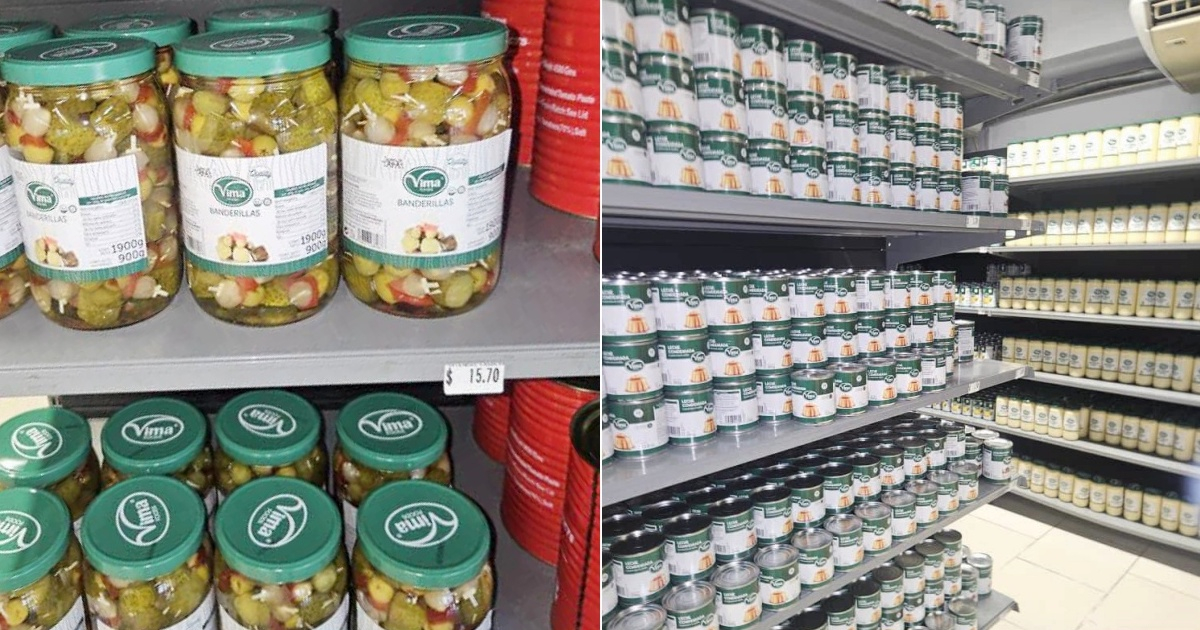
Vima World S.L., a Spanish food distribution group that supplies stores in foreign currency in Cuba and exports products to the island, hired a Washington lobbying firm in July.
The selected company, Continental Strategy LLC, is a lobbying firm, meaning it is a consultancy that represents the interests of businesses and organizations before lawmakers, officials, and other branches of the U.S. Government.
The chosen firm has close ties to figures in the circle of Secretary of State Marco Rubio and the White House, according to revelations from the U.S.-Cuba Trade and Economic Council after locating the registration submitted under the Lobbying Disclosure Act (LDA).
The LD-1 form submitted to Congress has an effective date of July 24, 2026, and was digitally signed on August 7.
In the document, Vima World S.L. is described as a company specializing in "food distribution and logistics focused on supply, import, and distribution" and states that it has contracted Continental Strategy LLC for $30,000 to manage matters related to domestic and foreign trade, the food industry—including aspects such as safety and labeling—and foreign relations.
The assignment can be summarized in one line: the search for "project opportunities in Latin America."
Cuba, the market from which nearly half of the group's revenue comes, is not mentioned anywhere in the document.
A firm with strong connections in Washington
The choice of Continental Strategy is particularly significant due to the connections of several of its partners with the current U.S. administration.
The firm was founded by Carlos Trujillo, former U.S. Ambassador to the Organization of American States (OAS) during the first Trump administration.
Trujillo also served as a state legislator for Florida for eight years, acted as the special representative of the United States to the 72nd United Nations General Assembly, and was later nominated as Under Secretary of State for the Western Hemisphere.
Trujillo summarizes the philosophy of the consultancy as follows: “We strive to achieve results, not just analyses or presentations, by combining deep sector knowledge with high-level access and a results-oriented mindset.”
The most striking connections with the current administration come from partners not listed in the Vima registry.
Alberto Martínez, managing partner of the Washington office, was a trusted advisor to Rubio for over a decade and chief of staff to the current Secretary of State in the Senate, where he "oversaw all aspects of the senator's legislative agenda, public policy initiatives, and communication strategy."
Martínez was also the chief strategist for the campaign that brought Rubio to the Senate in 2010 and has experience in three presidential campaigns and several state campaigns.
John Barsa, another partner, held senior positions in the Department of Homeland Security (DHS) and in the United States Agency for International Development (USAID).
In April 2020, he assumed the role of interim administrator of USAID by appointment of Trump and was a permanent member of the Deputy Directors Committee of the National Security Council.
Before that appointment, Barsa had been nominated and unanimously confirmed by the Senate as the Deputy Administrator of USAID for Latin America and the Caribbean, a position from which he led "policies and initiatives to promote democracy in Cuba, Venezuela, and Nicaragua", as well as economic development initiatives in the Western Hemisphere.
During her time at the helm of USAID, Barsa led an agency that, according to the profile compiled by Continental Strategy, had more than 10,000 employees and a budget exceeding $24 billion.
Y Katie Wiles, partner at the firm, is the daughter of Susie Wiles, assistant to the president and chief of staff at the White House since 2025.
The three lobbyists officially registered for Vima's account are Carlos Trujillo; Eric Farnsworth (who led the Americas Society/Council of the Americas office in Washington for over twenty years) and Francisco Petrirena, vice president of the consulting firm and former chief of staff to the City of Miami's administrator.
The silence on Cuba amid a storm of sanctions
The moment Vima formalized the contract coincides with a tightening of U.S. sanctions related to Cuba.
On May 1, 2026, Trump signed Executive Order 14404, which introduced secondary sanctions for foreign companies operating with blocked entities of the Cuban regime.
On May 7, GAESA, the business conglomerate of the Armed Forces, was designated.
On August 6—one day before the Vima registration was signed and made public—Tecnoimport and Tecnotex, two subsidiaries of GAESA dedicated to importation, were designated.
The Vima exhibition is dual.
Opera in Cuba through Vima Caribe S.A., whose local partner is Tiendas Caribe, an entity identified by specialized media as controlled by the military.
In addition, it exports agricultural and food products from the United States to Cuba through two subsidiaries called Vima USA Ltd, based in New York and Miami, which also makes it an operator under U.S. jurisdiction.
Commercial exports of agricultural and food products from the United States to Cuba were authorized by the Trade Sanctions Reform and Export Enhancement Act (TSRA) of 2000.
This legislation again allowed direct commercial sales of food—including branded products—and U.S. agricultural products to the island, subject to the payment terms and other requirements set forth by U.S. regulations.
In May 2024, Vima signed an agreement with Tiendas Caribe to manage 20 establishments on the island.
The Coruña branch of the group generated nearly 106 million euros in 2024, of which around 49 million came from operations with Cuba.
Washington's warning to foreign companies
While Vima was processing its registration, the Undersecretary of State for Western Hemisphere Affairs, Juan Pablo Segura, issued a clear warning:
"Foreign companies wishing to invest in Cuba must partner with a Cuban state enterprise, making them complicit in the dictatorship's corruption scheme. For this reason, the Trump Administration has imposed secondary sanctions on all companies that maintain trade relations with GAESA."
In that scenario, hiring a firm with close ties to figures in the Secretary of State's office and the White House could be seen as an attempt by Vima to safeguard its position in the face of tightening regulations, at a time when other Spanish companies—such as Meliá and Iberostar—have already begun to withdraw their operations in Cuba under the pressure of the same sanctions.
Related videos:
Filed under: