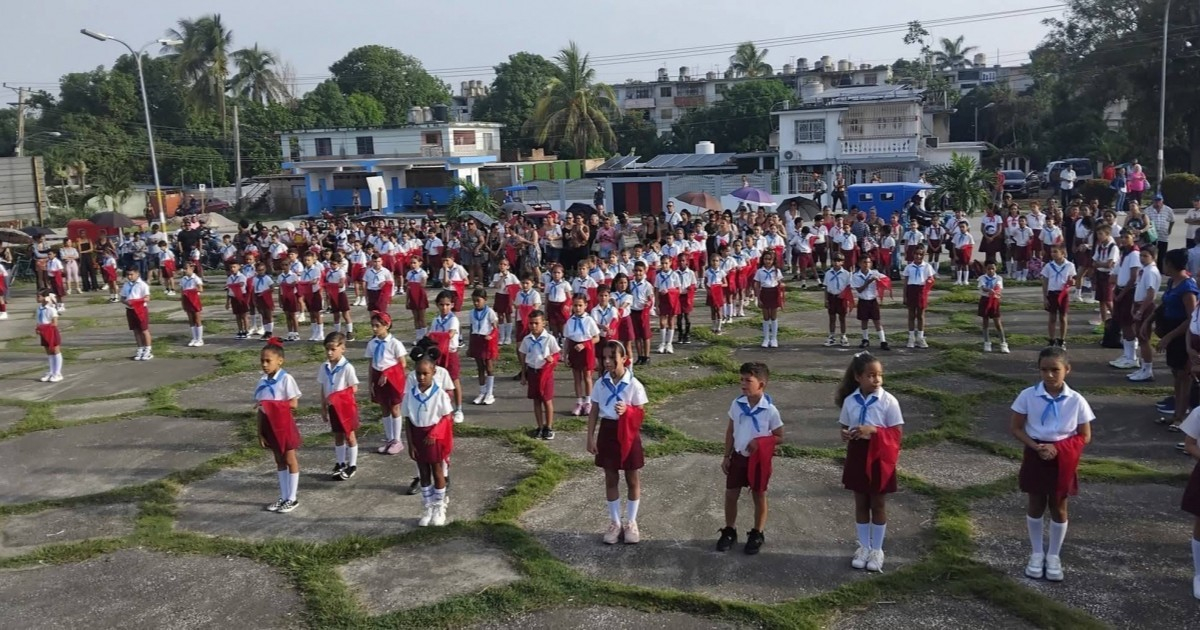
With a sharp phrase -“My girl is not going to school, I gave birth to her and she won't!”- a Cuban mother identified as Lety Lety summarized her initial stance regarding the start of the school year, which began on September 1.
However, her four-year-old daughter's desire outweighed all the hardships, and the little girl ended up attending classes.
The testimony published on Facebook describes a cascade of deprivations that make it nearly impossible to ensure a dignified school experience. The mother recounted that she had to "practically sell a kidney" to afford supplies, a uniform, and other basic materials, and that even so, she cannot guarantee the most essential items.
"How do I tell him that sometimes mom won't have anything to give him for a snack, that she won't even be able to take a shower in the mornings because we have no water, no gas, and sometimes not even charcoal to heat it?" she detailed.
Transportation is another insurmountable obstacle. “Mom doesn’t want me to walk to school because there’s no bus for my transportation and the scooter no longer has a battery, and Mom doesn’t even have money to buy another one,” wrote Lety Lety, who described the nights as “horrible with heat, sweat, and mosquitoes” due to the blackouts, which prevent the girl from resting.
"What do I do when I arrive and don’t have even a loaf of bread to give and have to undertake dark tasks, sweating profusely?" she emphasized.
Despite all the difficulties and anguish, it was the young girl’s own wish that tipped the scales.
"What should I do if my four-year-old girl wants to go to school?" wrote the mother, who ended her post with a thought-provoking question.
"How can this situation be normalized for our children?" she questioned.
The anguish of this Cuban mother reflects that of thousands across the country. The school year began on Tuesday amid blackouts that affected up to 70% of the national territory, with a available generation of only 960 MW against a demand of 2,910 MW and a projected deficit of 2,280 MW, according to the Electric Union.
The Minister of Education, Naima Ariatne Trujillo Barreto, admitted that the start of the school year would be under "very difficult" conditions and with "tremendous difficulties," contradicting her statements from days earlier when she had described the return to classes as "a great celebration."
The school system started with a teacher coverage of 73%, which equates to a deficit of at least 24,000 teachers, and only 20% of the students had new uniforms, as production reached between 2.2 and 2.3 million garments out of the 3.6 million needed.
The economic impact of the country's crisis on families with minor children is devastating.
Equipping a student in the informal market can cost between 15,000 and 20,000 pesos, with uniforms exceeding 5,000 pesos each, compared to less than 100 pesos for a complete set when available through state channels.
Supporting breakfast and snacks can exceed an additional 10,000 pesos per month, in a country where the minimum wage is between 2,100 and 3,210 pesos.
The World Food Programme reported that 48.5% of Cuban students aged six to eleven do not receive any meals or snacks at school, a figure that illustrates the magnitude of the problem faced by mothers like Lety Lety.
Related videos:
Filed under: