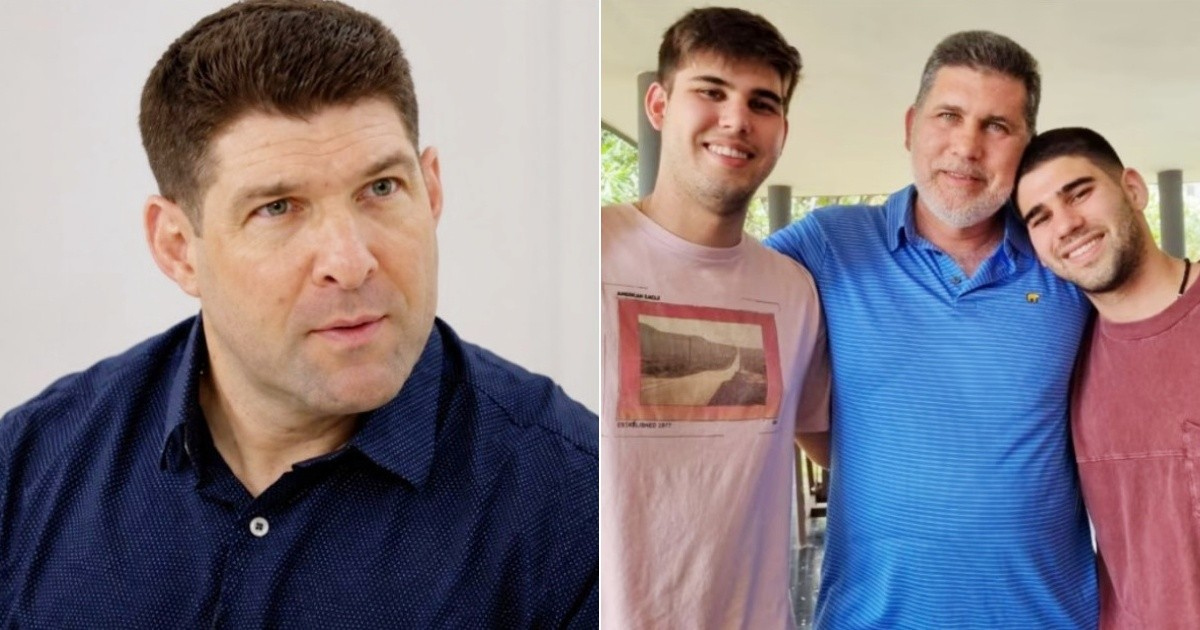
Raúl Guillermo Rodríguez Castro, known as "El Cangrejo" and grandson of Raúl Castro, maneuvered in communications with the U.S. negotiating team after FBI agents visited two of his relatives in Miami, according to Martí Noticias based on information from sources close to the process.
The young individuals contacted were Carlos Ernesto and Camilo Pérez-Oliva González, sons of Óscar Pérez-Oliva Fraga, great-nephew of Fidel and Raúl Castro, who is also the current vice prime minister and minister of Foreign Trade and Foreign Investment (MINCEX) of Cuba.
What was the FBI looking for?
Martí Noticias stated that it could not determine why the agents visited the brothers, under what circumstances they were contacted, or if the action was related to any specific investigation.
According to sources, the agents asked Carlos Ernesto and Camilo for their father's cell phone number and told them that the U.S. authorities wanted to establish direct contact with Pérez-Oliva Fraga.
The young people refused to give the number and informed their father about what happened, who in turn communicated it to El Cangrejo.
The reaction of El Cangrejo
The response of Raúl Castro's grandson to the FBI's visit is said to have been one of outright indignation.
“He was furious. He told the Americans that that action against Óscar's children was unacceptable and undermined any possibility of dialogue,” they assured the aforementioned media outlet.
A source from the State Department clarified, however, that “at no time were the negotiations in danger”, thus correcting the statement from a Cuban official source that had claimed the dialogue between Donald Trump’s government and the Havana regime was broken.
“In reality, the conversations are ongoing and, thus far, the regime has not been willing to accept anything that could help the Cuban people and that, ultimately, would threaten its total control,” a spokesperson for the Department of State stated to Martí Noticias.
Although the State Department avoided making official comments on the case, an official who was granted anonymity due to the sensitivity of the matter confirmed to the aforementioned outlet that there was communication between Raúl Guillermo Rodríguez Castro and the U.S. negotiating team to intercede on behalf of the children of Pérez-Oliva Fraga.
The legal risk and the precedent of Alejandro Gil
The episode takes on a significant legal dimension because contact with foreign officials without authorization is severely punished by the regime's legislation.
The former Minister of Economy Alejandro Gil was sentenced to life imprisonment for espionage in December 2025, and a key element in his trial was the contact with a foreign official with whom, according to the regime’s prosecution, he maintained communication.
That precedent helps to gauge the risk that an unauthorized interaction with foreign representatives could pose for a high-ranking Cuban official and explains, at least in part, the refusal of Pérez-Oliva Fraga's children to facilitate the direct contact requested by federal agents.
The expert in Criminal Law Frank Quintero explained to the mentioned media that a visit from the FBI "does not, by itself, mean that a person is suspected of any crime," and that "the person may have some type of knowledge or information, and the FBI may conduct an interview to obtain information."
Who are the Pérez-Oliva brothers in Miami?
Carlos Ernesto and Camilo Pérez-Oliva González arrived in the United States as minors with their mother, crossing through the southern border.
The family emigrated in 2014 and the siblings continued their academic education in the United States.
Both studied at Florida International University (FIU) and currently reside in Florida, where they run low-profile businesses that are not linked to Cuba.
The history of the brothers in the United States, and especially that of Camilo, had already been the subject of controversy on social media prior to the news of the FBI visit.
In November 2025, Camilo published a lengthy message to address numerous accusations circulating about him and his family, including questions related to how he arrived in the United States, the funding of his studies, his businesses, and the potential advantages he may have gained due to his father's position within the Cuban regime.
Camilo Pérez-Oliva had already responded to the accusations
In that statement, Camilo provided his own account of his journey since leaving Cuba.
According to what he explained, his university education was funded through a combination of federal programs, self-employment, and family efforts.
Camilo denied that the Cuban government had financed his studies or his business activities and rejected the accusations that he had received benefits as a result of his father's position and political connections.
He also denied reports circulating on social media that he had arrived in the United States with European citizenship.
Regarding his ventures in the United States, he stated that they stemmed from modest investments and denied that they were funded by resources from the Cuban government.
Camilo then explained that the decision to leave the island was precisely due to the existing conditions under the Cuban system.
"We decided to leave Cuba for the same reasons as the vast majority of Cubans: the lack of freedoms, discontent with the political system, and the aspirations for a better future," he wrote.
His position regarding the Cuban regime
Although he has clarified that he doesn't consider himself a political activist, Camilo stated that he maintains a critical stance towards the Cuban system and has publicly denounced the situation on the island.
He also claimed to have participated in a demonstration in Miami during the historic protests of July 11, 2021 (11J) and stated that he was closely following the work of activists documenting the repression within Cuba.
Camilo has acknowledged, however, that he holds a profound political difference with his father, Óscar Pérez-Oliva Fraga, despite maintaining his familial relationship with him.
"Although I admire him as a man and as a father, I would never want him to hold that position or any within the Cuban government," he wrote.
"Consciously or unconsciously, you support the dictatorship, and I receive unfair attacks for decisions in which I have no involvement or backing," he added.
In his statement from November 2025, Camilo also addressed what he viewed as a defamation campaign against him and his family, warning that he might take legal action in U.S. courts if the accusations continued.
The influence of Óscar Pérez-Oliva Fraga within the regime
The interest of U.S. authorities in establishing direct contact with Óscar Pérez-Oliva Fraga is particularly significant due to his current position within the Cuban power structure.
In addition to being the Deputy Prime Minister, Pérez-Oliva Fraga is the Minister of Foreign Trade and Foreign Investment, responsibilities that place him in strategic areas of the economy and international trade relations of the regime.
Pérez-Oliva Fraga is the grandson of Ángela Castro, sister of Fidel and Raúl Castro, and therefore is directly related to the Castro family.
The official has also experienced a rapid rise within the government structure. He was promoted to Deputy Prime Minister in October 2025 and subsequently appointed as a deputy in the National Assembly.
Analysts have pointed him out as a possible successor to Díaz-Canel in a potential scenario of controlled transition.
The fact that federal agents sought, according to sources cited by Martí Noticias, to establish a direct channel with an official at that level adds political significance to the episode, although it remains unclear what the U.S. authorities intended to discuss with Pérez-Oliva Fraga.
The context: Sanctions and dialogue
The episode is known one day after the U.S. announced a new round of sanctions, in this case against Fidel Ernesto Castro Calis, another grandson of Raúl Castro; the Banco Exterior de Cuba, and four energy and mining entities, raising the total number of measures against the regime to over 240 since January 2026.
El Cangrejo, a colonel in MININT and head of personal security for Raúl Castro, is identified as the main informal interlocutor of the regime with Washington.
Analysts have noted that he was deliberately excluded from the initial lists of sanctions, something interpreted as a sign that Washington was keeping him as a channel of communication.
Related videos:
Filed under: