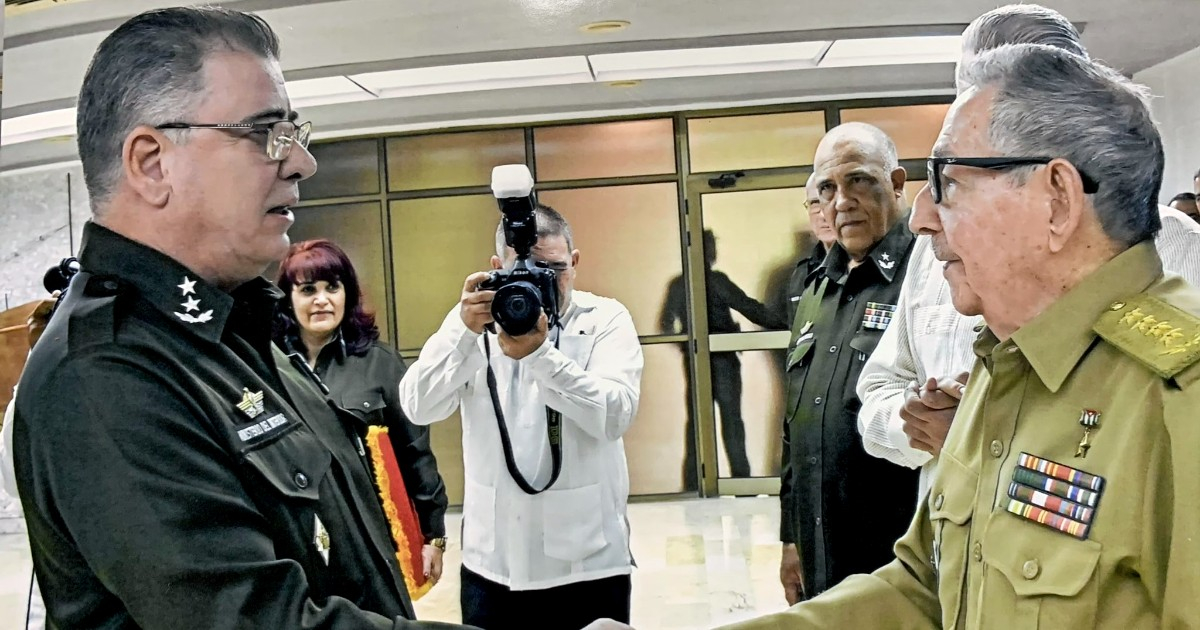
Amid reports that the administration of Donald Trump is looking for an internal interlocutor in Cuba with a role similar to that played by Delcy Rodríguez in Venezuela, a former U.S. official warned that negotiating with figures such as the Minister of the Interior, Lázaro Alberto Álvarez Casas, or Raúl Guillermo Rodríguez Castro —known as "El Cangrejo"— would be "catastrophic for the Cuban people."
The warning was issued by Emilio T. González in an opinion column published in The Washington Times. González is a retired U.S. Army officer with 26 years of active service, born in Havana and raised in Tampa. He held positions on the National Security Council and led the U.S. Citizenship and Immigration Services (USCIS) at the Department of Homeland Security.
The analysis is based on reports from US media stating that the Trump administration is exploring a formula in Cuba similar to that applied in Venezuela: to identify a figure within the power structures willing to cooperate with Washington during a transition process.
A report by The New York Times published in early August revealed that the Trump administration had instructed intelligence agencies to identify a pragmatic figure within or around the Cuban regime capable of playing a role similar to that of Delcy Rodríguez in Venezuela.
However, intelligence assessments warned that Cuba did not seem to have an easily identifiable figure of that profile and that many of the possible successors belonged to the stricter sectors of the regime, complicating Washington's strategy.
The parallelism points to Delcy Rodríguez, who assumed the role of interim president in Venezuela after the capture of Nicolás Maduro on January 3, 2026, and whose sanctions were lifted in April of that year.
According to González, Álvarez Casas, and "El Cangrejo", mentioned as potential interlocutors, would be precisely two figures that Washington should not negotiate with.
The MININT is the most corrupt and feared institution in Cuba, closely linked to systematic human rights abuses, human trafficking, drug trafficking, and espionage, wrote the analyst, who described the Ministry of Interior (MININT) as the "praetorian guard" of the communist regime.
The power of MININT within the Cuban regime
The MININT controls the Revolutionary National Police, State Security, the Border Guard Troops, intelligence, counterintelligence, prisons, and immigration, as well as overseeing the Defense Committees of the Revolution.
González points out that over 1,200 political prisoners remain confined in prisons controlled by that state apparatus.
The United States sanktioned the MININT and Álvarez Casas in January 2021 under the Global Magnitsky Act due to serious human rights abuses. In July 2025, Washington expanded those sanctions and banned the minister and his family from entering the United States.
«El Cangrejo», grandson of Raúl Castro and a figure close to the family's power circle, was sanctioned by the United States in June 2026.
In August 2026, The New York Times revealed alleged connections of "El Cangrejo" with a human trafficking network in Mexico, based on testimonies from individuals convicted in courts in New York.
A member of the so-called "Cuban Mafia in Quintana Roo" stated that he gifted a speedboat, a Rolex watch, a Suzuki motorcycle, and Louis Vuitton clothing.
Contacts between Washington and Havana
The debate over potential interlocutors within the regime arises following the visit of CIA Director, John Ratcliffe, to Havana in May 2026, when he met with Álvarez Casas and conveyed a message from Trump about the possibility of a dialogue contingent upon "fundamental changes" on the island.
González also warned about the international reach of MININT. According to his analysis, Cuban advisors participated in the establishment and training of the Ministry of the Interior of Nicaragua and in the reorganization of Venezuelan intelligence services during the Chavismo era.
He also noted that among the 32 Cubans who died during the military operation in which Maduro was captured, there were alleged officials of the MININT.
A warning about the power structure in Cuba
Regarding the architecture of power on the island, González argues that the Armed Forces, through the economic conglomerate GAESA, control up to 70% of the Cuban economy, while attributing to MININT the internal political control of the country.
"The idea that General Álvarez and Colonel Rodríguez could be at play would be catastrophic for the Cuban people," concluded González.
The former official concluded his analysis with a direct warning to Washington: «They are not the good ones you are looking for. Policy planners would do well to stay away».
Related videos:
Filed under: