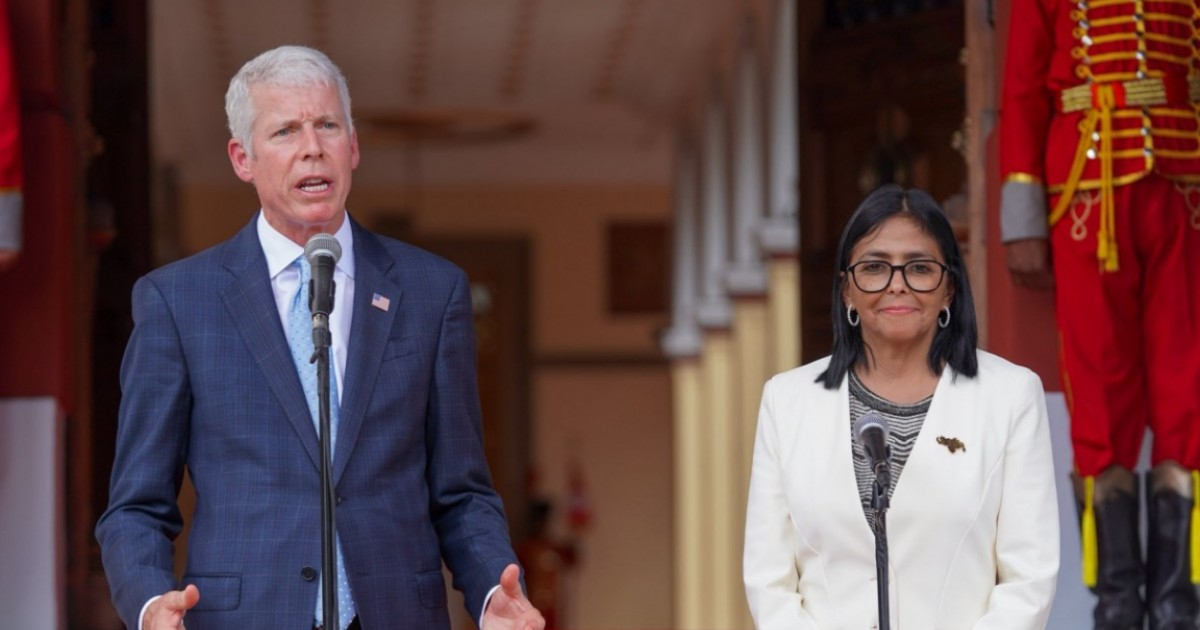
The United States Secretary of Energy, Chris Wright, announced in Caracas that an agreement signed with the company GE Vernova will stabilize the deteriorating Venezuelan electrical system within six to 12 months, according to Reuters.
The announcement was made during a ceremony to sign energy agreements held in the Venezuelan capital, presided over by the interim president Delcy Rodríguez and Wright, who traveled to Venezuela for the second time this year to finalize these commitments.
"The plan is, immediately, within six to twelve months, to focus on putting the existing assets on the ground back into operation, in good condition, stabilizing the network, and extending service hours," Wright stated to the press before returning to Washington.
The White House specified that GE Vernova committed to bringing online 1 gigawatt (GW) of new capacity within the first 24 months, and an additional 5 GW over the following four years.
«The catalyst for improving Venezuela is energy. I am honored to have had the opportunity to witness energy agreements that will replace the conflicts of the past with trade for the present and future,» Wright wrote on social X.
Among the priority infrastructures is the Guri Dam, built in the 1960s and a cornerstone of the national electrical system, alongside the Caruachi and Macagua dams, which together generate between 70% and 80% of the country's electricity.
According to Wright, the Guri Dam currently produces only half the energy it was designed for, due to the aging of its turbines and transmission lines.
The U.S. Department of Energy has characterized the Venezuelan electrical system as "deteriorated and fragile" and the "most critical bottleneck" for the country's recovery, with an available capacity of only 12,000-12,500 MW compared to a demand of 15,500-15,700 MW. This shortfall accounts for the blackouts and rationing of up to six to eight hours daily in states like Zulia.
This final agreement is the culmination of a process that started in February, when Wright visited Venezuela for the first time and signed a long-term energy agreement with Rodríguez at the Miraflores Palace, which in June led to a memorandum of understanding between Venezuela, Corpoelec, and GE Vernova with similar goals.
On August 3, technicians from the U.S. Department of Energy visited the Guri Dam to assess the state of the infrastructure, a precursor to formalizing the agreement.
Wednesday's events in Caracas also included significant oil commitments: Chevron announced plans to invest more than $7 billion in Venezuela over the next five years through its joint ventures, aiming to increase its production to 600,000 barrels per day. Meanwhile, the Italian company Eni signed a production-sharing agreement for Block Junín 5 in the Orinoco Belt, becoming the exclusive operator of that field.
In the oil sector, Wright reiterated his growth projections: Venezuelan production has already surpassed 1.2 million barrels per day, up from less than one million at the start of the process, and the secretary expects it to reach over 1.5 million in the first half of 2027 and exceed two million by the end of the decade.
These agreements fall within the Trump administration's plan for Venezuela, which includes three phases: stabilization, economic recovery, and political transition with elections. They come just days after the White House announced the oil agreement granting concessions for 100 years over 17 Venezuelan oil fields.
Related videos:
Filed under: