The Trump administration announced on Monday what it described as "the largest oil deal in world history": U.S. majority control over more than 65 billion barrels of proven oil reserves in Venezuela, funneled through a private company and at no cost to the taxpayer.
But behind the triumphalist headlines, the agreement published by the White House is fraught with contradictions, legal loopholes, and unanswered questions that no official document has resolved so far.
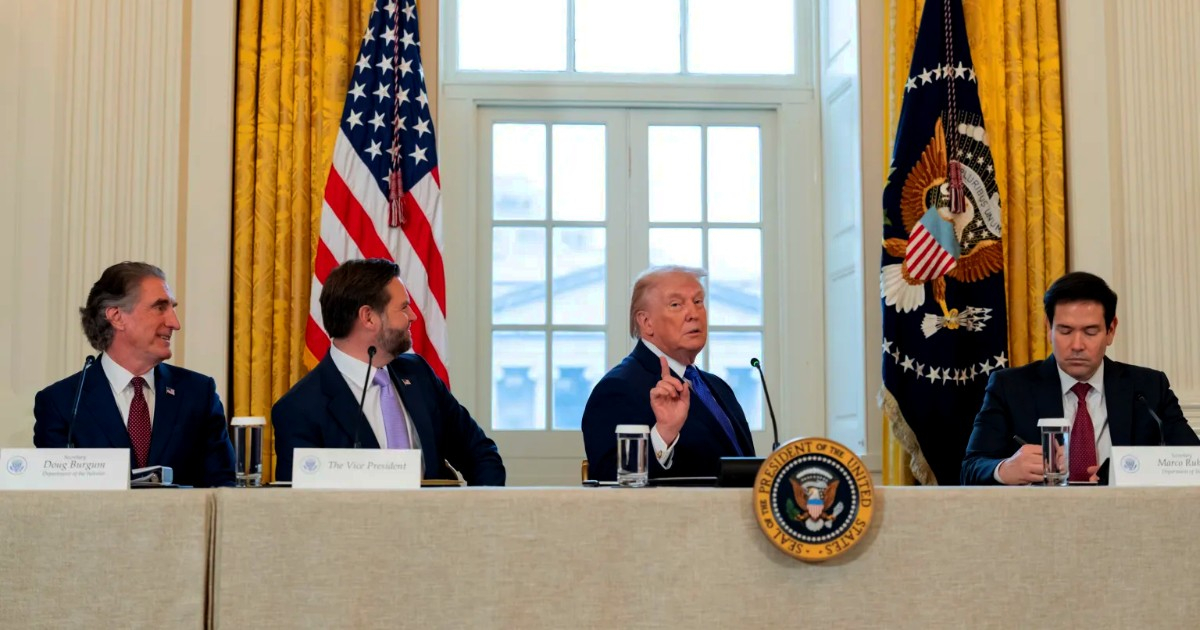
The agreement was signed by Secretary of State Marco Rubio and Secretary of War Pete Hegseth, granting the private company North American Blue Energy Partners (NABEP) concessions over 17 Venezuelan oil fields.
In return, NABEP granted the Department of War a 35% equity stake in its parent company and to the Department of State the right to purchase, at production cost, 20% of its guaranteed output, along with the right of first refusal on the remaining 80%.
The U.S. government also obtained veto power over any appointments to the board of NABEP, and the majority of that board must consist of U.S. citizens. The agreement is governed by U.S. law and is subject to the jurisdiction of the courts of that country.
However, one of the first visible cracks is the very duration of the agreement: while the White House speaks of concessions lasting 100 years and 200 billion dollars in royalties and taxes over the first 25 years of operation—which would be allocated to finance reconstruction and social development programs—Venezuelan interim president Delcy Rodríguez publicly stated that the agreement only has a validity of 25 years.
The complete contract has not been published, so there is no way to verify which of the two versions is correct.
Another underlying inconsistency comes from the Pentagon itself. According to a spokesperson quoted by Reuters this Tuesday, the Office of Strategic Capital of the Department of War does not take equity stakes in private companies, which calls into question the exact legal mechanism through which Washington would hold that 35% of NABEP.
The figure behind NABEP adds another layer of opacity to the agreement. Alejandro Betancourt López, a 46-year-old Venezuelan businessman and owner of the company, is facing open cases for alleged money laundering in Spain and Switzerland.
NABEP was founded in April 2024, and in just two years, it grew from producing about 18,000 barrels per day to approximately 200,000, a growth that has not been explained in detail in any official document.
The White House projects that NABEP will invest up to $100 billion in Venezuelan oil infrastructure and will pay $200 billion in royalties and taxes over the first 25 years of operation.
Most of the fields that the company will operate were previously in the hands of Russian and Chinese firms, or associates of chavismo, according to the official statement, which noted that those actors "plundered Venezuela's resources for the benefit of adversaries such as Cuba, Russia, and China."
That mention of Cuba is not rhetorical. Since the capture of Nicolás Maduro on January 3, 2026, Venezuela has halted the shipment of approximately 35,000 barrels of oil daily to the island that it received under barter agreements. The new scheme consolidates this cut as permanent and frames it within the reaffirmation of the Monroe Doctrine.
The political reaction was divided. Congresswoman María Elvira Salazar initially criticized the agreement, stating that Delcy Rodríguez was "the wrong person to sign it" and warned that Venezuela "is only buying time." However, she later described it as "a great agreement for the United States and the Venezuelan people," conditioning her support on the holding of free elections.
In Caracas, chavista sectors protested against the pact, while the Venezuelan opposition labeled it a predatory concession of sovereignty.
The U.S. also sponsors reconciliation talks between the 2015 National Assembly and the Venezuelan interim authorities, a process that has already led to judicial reforms and the release of hundreds of political prisoners.
New meetings are scheduled for September, suggesting that the oil agreement is just one part of a broader political negotiation whose full terms have also not been disclosed.
Related videos:
Filed under: