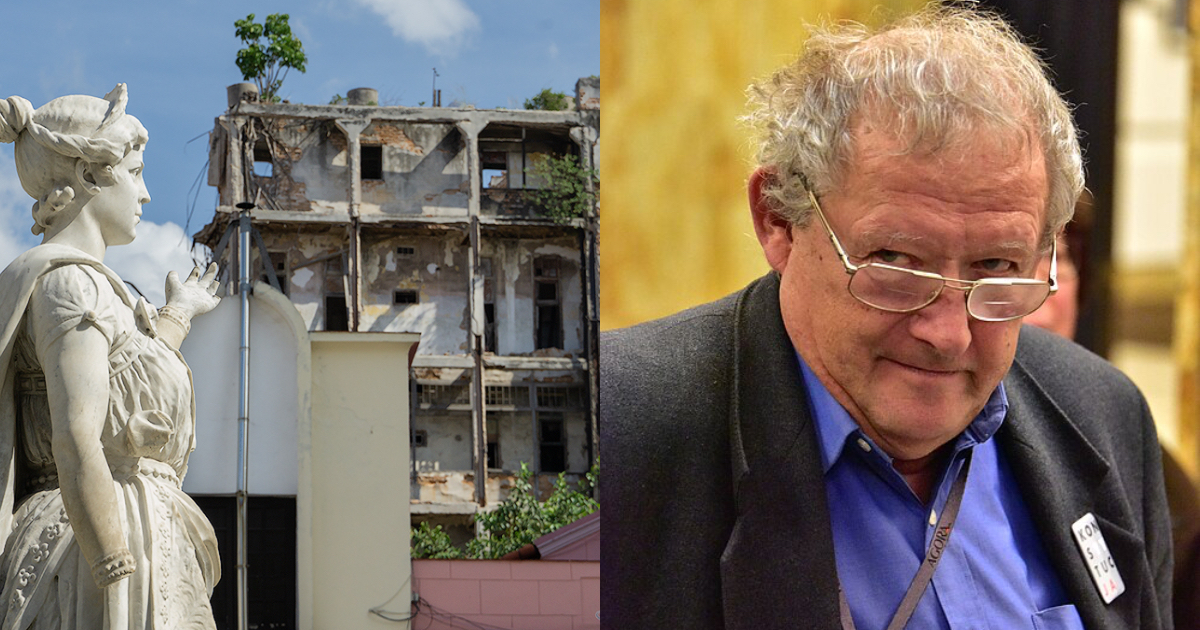
On the night of May 7 to 8, 1981, in the Polish city of Otwock, an enraged crowd nearly took justice into their own hands. Two men had been detained and beaten by members of the "Citizen Militia," the uniformed police of communist Poland, similar to Cuba's PNR. Outrage was mounting. Stones were thrown, windows were shattered, and some began discussing setting the police station on fire and punishing the responsible officers.
Then Adam Michnik appeared. He was not a defender of the regime; quite the opposite. He was one of its most steadfast and well-known enemies. He had been surveilled, detained, beaten, and imprisoned for standing up to the communist dictatorship. He was thoroughly aware of the brutality of that repressive apparatus. However, when he saw that hate could transform victims into perpetrators, he stepped in. He took a megaphone and shouted, "My name is Adam Michnik and I am an anti-socialist force."
The phrase was a provocation laced with humor. Michnik used against the regime the same label that official propaganda sought to discredit those who fought for freedom.
The crowd began to listen to him. Michnik argued that the guilty police officers should answer for their actions, but before the law. Those who fought against arbitrariness could not replicate arbitrariness, hatred, and crime. Those who demanded justice could not become executioners.
That night left one of the great moral lessons of European democratic resistance: it is possible to fight fiercely against a dictatorship without morally becoming what one combats.
Adam Michnik was born in Warsaw in 1946. From a very young age, he understood that an intellectual cannot remain a distant observer when lies dominate public life and terror seeks to subdue the consciousness of an entire people.
He studied History at the University of Warsaw. During the protests in March 1968, he was expelled, arrested, and sentenced to prison. But prison did not manage to tame him. After regaining his freedom, he continued to participate in opposition initiatives.
He collaborated with the Workers' Defense Committee, KOR; promoted underground publications and defended something that would ultimately prove decisive for Poland: the unity among workers, students, intellectuals, believers, artists, and citizens of different political sensitivities around a higher cause: Freedom. This is something we are building in the Cuban context, but it has not yet solidified enough and is not progressing at the speed that the national crisis demands.
When Solidarność emerged in 1980, Michnik became one of its main intellectual advisors. On December 13, 1981, when General Wojciech Jaruzelski imposed martial law to crush that extraordinary civic movement, Michnik was sent back to prison. It was precisely in jail that he proved that an intellectual can be imprisoned and still remain freer than those who imprisoned him.
His letters from prison are exceptional documents of moral resistance. They reveal irony, humor, intelligence, and above all, an extraordinary refusal to accept the degradation that the dictatorship sought to impose on him.
One of the most famous letters was addressed to the powerful Interior Minister, General Czesław Kiszczak. The regime offered him a seemingly attractive option: he could leave prison if he agreed to leave Poland. Freedom in exchange for exile. Michnik said no. He could trade his cell for the West, reunite with a "normal" life, escape interrogations, surveillance, and sentences. But he understood that this proposal aimed at something more significant than expelling him from the country: it sought to obtain a moral surrender from him. That is why he wrote to the general: “You, yourselves, debased, want to drag us down to your level.”
What an extraordinary reversal of roles. Kiszczak had police, prisons, weapons, informants, interrogators, and listening devices. Michnik had a cell, paper, a pen, and a conscience. And yet, the truly powerful man was the prisoner. Because the State could confine his body, but it could not compel him to say yes.
Michnik wrote that power could wield immense repressive instruments and, nonetheless, there would always be someone willing to say: "I am not afraid of you!" And he concluded: "Here lies consciousness."
That is probably one of the most beautiful definitions of civic resistance. Awareness is something that no repressive force can fully imprison as long as there is a person willing to defend it. Michnik spent approximately six years of his life in communist prisons. But then came 1989, and the men who had tried to break him ultimately had to sit down and negotiate with him. He participated in the historic Round Table talks that paved the way for the democratization of Poland. Shortly after, Lech Wałęsa tasked him with organizing the Solidarity newspaper for the elections.
On May 8, 1989, the first issue of Gazeta Wyborcza was published. The former political prisoner became one of the most influential journalists in the new democratic Poland. His life offers a particularly important lesson for Cuba. When a nation lives under censorship, repression, poverty, fear, and lies, intellectuals must decide what role they will play in history.
They can stay silent, they can make themselves comfortable, they can look the other way, or they can take the risk of speaking the truth and fighting for freedom.
Cuba needs writers, teachers, journalists, filmmakers, artists, academics, musicians, men and women of culture who are capable of understanding that talent also entails responsibility and commitment. Intelligence does not reach its highest greatness when it receives awards, applause, or scraps from an arbitrary power. It achieves greatness when it is put at the service of human dignity. Michnik could have remained silent, but he did not. He could have accepted exile but chose to preserve his inner freedom. He could have hated but chose justice.
This is the true commitment of an intellectual to their time: to stand by the truth when lying is convenient; to defend freedom when it comes at a cost; to stand with the people when power oppresses and represses; and to be willing to sacrifice comfort, prestige, freedom, and even one's own life so that one day their nation can be truly free.
This article for CiberCuba is written by someone who admires men and women like Félix Navarro and his daughter Saylí, who refuse to gain their freedom at the expense of exile. A man who does not feel comfortable in the safety and comfort of exile and who works tirelessly, sacrificing his family's well-being, to consolidate the effective strength we still do not have, to return, just as Martí, Gómez, and Maceo did after many years away, because one day they had to leave, but they did not forget Cuba and returned ready to conquer freedom or die.
Related videos:
Filed under:
Opinion article: Las declaraciones y opiniones expresadas en este artículo son de exclusiva responsabilidad de su autor y no representan necesariamente el punto de vista de CiberCuba.