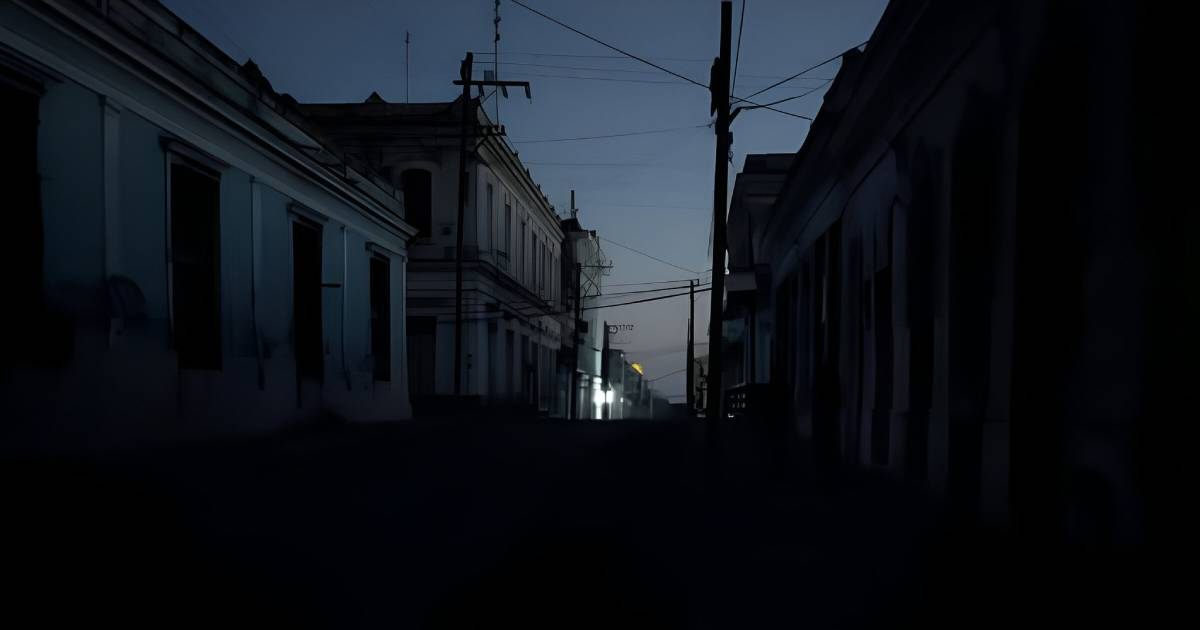
The National Electric System (SEN) of Cuba is facing a day of widespread blackouts this Saturday: according to the official report from the Electric Union (UNE), at six in the morning, the available capacity was only 1,000 MW compared to a demand of 2,890 MW, with 1,915 MW already out of service.
Friday was even more devastating: the blackout lasted a full 24 hours, with no interruption even in the early morning, and the maximum impact reached 2,272 MW at nine in the evening.
For the peak demand hours this Saturday, the UNE projects a capacity of 1,000 MW against a demand of 3,250 MW, resulting in a deficit of 2,250 MW. «If the expected conditions persist, an impact of 2,280 MW is anticipated during this period», warns the official report —equivalent to approximately 70% of the national demand.
The thermal generation sector is experiencing multiple simultaneous outages. Units 5 and 6 of the Mariel thermal power plant (CTE), unit 2 of the Santa Cruz CTE, unit 4 of the Cienfuegos CTE, unit 2 of the Felton CTE, and unit 6 of the Renté CTE remain out of service due to breakdowns.
Three additional units —the 3 in Santa Cruz, the 5 in Nuevitas, and the 5 in Renté— are under maintenance. The limitations in thermal generation amount to 402 MW.
As the only partial relief, the solar photovoltaic parks contributed 4,221 MWh on Friday, with a maximum power output of 657 MW at noon. However, that generation disappears in the evening, just when demand reaches its peak and the deficit skyrockets.
This journey is part of a trend of sustained blackouts in September that began on the first day of the month, when the availability was approximately 960 MW and the projected deficit for peak times exceeded 2,310 MW.
On August 31, the UNE had projected a deficit of 2,410 MW, just one megawatt below the historical record of 2,411 MW set on August 4.
So far in 2026, the SEN has experienced at least seven total blackouts—complete collapses of the network—spread across March, July, and August.
The outages have triggered an unprecedented wave of protests: loud pot-banging demonstrations, roadblocks, and rallies in Havana, Santiago de Cuba, Matanzas, and Ciego de Ávila, among other provinces. The Cuban Conflict Observatory recorded 107 street protests in June, a historical record, with the electricity crisis as the main catalyst.
The UNE itself warned in August that the period between September and December could be the most critical of the year, as scheduled maintenance coincides with breakdowns in multiple thermoelectric units—a scenario that the data from this Saturday confirms starkly.
Related videos:
Filed under: