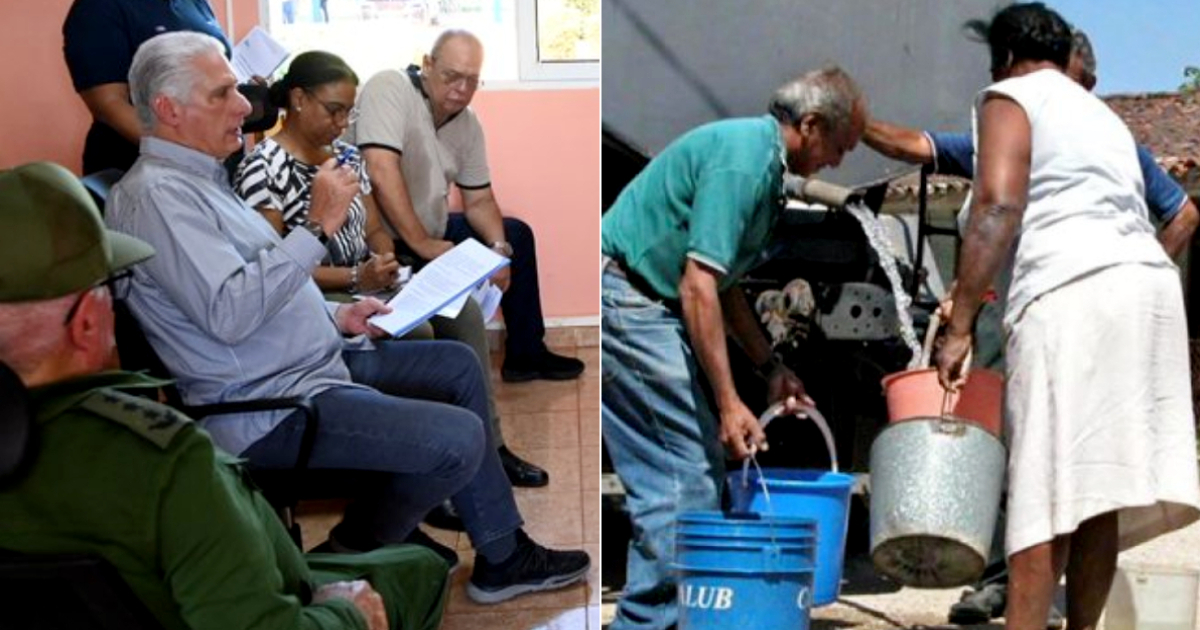
Miguel Díaz-Canel set a specific deadline for the first time to begin measuring the results of the strategy that the Cuban government aims to implement in order to alleviate the severe water supply crisis in Havana: the end of September.
The leader assured that by the end of this month, the first effects should begin to be noticeable in two or three of the main supply systems of the capital, while during October it is expected to consolidate other sources and, before the end of the year, move towards a more stable solution based on renewable energies.
The calendar turns the coming weeks into the first concrete test for a strategy announced after months of blackouts, breakdowns, leaks, and pumping failures that have left hundreds of thousands of Havana residents with irregular water supply or without water for days and weeks.
But, although the leader is already speaking of dates and stages, there are still significant uncertainties regarding the available resources, financing, and the actual capacity to implement the plan.
Late September: the first commitment
Díaz-Canel explained during a visit to the Southern Basin System that the government expects to see the first results by the end of September in "two or three" main systems of Havana, according to the website of the Presidency.
Later, according to the announced schedule, additional supply sources should be consolidated in October, and by the end of 2026, solutions supported by renewable energy sources are expected to begin operating.
The strategy aims to tackle one of the main issues that has worsened the crisis: the extreme dependence on water pumping from the deteriorated National Electrical System.
Díaz-Canel himself acknowledged that hydraulic systems require between ten and 12 continuous hours of electrical stability to function properly and that currently the country can hardly guarantee that period, not even when it tries to prioritize the energy supply to these facilities.
The admission is significant because it implies that the solution no longer lies solely in allocating electricity to the pumping stations, but in developing energy sources capable of operating partially independently from the national electricity system.
From generators to solar energy
The first measure involves supporting 29 supply sources with generators and selected boosters in Havana.
Authorities have inspected around 70 facilities to determine how to maintain pumping during power outages, but so far, only the energy backup planned for those first 29 has been reported.
The government has not publicly specified what will happen with the rest of the inspected facilities, which ones will be included later, or under what timeline.
The second phase involves using distributed generation, and the third phase includes installing systems based on renewable sources, such as solar parks and energy storage mechanisms.
The declared objective is that the pumping can continue even when Havana remains without electricity for long hours.
The generators raise another question: the fuel
The use of generators can provide an immediate solution to blackouts, but it also shifts part of the problem to another scarce resource in Cuba: fuel.
If the stations require long continuous hours of energy to stabilize conductors, pumps, and pumping systems, the generation equipment will also need to operate for extended periods.
So far, the authorities have not reported how much fuel those generators will need, what amount is specifically guaranteed for pumping water, nor how long this arrangement can be maintained.
This question becomes particularly relevant after months of energy difficulties and fuel limitations that have impacted both electricity generation and other essential services.
A plan without public funding
The government acknowledges that the strategy will require investments, but it has not indicated how much it will cost.
The Presidency has mentioned the recovery of pumping equipment, leak elimination, rehabilitation of pipelines, infrastructure maintenance, automation, distributed generation, renewable sources, and storage systems.
However, no figures have been published regarding the necessary budget, the electrical capacity to be installed, the number of solar panels or batteries required, or the specific source of financing.
In the case of the Southern Basin System, which serves more than 336,000 residents of Plaza de la Revolución, Diez de Octubre, Cerro, Centro Habana, Habana Vieja, and parts of Boyeros, the government also announced the recovery of pumps, elimination of leaks, rehabilitation of pipes, and other investments, but without publicly quantifying the necessary resources.
There are also no concrete goals regarding how many Habaneros will recover the water
Another element that still does not appear in the official strategy is public indicators that allow to accurately determine what the announced "impact" at the end of September will mean.
It has not been stated how many people should regain stable service by that date, how many hours of supply are intended to be guaranteed, how many stations should be supported, or how much the volume of water pumped should increase.
The absence of those indicators makes it difficult to measure the success of the program solely based on the announced dates.
In July, more than half a million residents of Havana faced supply difficulties, after around 200,000 were affected in April and over 376,000 in May.
During those months, CiberCuba has documented neighborhoods without service for over a week, families forced to buy water at inflated prices, distribution via tank trucks, installation of manual pumps, and numerous reports and citizen protests due to the combination of blackouts and water shortages.
The government admits that the current model no longer works
Beyond the concrete measures, Díaz-Canel's statements contain a significant admission about the depth of the crisis.
The ruler stated that the situation requires to "reinvent the entire water supply management system", because the instability of the SEN makes it impossible to maintain the electricity needed for hydraulic systems for a sufficient amount of time.
In practice, the strategy involves gradually attempting to separate a portion of the pumping infrastructure from its absolute dependence on the national electric grid.
It's not just about installing generators. The official program itself acknowledges issues with pumps, leaks, conductors, maintenance, distribution, and management that will also need to be addressed to stabilize the service.
A calendar that Díaz-Canel himself left open
Although he set the end of September, October, and year-end as references, Díaz-Canel also warned that the schedule "can shift over time."
The leader attributed that uncertainty to the U.S. sanctions and the so-called "energy blockade."
The warning now introduces a margin for potential delays in a program whose implementation will depend on investments, fuel, equipment, and resources that have yet to be publicly detailed.
That's why the end of September becomes a particularly significant date.
It will then be when it can begin to be verified whether the generators and the initial interventions produce a noticeable improvement in the selected systems or if the program remains conditioned by the same shortcomings that have accompanied the water crisis in the capital for months.
Related videos:
Filed under: