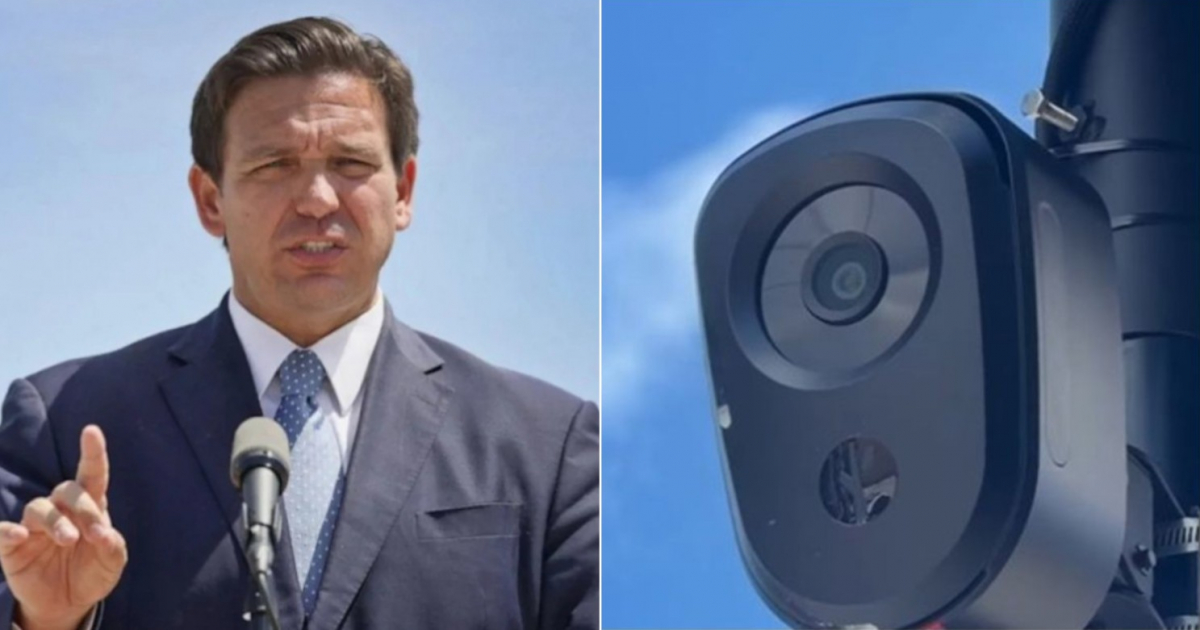
The Miami-Dade Sheriff's Office has completely suspended its license plate recognition camera program following a state directive that restricts the use of this technology on Florida highways, as reported by Univision 23.
The 84 Flock devices operated by the department have been taken out of service, which has sparked an increasing debate about mass surveillance and citizen privacy.
Sheriff Rosie Cordero-Stutz defended the program's track record before announcing its total suspension, noting that the devices helped apprehend individuals wanted for homicides and robberies, and locate abducted children and missing persons. However, she acknowledged the need to establish safeguards against misuse.
The southern part of Florida had over a thousand Flock cameras in operation -about 372 in Miami-Dade and 863 in Broward, according to the independent map DeFlock.
Such an abundance of devices has sparked an increasing debate about mass surveillance and citizen privacy.
DeSantis' stance
The state Department of Transportation issued a memo on August 31 revoking all previous authorizations for automatic license plate readers installed on state roads, with a 30-day deadline for removing the equipment.
The document, signed by Will Watts, the operations director of the agency, cited a "recent exponential increase" in the deployment of police cameras and "worrying reports of misuse, data privacy issues, and surveillance plans" that require immediate action "to preserve the sovereignty and quality of life of Floridians."
The measure fulfills a promise from Governor Ron DeSantis, who days earlier had described the technology as "out of control" and warned about the risk of establishing a surveillance state based on artificial intelligence.
“I am fully supportive of law enforcement having tools to hold criminals accountable. But I do not want this to turn into a surveillance state,” stated DeSantis.
In the podcast Real America's Voice, the governor went further: "These cameras that are out there... who says they only record license plates? I think they also capture people inside their cars. I believe they collect much more information than they admit. And we've already seen the abuses."
How do Flock cameras work, and why are they not liked by everyone?
Unlike conventional cameras, Flock's automatic license plate readers do not just photograph vehicles: they capture the license plate, make, model, color, and even distinctive features of the car such as dents, roof racks, and bumper stickers. They record the date, time, and exact location of each car that passes by.
“You pass by a location where there is a camera; the camera scans and records that you passed by, that is basically metadata,” explained to Univisión 23 Rod Soto, a cybersecurity researcher, who added that this data allows for tracking the complete route of a vehicle.
Martha Torres, spokesperson for the organization Iniciativa Libre Florida, questioned how this information is being used. "We don’t know who controls it, how it is controlled, to whom it is sold, and who is managing this information about citizens."
The portal DeFlock warns that these cameras collect data on millions of cars, even if the driver is not suspected of a crime. "They are marketed as essential tools for combating crime, but they overlook the powerful tools that the Police already have to track down criminals, such as mobile phone location data, creating a legal gap that does not require a court order."
In favor of and against the cameras
The Florida order does not affect cameras installed on private properties or local roads, where 98% of the surveillance devices are concentrated, according to DeSantis.
Among those opposing the new restriction is the mayor of Miami Beach, Steven Meiner, who announced that he will seek legislation to keep the cameras in his city, where approximately half of the 40 installed devices are located on state roads.
On the other hand, the Jacksonville Sheriff's Office announced the immediate suspension of its program throughout Duval County.
Florida's Attorney General, James Uthmeier, also questioned the technology and pointed out documented cases where agents used it to monitor ex-partners or track individuals without legal justification.
According to the Institute for Justice, there were at least 24 reported cases of this type by mid-July, including an officer who checked his ex-girlfriend's license plate at least 69 times and another who tracked his ex-wife's vehicle 717 times over more than two years.
DeSantis, who warned about Flock cameras weeks ago, proposes the regulatory model of New Hampshire's law, which mandates the deletion of captured data within three minutes unless it is linked to an active case, and has urged the state legislature to approve similar regulations to protect the privacy of Floridians.
Other states have taken measures against Flock Safety, canceling or not renewing their contracts with the company. Texas Governor Greg Abbott ordered the suspension of state funding for these cameras, impacting more than 300 devices in Dallas.
Related videos:
Filed under: