The Miami International Airport (MIA) does not have a special braking system installed in more than 120 airports across the United States to stop aircraft that exceed the end of a runway, as revealed on Monday by Local 10.
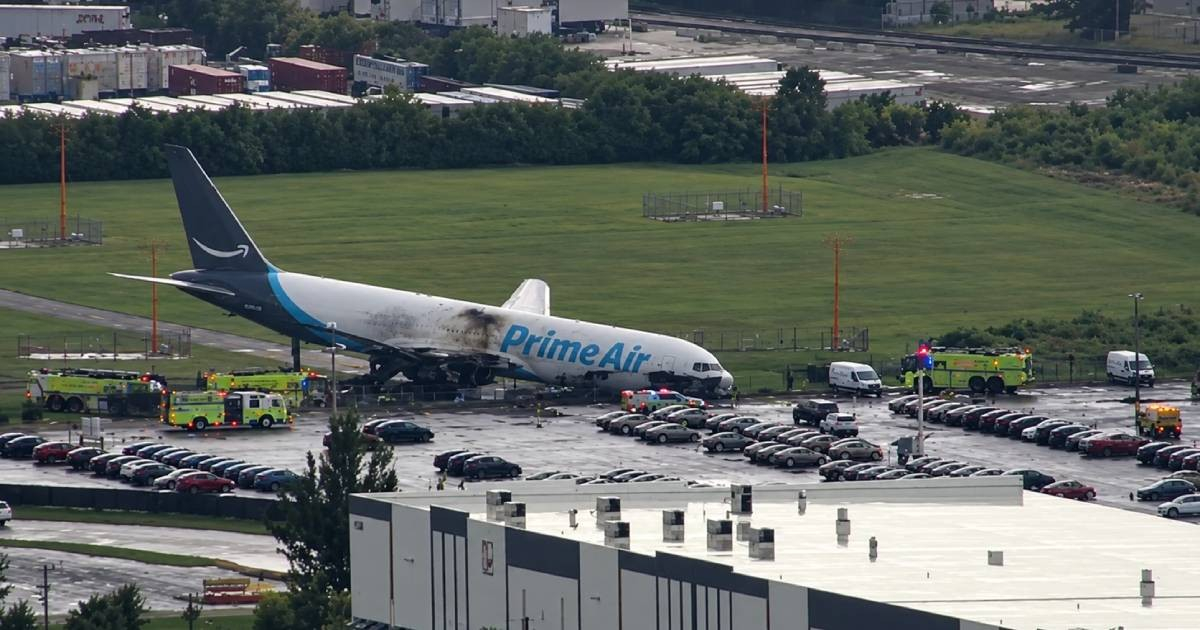
The revelation comes a day after the accident of a Boeing 767 cargo plane operated by 21 Air for Amazon Prime Air, which veered off the airport runway, crossed a road, and struck several vehicles in a nearby parking lot. The toll was five dead and five injured.
The system that is now raising questions is known as EMAS (Engineered Materials Arresting System) and is specifically designed to stop aircraft that are unable to brake before reaching the end of the runway.
Captain Francisco Díaz, who claimed to have piloted the same aircraft involved in the accident a decade ago, explained to Local 10 that the device uses a deformable material placed after the runway.
"It prevents the airplane from leaving the airport facilities. It is a soft concrete that is located after the runway, and if the airplane enters that area, it turns into mud and prevents it from moving forward," he explained.
According to data from the Federal Aviation Administration (FAA) cited by the channel, these systems have helped save at least 497 lives in 26 incidents of aircraft overrunning runways in the United States.
However, MIA is not currently required to have EMAS. The airport has a safety area of approximately 1,000 feet (305 meters) at the end of the runway, one of the alternatives considered by FAA standards.
The airplane that crashed on Sunday managed to navigate past that area and ended up outside the airport grounds, which has raised the question of the practicality of additionally installing an EMAS system.
Díaz also analyzed the landing images and noted that they depict what is referred to in aviation as an "unstable approach."
"It can be seen that it tilts slightly downward and then, upon reaching the landing area, remains suspended in the air. In fact, it gives two small bounces before touching down with the main landing gear," he explained.
According to the pilot, in a situation like that, the expected procedure would be to abort the landing and try again.
Nevertheless, Díaz urged caution and warned that the causes of the accident are still unknown.
"We do not know if the plane had any malfunctions. We do not know if the systems experienced problems, such as the hydraulics, the brakes, or something similar," he noted.
The pilot also revealed his particular connection to the crashed Boeing 767, registration N1997A.
"It was Amazon Prime's first plane about 10 years ago [...] I flew with this specific tail number 10 years ago," he stated.
Díaz took advantage of the accident to urge the authorities to consider incorporating EMAS into the planned investments for the airport.
"The Miami airport is investing $9 billion in infrastructure. Please include a system like EMAS for all runways," he demanded.
This Monday, MIA continued to experience delays and cancellations due to the accident, while authorities advised passengers to check the status of their flights before heading to the terminal.
The FAA and the National Transportation Safety Board (NTSB) are investigating the incident. For now, it has not been determined what caused the Boeing 767 to overrun the runway or whether the presence of an EMAS system would have altered the outcome.
Related videos:
Filed under: