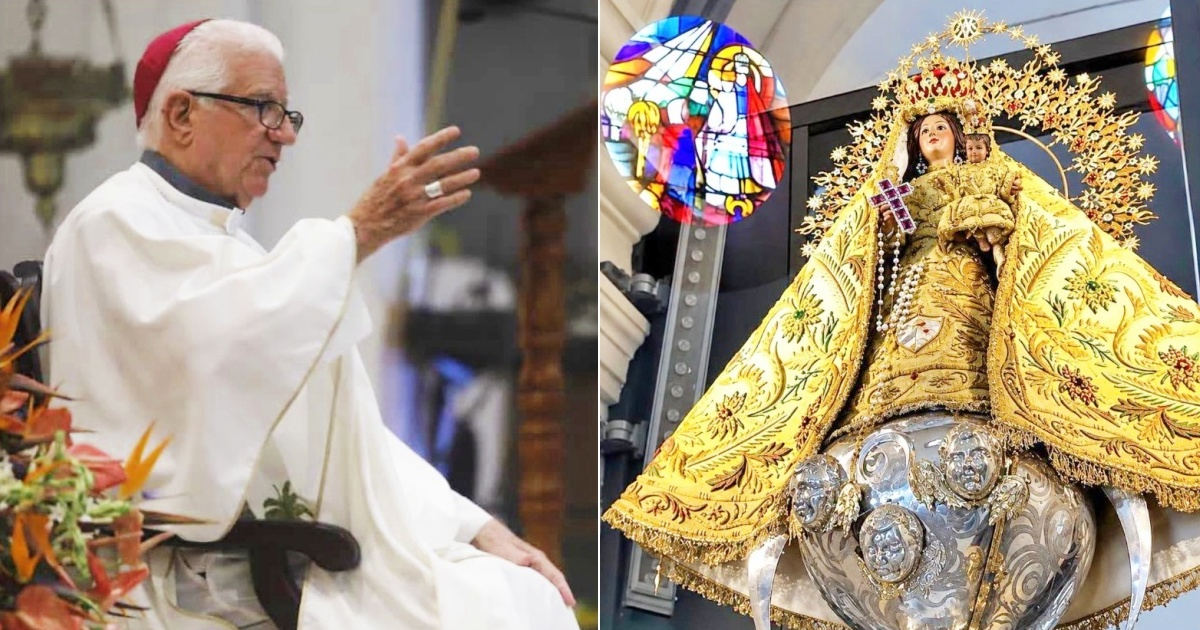
In the early hours of this Tuesday, before thousands of pilgrims gathered at the National Sanctuary Basilica of El Cobre, the Metropolitan Archbishop of Santiago de Cuba, Monseñor Dionisio García Ibáñez, delivered a homily with strong political and social content during the First Mass of the Solemnity of Our Lady of Charity of El Cobre.
García Ibáñez called for urgent structural transformations and described the country's situation as "sad" and that "no people deserves this."
The sanctuary of El Cobre, in Santiago de Cuba, has remained open continuously since Monday afternoon to welcome the faithful arriving from various parts of the island, on one of the most significant dates in the Cuban religious calendar.
"May the changes not remain on the periphery."
The prelate was direct in addressing the national reality, asking the faithful to lift up a collective prayer so that the reforms reach true depth.
“Let us ask the Lord that any changes made, the changes that are being made, do not remain on the periphery, but rather deepen and touch all the structures of our lives, the lives of every Cuban, every person,” stated García Ibáñez.
And he added: "We must ask God for that. That the necessary changes are made so that we can live each day with more peace, as a people that wishes to love God and to care for one another as brothers."
The archbishop also asked for God to grant the Cuban people "strength, wisdom, and determination so that we can overcome the situation we are experiencing, which is sad and that no people deserve."
A direct message to the rulers
One of the most striking moments came when García Ibáñez addressed each sector of society—religious leaders, students, parents, doctors, farmers—to ask them how they can fulfill God's will according to their circumstances.
Upon reaching the rulers, their response left no room for ambiguity.
"How can a ruler fulfill God's will? By governing for the benefit of the people and not for personal gain. That is the priority. Then, by ensuring that what the people need and want is realized, rather than catering to my whims or insisting that my will or my way of thinking is the only one that matters," he asserted.
The prelate also warned about the dangers of political projects that disregard God: "There are times when we humans believe—and we have heard this and experienced it—that a paradise can be built on Earth. And we do not realize that when we forget God's will, our paths cannot end well."
Judit and María, figures of salvation
García Ibáñez structured his homily around the day's biblical readings: the Book of Judith and the Annunciation to Mary.
Judit emphasized that God "chose her, a woman precisely, to lead all men and women to live the dignified life that God wanted for His people, granting them the freedom of faith so they could practice their beliefs."
He then drew a parallel with Mary and extended that call to all those present: "To do God's will is up to each individual according to their condition."
A voice that does not remain silent in 2026
The homily this Tuesday represents the most visible point of a pastoral line that the archbishop has maintained throughout the year. In May, García Ibáñez had already stated from the same sanctuary that "Cuba needs to change."
In July, he acknowledged the popular distress: “There are so many people asking for help. And the help is not enough”. A month later, he demanded that Cubans be able to “live with decency” and dignity, criticizing empty rhetoric.
At the end of January, the Cuban Conference of Catholic Bishops published a message demanding "structural, social, economic, and political changes" and warning of the risk of social chaos. García Ibáñez presides over that episcopal conference.
The homily delivered by the archbishop this Tuesday concluded with an invitation to hope: "May the Lord accompany us, may He give us strength, and let us remember Him today in the arms of Mary and say: You are my Savior. I want to hear you, I want to follow your word."
Related videos:
Filed under: