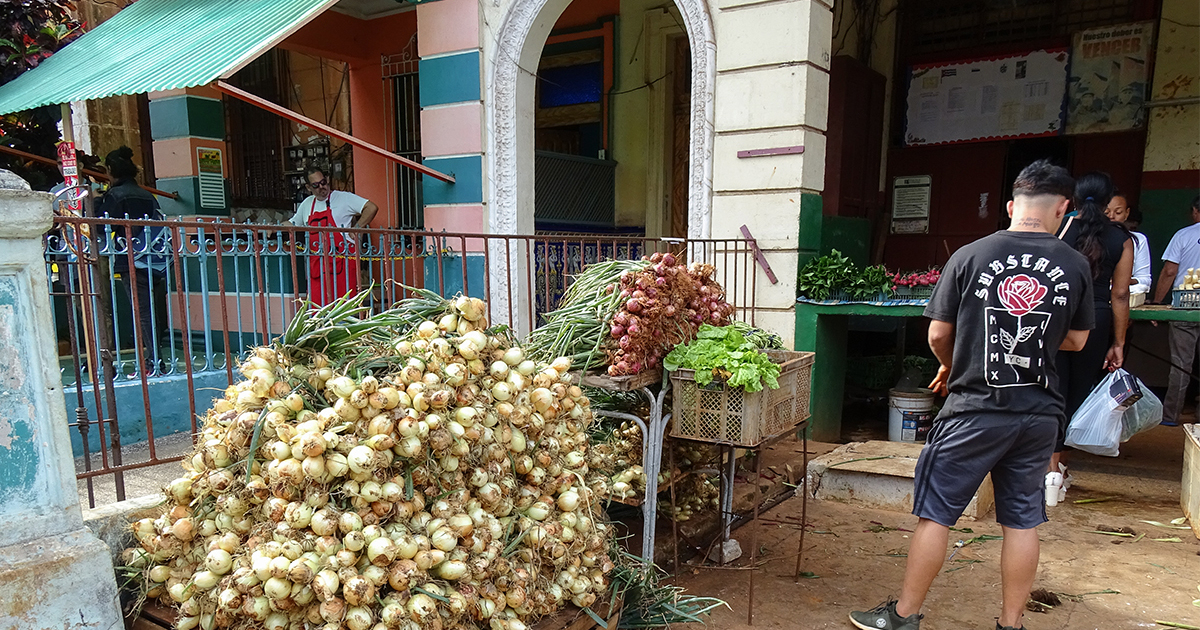
The Council of Ministers of Cuba approved , a norm that modifies Decree 143 "On the Marketing of Agricultural and Forestry Products" with the aim of updating the regulatory framework governing contracts, pricing, and institutional roles in that sector.
The decree was signed by Prime Minister Manuel Marrero Cruz on July 23rd and took effect this Wednesday, with its publication in the , on pages 70 to 72.
The text of the decree itself justifies the reform by stating that "the approved Economic and Social Transformations make it necessary to update the regulatory framework governing the legal regime of the marketing of agricultural and forestry products."
Among the most significant changes is the redefinition of the principle of state regulation and control, which now explicitly encompasses production, contracting, quality and safety, access, and consumption of food under exceptional conditions, as well as planting and land use.
Regarding institutional roles, the regulation stipulates that provincial governors must "define the destinations for contracting agricultural and forestry products approved by campaigns circulating among their municipalities."
The Municipal Administration Councils are responsible for conducting product assessments, setting destination priorities, and overseeing compliance with state mandates by individuals and legal entities involved in marketing.
In terms of pricing, it is established that prices "are set by agreement between the contracting parties," replacing the previous scheme of centralized pricing.
Differentiated prices are also introduced for two categories of products: those obtained through certified organic methods, and those derived from scenarios certified by the Participatory System of Agroecological Guarantee, applicable to both national and international marketing.
The document specifies that the centralized prices in effect at the time the decree comes into force "will be updated in accordance with the implementation of the subsidy transformation to be carried out by the Ministry of Finance and Prices."
It also removes the requirement for having the production and marketing of agricultural and forestry products approved in the corporate purpose for various stakeholders in the sector, thus expanding the pool of individuals and legal entities that can operate in this market.
Decree 161 falls within the package of 176 economic and social transformations approved by the regime in June, which includes the decentralization of agricultural prices, the shift from product subsidies to targeted subsidies for individuals, and the expansion of land access.
La Gaceta No. 75 Ordinary of 2026 is a widely impactful regulatory edition for the agricultural sector: it contains 19 regulations, including Law 185 on land ownership and use, several decrees from the Council of State regarding cooperatives and agricultural resources, and resolutions from the Ministry of Agriculture on meat commercialization and phytosanitary exportation.
The Ministry of Justice must publish, within 30 days, the updated and reconciled version of Decree 143, which is the foundational regulation that this new decree modifies.
Related videos:
Filed under: