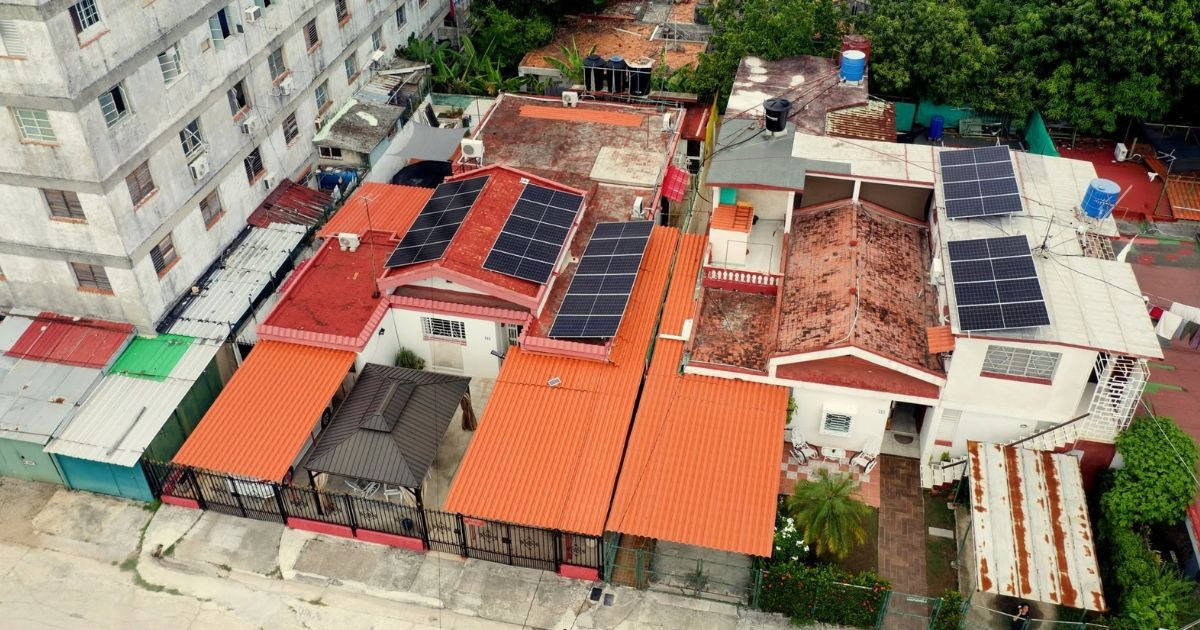
The proliferation of solar panels on the roofs of homes and buildings in Havana, largely driven by the prolonged blackouts and the regime's inability to restore its outdated energy infrastructure, has prompted Cuban authorities to highlight the need to regulate these installations and establish clearer criteria to avoid risks.
The Minister of Science, Technology, and the Environment (Citma), Armando Rodríguez Batista, shared an analysis titled "Solar Panels: Between Need and Order" on Facebook this Wednesday, in which he described the expansion of these systems as a "historic opportunity", but warned that it must be approached carefully to avoid creating new problems.
One day later, the Cuban News Agency (ACN) revisited the topic and noted that Rodríguez emphasized the need to regulate the installation of solar panels on the roofs of houses and buildings in Havana, a phenomenon that has grown considerably in recent months.
The analysis shared by the head of Citma includes the assessments of architect Dania González Couret, a professor at the Technological University of Havana (CUJAE) and founder of the National Board of Cuba Solar, who celebrated that more and more citizens are taking advantage of rooftops in cities to produce electricity.
"I am happy because I have been saying for a long time that the large photovoltaic parks on the outskirts of cities are taking away land for food cultivation. In cities, there are roofs, lots of roofs," he stated.
According to studies conducted in El Vedado, properly positioning the panels can have a dual benefit: to generate electricity and protect homes from heat.
These structures reduce the thermal load on the building and can decrease the need for ventilation and air conditioning.
González explained that, given the conditions in Cuba, the panels achieve better performance when installed at an inclination of between 15 and 30 degrees from the horizontal.
However, the specialist warned that the accelerated growth has also led to installations being carried out without adequate technical preparation.
«It is a business, and many people are charging for it without having all the knowledge. Things are being done incorrectly», he warned.
The problem can become more significant in multifamily buildings, older properties, and historical areas, where certain installations require permits and must ensure that the structures can safely support the equipment.
For now, the authorities assure that there will be no fines for those who already have installed systems. According to the analysis released by the minister, the aim is to provide technical guidance and unify the requirements to prevent owners from encountering different criteria depending on the municipality.
For González, the current energy crisis could ultimately lead to at least one positive transformation if the expansion of domestic solar energy is carried out safely and does not fade away once the electricity supply improves.
"It’s never too late if the outcome is good; what’s important is to make the most of it, to do it well, and to follow up to perfect it, without abandoning this practice when the electricity supply situation improves," he concluded.
The rise of these systems is directly related to power outages. González pointed out that many Cubans have opted to install autonomous battery systems, as systems connected solely to the grid stop supplying electricity when an outage occurs.
Autonomy, however, comes at a price: batteries significantly increase the cost of systems, have a limited lifespan, and also create environmental issues when they need to be replaced.
The growth of private panels is taking place in a Cuba where the ability to escape blackouts increasingly depends on the economic capacity of each family.
For those who can afford them, solar systems allow for the operation of refrigerators, fans, lights, and other equipment during lengthy power outages.
The Government has also been working to encourage domestic generation. Resolution 114/2026 from the Ministry of Finance and Prices established a rate of 90 CUP for each kilowatt-hour (kWh) delivered to the National Electric System by residential and non-residential producers, in addition to exempting the income from this sale from the service tax.
The possibility of selling electricity back to the grid, however, requires certain technical conditions, including systems compatible with interconnection and bi-directional meters capable of measuring both the electricity consumed and the electricity delivered.
Incentives for acquiring these technologies have also been expanded. In August, the Government extended until December 31, 2027, the exemption from customs duties for importing photovoltaic solar systems, their components, and other equipment related to renewable energies.
Related videos:
Filed under: