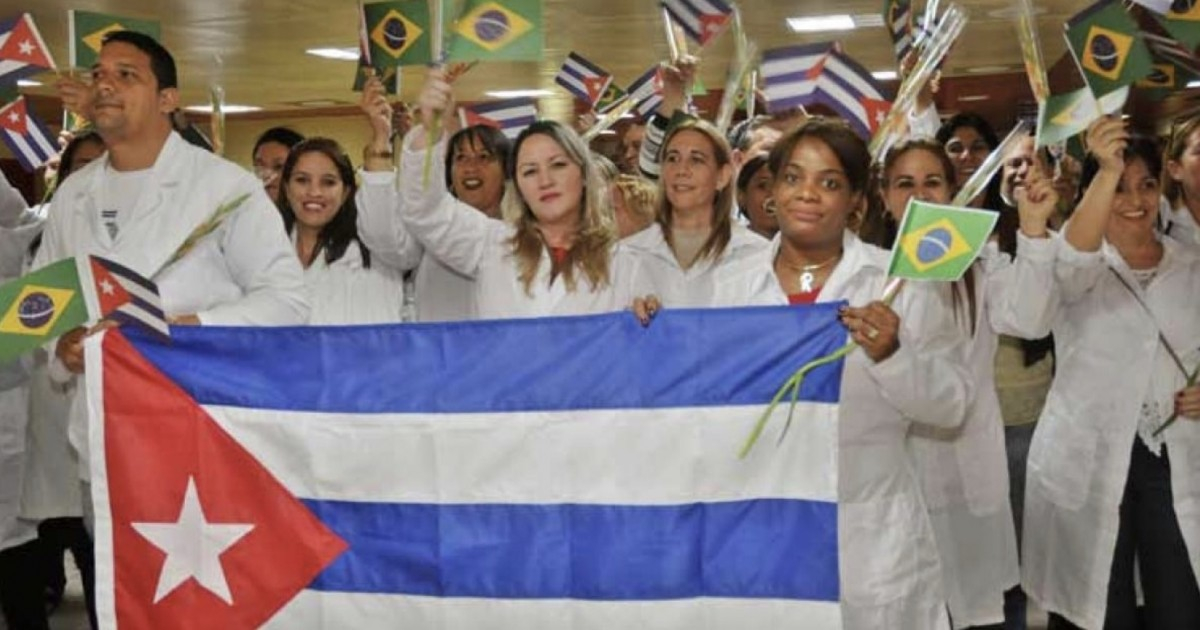
A group of Cuban doctors who worked in Brazil under the Mais Médicos program is claiming $129 million in damages from the Pan American Health Organization (PAHO), which they accuse of facilitating a scheme by the Cuban regime that subjected the professionals to forced labor conditions and withheld most of their salaries.
According to a report this Thursday by the New York Post, the federal lawsuit claims that the PAHO acted as an intermediary between the governments of Cuba and Brazil in a system that allowed Havana to earn billions of dollars through the work of its doctors.
The plaintiffs claim that between 2013 and 2018 the Cuban regime sent 3,500 health professionals to Brazil and received over 2.3 billion dollars for their services.
According to the lawsuit cited by the newspaper, 85% of the funds would have remained in the hands of the Cuban government, while the OPS would have received a 5% commission for managing the program. The doctors would have received less than 10% of the income generated by their work.
The four main plaintiffs are Ramona Matos Rodríguez, Tatiana Carballo Gómez, Fidel Cruz Hernández, and Russela Margarita Rivero Sarabia, Cuban professionals who subsequently received humanitarian parole in the United States and currently reside in South Florida.
Withheld salaries and oversight
The doctors claim that before traveling, they were not informed of how much money Cuba would actually receive for their work or the proportion that the State would withhold.
Matos reported that he learned the terms of his payment only a day before leaving the island.
"They were going to give us 1,000 dollars, of which 400 were to be given to us at the exchange rate and 600 dollars were for our account in the bank of Cuba," he recounted, according to the New York Post.
Her testimony also describes restrictions on her movements during the mission. Stationed in the Brazilian Amazon, she claims that there was a curfew at six in the evening and that Cuban agents threatened her after she went to a bakery to buy bread and smoke a cigarette.
Tatiana Carballo Gómez, for her part, claims that she received instructions to ask her patients to vote against the sitting mayor and support leftist candidates favored by Havana.
Also, when one of her Cuban colleagues complained on social media about their miserable wages, her Cuban superiors issued her a warning.
The plaintiffs also report that the regime used their relatives in Cuba as a means of pressure and warned them that there were "1,000 people lined up in Cuba to replace them."
Those who abandoned the missions were also subject to penalties, including a ban on returning to Cuba for many years.
The lawsuit accuses the PAHO of having been the "creator, administrator, and executor" of the mechanism by which Cuba sent professionals to Brazil under conditions that, according to the plaintiffs, amounted to human trafficking.
A legal battle that started in 2018
The case was presented in November 2018 in Miami and subsequently moved to Washington D.C., where the OPS has attempted to halt the litigation by claiming immunity.
In March 2022, a unanimous panel of the D.C. Circuit Court of Appeals allowed part of the lawsuit to proceed. The judges believed that the claims related to the financial transactions conducted by the OPS in the United States could fall under the commercial activity exception to the immunity claimed by the organization.
According to the lawsuit, payments from Brazil went through a bank account of the OPS in the United States before being transferred to Cuba, and the organization withheld 5% as a fee for its involvement in the program.
The legal battle has continued since then. On August 14, the D.C. Circuit Court of Appeals dismissed another appeal from the OPS, this time against an order allowing doctors to obtain documentation and other evidence related to the dispute over the organization’s immunity. The court concluded that it could not review that order at this procedural stage, so the litigation will continue in the district court.
The plaintiffs' attorney, Sam Dubbin, accused the OPS of trying to delay the process: "The OPS has cynically chosen to prolong the case, hiding behind immunity arguments that it continues to lose," he stated to the New York Post.
The PAHO, for its part, has continuously rejected the accusations and defends its actions in the program.
The organization assured the newspaper that it "acted legally by providing technical cooperation under the Mais Médicos Program" and stated that it will not make any further comments while the litigation remains active.
The United States increases pressure on Cuban missions
The legal dispute arises amid growing pressure from Washington against the model used by Havana to send healthcare professionals abroad.
In August 2025, Secretary of State Marco Rubio imposed visa restrictions on Brazilian officials and former OPS executives linked to the Mais Médicos program.
In April of this year, the Inter-American Commission on Human Rights also recommended that countries in the region distance themselves from Cuban medical cooperation schemes when there are insufficient guarantees regarding the working conditions and rights of professionals.
Reports on Human Trafficking from the U.S. State Department have denounced for years the signs of forced labor in Cuban medical missions and highlighted that the regime receives significant income through these programs.
Related videos:
Filed under: