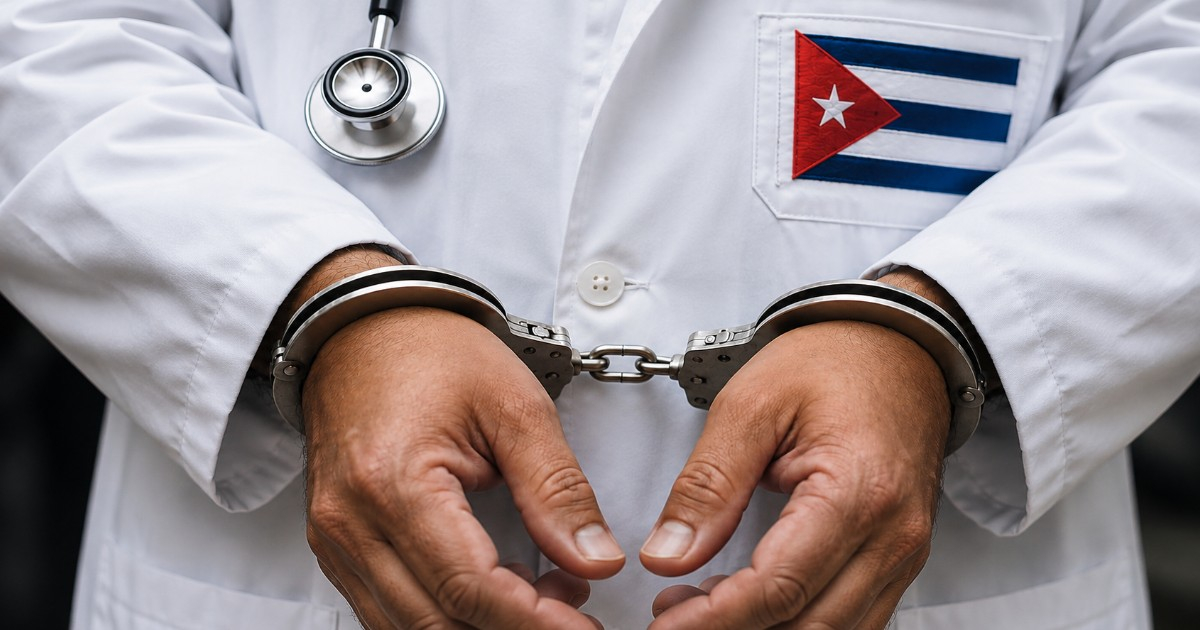
The Cuban Observatory of Human Rights (OCDH) brought a formal request to Brussels for the European Union to investigate possible human trafficking practices in the Cuban medical brigade deployed in the Italian region of Calabria, where around 200 healthcare professionals are working.
The delegation, led by Yaxys Cires, director of Strategies at OCDH, and the Cuban doctor Daily Coro, who specializes in documenting the operations of international medical missions, met with representatives from several European parliamentary groups —Popular, Socialist, Renew Europe, Conservatives and Reformists, and Patriots— as well as with officials from the European External Action Service.
"There are victims of human trafficking, which is why we have requested that they be protected," Coro stated to Martí Noticias.
The organization supported its request based on the resolution passed by the European Parliament on June 18th regarding political repression and the humanitarian situation in Cuba, which explicitly mentions medical brigades as a potential form of human trafficking.
"We appreciate the latest resolution from the European Parliament regarding Cuba, in which medical brigades are mentioned as a possible form of human trafficking," stated the doctor.
International organizations such as the Inter-American Commission on Human Rights and various United Nations mandates have documented in these missions salary deductions ranging from 75% to 90%, workweeks of up to 71.89 hours, restrictions on movement, surveillance of private life, and limitations on family reunification.
In the specific case of Calabria, according to an investigation by the independent newspaper Cubanet, the original agreement stipulated a payment of 4,700 euros per month for each doctor, of which 3,500 euros went to the Commercializing Agency of Cuban Medical Services (CSMC) —an entity linked to the military conglomerate GAESA— and only 1,200 euros reached the professional directly.
The mission in Calabria is facing increasing international pressure. In August, the bank account of the CSMC at the Italian bank BPER was blocked, an event possibly linked to the sanctions that Washington imposed on July 23, 2026, against the CSMC, the Ministry of Public Health, and the Central Unit for Medical Cooperation (UCCM).
Coro also warned about the impact these missions have within the Island: "These missions affect healthcare in Cuba because the system has lost around 30% of its personnel since 2023, while approximately 23,000 healthcare professionals are still working outside the country."
The regional context also plays a role. Jamaica, Honduras, and Guatemala canceled their medical agreements with Cuba in the early months of 2026 under pressure from Washington, while the governor of Calabria, Roberto Occhiuto, has refused to follow that path, arguing the necessity of keeping hospitals open.
In addition to the research on Calabria, the OCDH requested European institutions to establish a working group dedicated to a potential democratic transition in Cuba.
"Now it is up to the European Executive and the member states to articulate a new policy towards the Cuban regime," said Cires, who announced that the European Parliament is preparing a new resolution to denounce the situation of political prisoners on the Island.
Related videos:
Filed under: