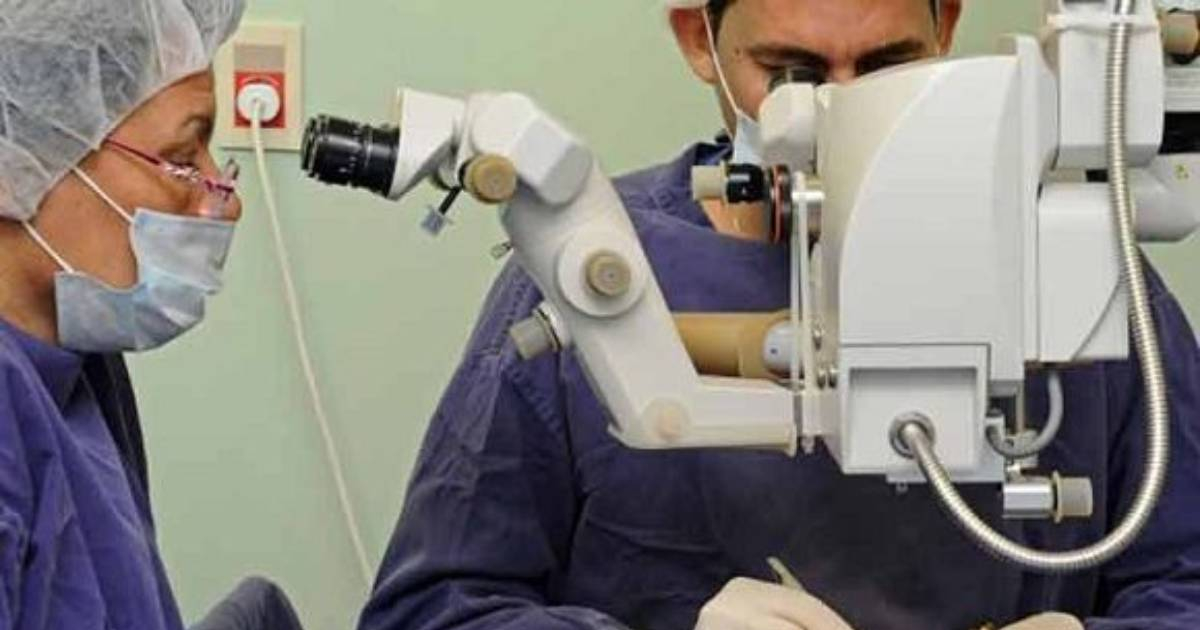
Uruguay allocates about 250,000 dollars annually for the operation of the Cuban medical mission Operación Milagro, but the National Social Security Bank (BPS) does not directly pay the salaries of the professionals: the remuneration of the doctors is managed by the Cuban government.
The president of BPS, Jimena Pardo, explained that the money contributed by Uruguay does not constitute a salary for the specialists, but rather a reimbursement intended to cover the operational expenses of the brigade.
«What is reintegrated to Uruguay is called a stipend; it's a reimbursement of expenses,» Pardo specified during an interview on the 8AM program of Canal 4, as reported by Telenoche.
According to the explanation, the funds are allocated in advance and must later account for the expenses incurred. The money is transferred to an account of the brigade established by the Ministry of Public Health.
Pardo emphasized that the BPS does not directly compensate Cuban doctors and that the management of their salaries is the responsibility of the Cuban side.
The explanation arises amid a controversy over Havana's medical missions and a warning from the United States to Uruguay.
According to the weekly Búsqueda, the Uruguayan Foreign Ministry was informed that the country is among 15 nations that could lose certain U.S. assistance due to payments related to the services of Cuban medical brigades.
Washington has been questioning for years the model through which foreign governments contract these services with the Cuban state, while Havana subsequently manages the payments to the professionals.
Pardo assured, however, that the BPS has not received any official communication regarding possible consequences.
"No official communication regarding this has reached the BPS," she stated. The official indicated that the matter is being handled by the Uruguayan Foreign Ministry and expressed hope that it can be resolved through dialogue.
The controversy extends beyond the Uruguayan case. The United States sanctioned the Cuban Minister of Public Health, José Ángel Portal Miranda, as part of its actions against Havana's medical service export system.
The State Department has reported that the Cuban government retains between 50% and 95% of payments intended for its professionals on certain missions, in addition to imposing conditions that Washington considers indicators of forced labor. In fact, the United States Secretary of State, Marco Rubio, has referred to them as a “horrific practice”.
The Inter-American Commission on Human Rights (IACHR) addressed in April the conditions of Cuban professionals sent abroad, documenting complaints about surveillance, restrictions on movement, document control, and reprisals. Furthermore, it urged all countries on the continent to withdraw from the Cuban Medical Missions Program.
Despite U.S. pressure, the government of Uruguay has made it clear that it intends to maintain cooperation with Cuba.
The Secretary of the Presidency, Alejandro Sánchez, recently confirmed the continuation of Cuban doctors, according to Medios Públicos.
"We obey the Uruguayan people. The Government obeys the Uruguayan people because Uruguay is a sovereign nation," he asserted.
Currently, 21 Cuban ophthalmologists are working in Uruguay as part of Operation Miracle, with rotations of approximately three years. Since the inception of the program during Tabaré Vázquez's first term, nearly one million screenings have been conducted, along with more than 220,000 surgical interventions, primarily for cataracts.
"The agreement with the Cuban doctors allowed thousands of Uruguayans to receive care, and we recognize and value that greatly," defended Sánchez.
Related videos:
Filed under: