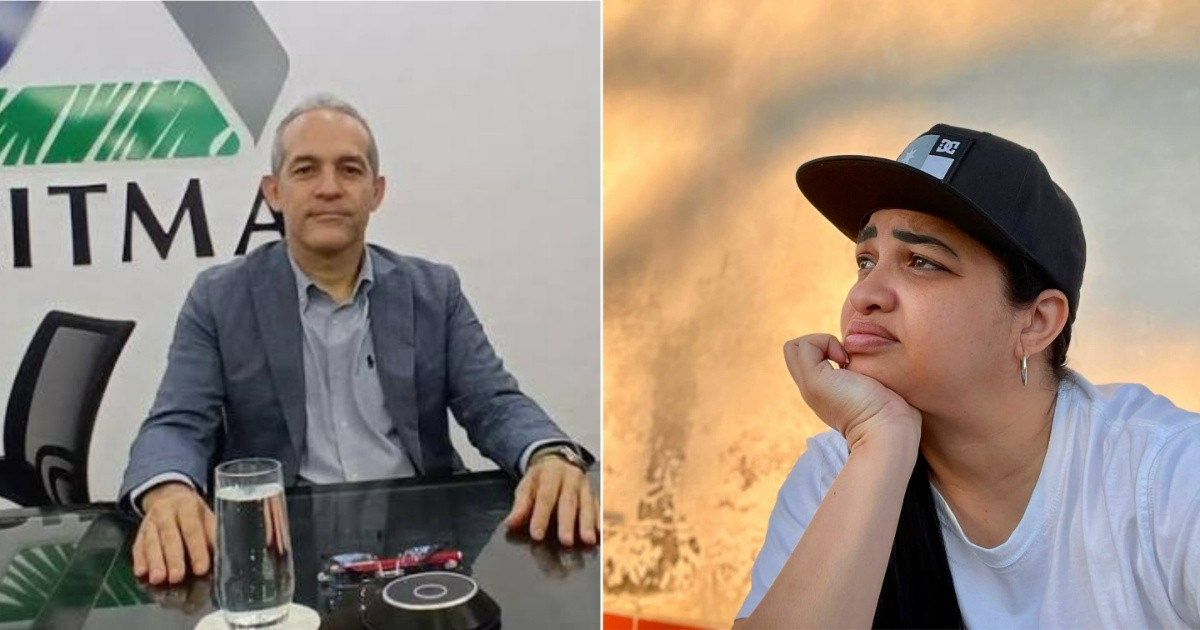
The Cuban activist Lara Crofs published an open letter on Facebook addressed to the Minister of Science, Technology, and the Environment, Armando Rodríguez Batista, in which she strongly criticizes the official announcement to regulate the installation of solar panels in Cuban homes while the State ignores much more urgent and visible environmental crises.
The trigger was a statement from the official in which he referred to the expansion of photovoltaic systems on rooftops as a "historic opportunity," but warned that it needed to be organized to avoid technical and structural risks, especially in old buildings, multifamily residences, and heritage areas. The note about this announcement sparked a broad debate about the regime's attempt to regulate the solar panel boom.
Crofs acknowledges in his letter that the technical regulations are reasonable, but points out a fundamental contradiction: the State itself facilitated the importation of photovoltaic equipment through tariff exemptions —valid until December 2027— and in April 2026 reduced the installation requirements for specific cases such as historical centers and multifamily buildings, canceling already initiated procedures and discarding fines.
"How can the expansion of panels in homes now be presented almost as a threat, when for thousands of Cubans it represents one of the few available alternatives to cope with endless blackouts, preserve food, pump water, keep medications refrigerated, and ensure minimal living conditions?" asks the activist.
The central argument of Crofs points to what he calls a "selective environmental concern": while CITMA announces oversight on those who install solar panels, Havana has been buried under mountains of uncollected garbage for months.
The waste crisis in the capital is alarming. In February 2026, only 44 out of 106 garbage trucks were operational, approximately 41% of the fleet, while the city generates between 24,000 and 30,000 cubic meters of waste per day. Faced with the collapse of the service, residents have resorted to burning garbage in the streets and vacant lots, releasing carbon monoxide, dioxins, furans, and fine particles.
"We are not talking about a hypothetical threat for ten or twenty years from now; we are talking about people who are currently breathing in smoke from the combustion of plastics, textiles, organic matter, and all kinds of waste," writes Crofs.
The activist also recalls the fire at the Matanzas Supertanker Base in August 2022, when the column of toxic smoke —containing sulfur dioxide, nitrogen dioxide, carbon monoxide, and organic compounds documented by the Pan American Health Organization— reached Havana and Mayabeque. She claims to have reported black rain and particle precipitation to CITMA at that time without ever receiving a response.
Rodríguez Batista admitted in September 2025 that trash was "scattered all over Havana," describing it as a sanitation, environmental, and social issue. Months later, in February 2026, he denied that the government promotes open-air burning, although he acknowledged its impact.
Crofs does not oppose regulation itself, but rather its approach: "If there are environmental risks associated with batteries, regulate them, establish protocols, create collection and recycling systems, educate the public, and ensure responsible management of these waste materials. That would be fulfilling the role of an environmental authority."
The letter concludes with a phrase that summarizes its criticism of the regime's management model: "Cuba needs less control over those who survive and more accountability from those in charge."
Related videos:
Filed under: