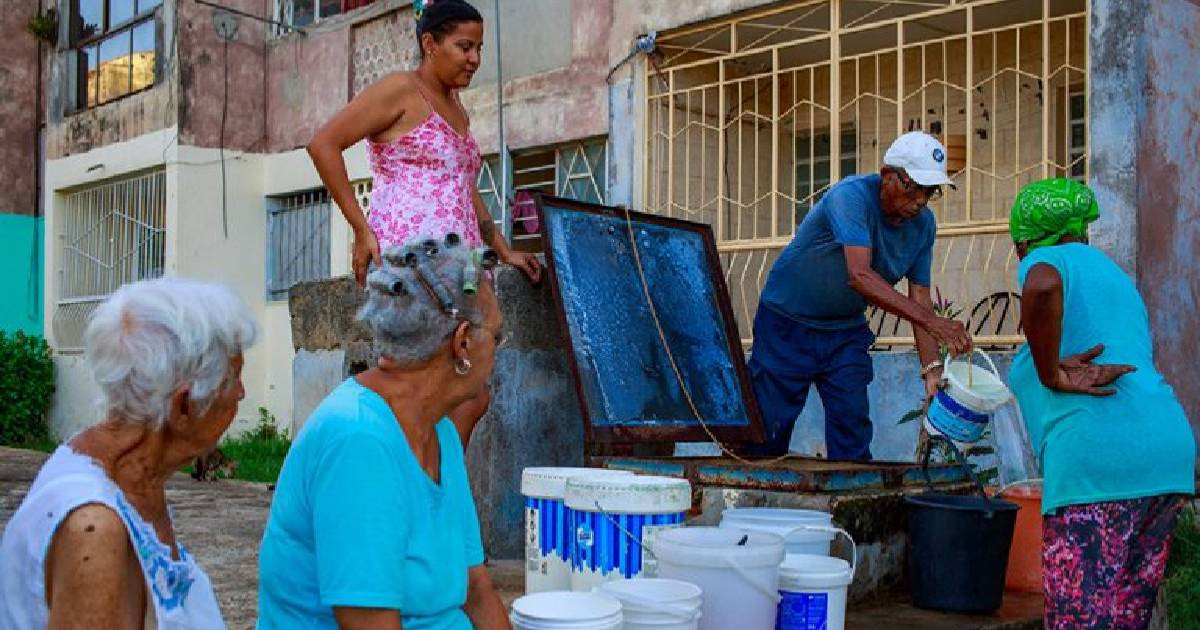
The official portal Cubadebate launched a call on Wednesday for its readers to send in photographs that reflected gestures of solidarity among Cubans, but the response was a flood of criticisms that turned the initiative into a reflection of the basic service crisis that the government has been unable to resolve.
Under the title Readers' Strip: Share a photo that speaks of solidarity, the media illustrated the call with an image of neighbors from the Mulgoba district in Havana, and a man extracting water from the cistern of a building, urging that "in difficult times, a gesture can make a difference."
The reaction on the Facebook page of Cubadebate was immediate and overwhelming. Instead of photos of mutual aid, readers responded with indignation and direct questions about the state's responsibility.
"With the wheel of solidarity among neighbors, the state is washing its hands," wrote a commentator.
Another was more straightforward: "In the 21st century, the government must guarantee access to water and electricity; if it can't, then it needs to be changed."
A reader presented the constitutional argument in greater detail: "Access to safe drinking water should not be seen as a matter of neighborly solidarity, but rather as a human and constitutional right whose guarantee falls to the State. A place going days without water is not an opportunity to celebrate mutual aid, but a direct violation of the government's constitutional responsibility. Solidarity is valuable, but it can never replace the legal duty of the State to ensure minimum conditions for a dignified life."
The Cuban Constitution of 2019 recognizes in its Article 76 the right to water and compels the State to create the conditions to guarantee it, an argument that several users raised in their comments.
Others pointed out the gap between the population and the ruling class: "I want to see the solidarity of the ministers and the connected with the government," wrote a reader. Another added: "A photo of the leaders sharing their wealth will go viral."
Someone reported that in the high areas of La Víbora and Vieja Linda, homes have been without water since June 23. Another pointed out that the scarcity already has a price in the informal market: "A bucket of water costs 500 pesos, what kind of solidarity are they talking about? This can't go on."
The frustration was also expressed with irony: "It's all very nice when it's work that lasts two or three days, but when it's every day, it's overwhelming; you’re wearing one out."
"The people are united... what a shame that the government does not join the people as well," summarized a reader the gap that separates citizens from those who have the duty to govern.
In March, Cubadebate described the situation on the Island as "difficult days" and Cubans erupted on social media. In August, the outlet published a report on the water crisis in Puerto Rico and received over 1,000 comments in less than two hours, with readers pointing out the hypocrisy of covering foreign issues while the water crisis in Cuba affects millions.
The backdrop is an unprecedented water emergency. Official data shows that nearly three million Cubans regularly suffer from water shortages, and several million have intermittent supply.
In Havana, over half a million residents lacked regular access to the service in July. Additionally, 87% of the pumping system relies on the electrical grid, so each blackout directly disrupts the supply.
The government has responded with calls to take advantage of "local potentials" and promises of gradual improvements. The ruler Miguel Díaz-Canel announced a few days ago that the severe water supply crisis in the capital could begin to ease by the end of September.
Related videos:
Filed under: