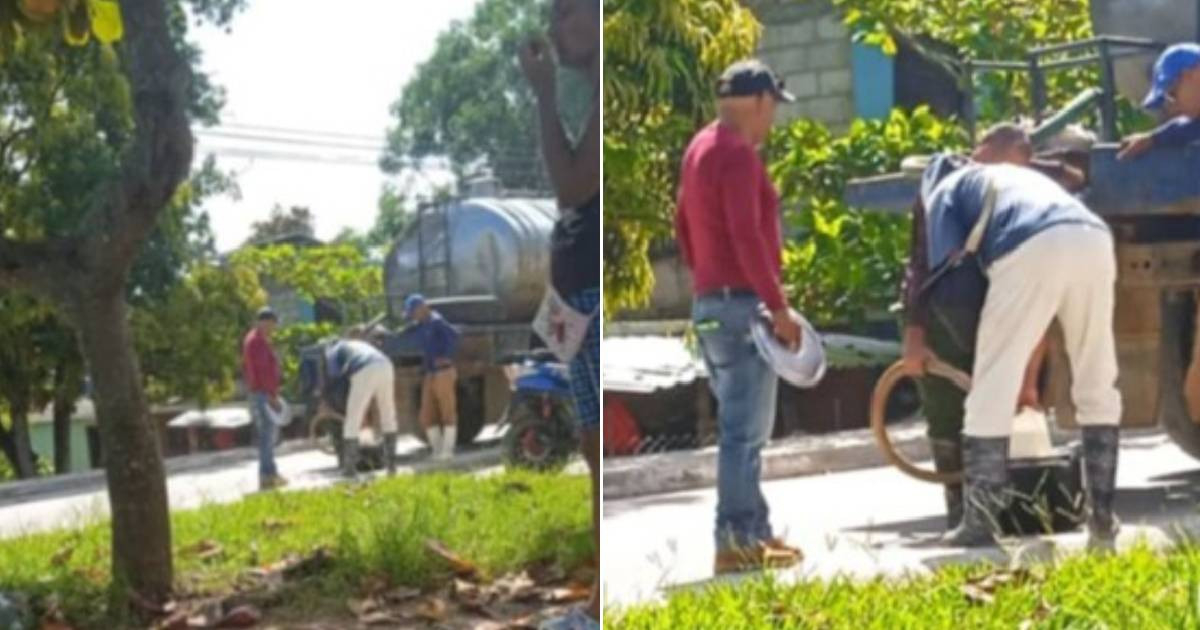
Images circulated on social media on Saturday show several men handling hoses and containers next to a truck parked right in front of the Maternal Home in Manicaragua, Villa Clara, as they pour a liquid that appears to be milk into a plastic container, in the middle of the street, a scene that sparked outrage among local residents.
The post on Facebook by the user identified as Héctor Tol Etón Plus (pseudonym) identified the vehicle as the tanker responsible for distributing liquid milk to pregnant women, services, and stores in the area. Residents reported that the product may have been diverted or sold illegally in the middle of the street.
"This is the last straw! While pregnant women and essential services are running out of milk, openly in the street, we see things that should not be seen. Where is the milk for the vulnerable? Who will take responsibility?" stressed the whistleblower.
"Let them not tell us it's a misunderstanding. Let them investigate, identify those responsible, and return what is missing to pregnant women and children," he insisted.
The comments revealed a pattern of irregularities that goes beyond the incident captured in the photographs. A nurse pointed out that the medical staff has a prescribed milk diet but does not receive it.
A resident of the Manuelita area recounted that the truck arrived on August 14 and did not return until nearly a month later, after which it provided less than a liter.
From La Campana, another resident reported that what is being sold is "milk water" and that resellers are offering the gallon for 780 pesos.
Others reported that in Santa Clara, the provincial capital, there has also been over a week without milk for children, a situation that, according to the residents themselves, has repeated several times. One commentator noted that children are receiving milk "every four days, that is to say, one glass per day, which is unprecedented."
A neighbor summed up what many consider an open secret: "The milk they resell, for children, pregnant women, and sick diets, has been taken away here in Manicaragua for years. It's a business with everything, and no one sees anything or cares."
While the authorities remain silent regarding the complaint from Manicaragua, the neighbors insist on the need for an investigation: "If there isn't enough for those who are entitled, how can it be understood that there is allegedly stealing occurring on the street?" argued the source.
The complaint is part of a structural crisis of milk supply in Cuba that the government itself has acknowledged. In June, the Minister of Food Industry, Alberto López Díaz, admitted on the official television program Mesa Redonda that more than 100,000 children are not receiving their daily milk ration and that the official plan is impossible to meet.
In early June, it was reported that Villa Clara, where the complaint occurred, lost about 181,000 cattle in a decade, with the provincial herd reduced to 337,960 heads.
Nationwide, between 2018 and 2023, milk production fell by 58% and powdered milk imports decreased by 71%, according to the World Food Program.
Similarly, the theft and diversion of milk intended for vulnerable groups are incidents that occur in various provinces. In June 2025, five people were arrested in Havana for stealing 197 bags of powdered milk for babies from a facility of En Frigo, a product that was being resold for 1,650 pesos per pound.
In August, a bag of milk was priced at 6,500 pesos in Matanzas, twice the monthly minimum wage of 3,210 pesos.
Related videos:
Filed under: